In the hours after a strike on an airbase, the question that decides whether the base keeps flying has nothing to do with runways. It is whether the fires can be put out — the burning fuel farm, the munitions depot, the smoke-choked hangar — before they turn into a cascade no one can contain. Human crews cannot walk into that. So a company from Changodar, near Ahmedabad, built something that can.
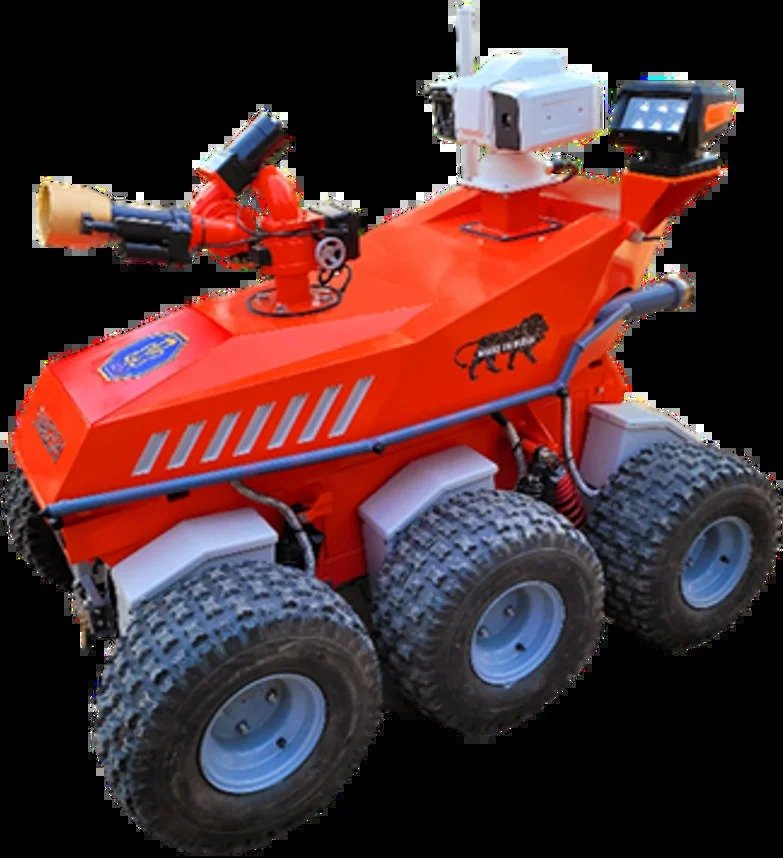
The machine is called the FF Bot, and the company behind it is Swadeshi Empresa. It is a six-wheeled, remotely operated firefighting robot: an operator stands well outside the danger zone and drives it into smoke and heat using cameras that can see through flames. WION reported this week that the Indian Air Force has ordered 80 of the machines for its airbases — the third service to adopt them, after the Navy and the Army.
Swadeshi Empresa is not a venture-backed robotics startup in the usual mould. The company says it has spent close to four decades working in fire suppression and water-mist systems, and it started building firefighting robots in 2017. The military version of the FF Bot came through the Ministry of Defence’s iDEX programme — Innovations for Defence Excellence — which funds startups to solve real problems for the armed forces. WION notes it was the first project of its kind under one of iDEX’s early challenges to receive formal approval, back in 2023.
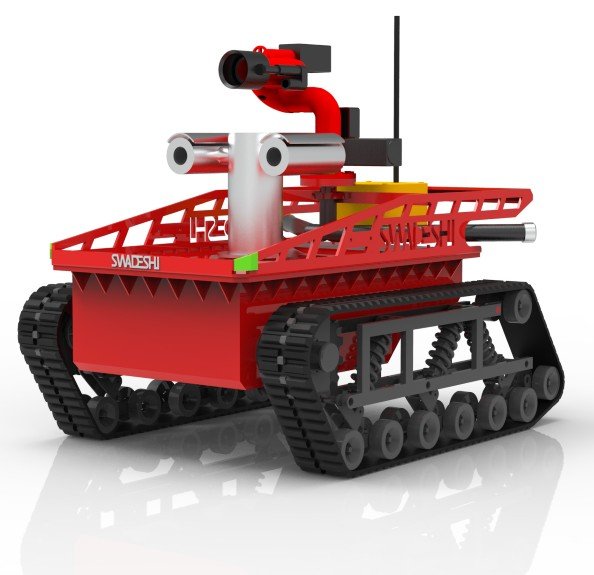
The robot itself is built for the specific geometry of military emergencies. It is fitted with an aqua foam jet and fog water monitor for suppression, plus optical and thermal pan-tilt-zoom cameras that give operators real-time visual and infrared awareness — enough to target a fire source and navigate where ordinary cameras fail. A built-in self-cooling system lets it keep working inside extreme heat; one detailed technical write-up of the machine cites the maker of its wireless link as saying the casing withstands 800 to 900°C while discharging 300 litres of water a minute. The company’s own product page describes remote operation from a safe distance, customisation for all terrain types, and six powered wheels with suspension that let it drag a charged hose or tow loads of up to five tonnes across rubble — with a 360-degree turning radius for tight depot and hangar corridors.
The induction arc is what makes the FF Bot stand out. The Indian Navy took dozens of the robots first — defence reports put the figure at 50 units — and one of them is operational aboard the aircraft carrier INS Vikrant, according to the company’s own site. The Army then signed a ₹62-crore contract in January 2026 for 18 units for ammunition depots, inducting a system the Navy had already tested through a single-stage composite trial — a cross-service procurement provision that let the Army skip a fresh development cycle. The machine was also tested in live-fire and debris scenarios during the IAF’s Vayu Shakti 2026 exercise at Pokhran in February, and in June 2026 the Defence Ministry’s quality agency certified it “Fit for Indian Military Use,” a stamp that both confirms the trials and lets the company sell the same machine abroad.
There is context behind the order. WION’s reporting links the Air Force’s urgency to the lesson of Operation Sindoor in May 2025, when Indian air bases faced drone and missile attacks — and to a broader pattern visible from Ukraine to the 2026 Iran conflict: a missile does not need to destroy a runway to neutralise an airbase. It only needs to find the fuel farm or the munitions bay and let the fire do the rest. The FF Bot is not a weapon. It is, as the reporting puts it, a tool for the hours after an attack — a way to absorb a strike and keep flying.
More Read
Swadeshi Empresa lists the FF Bot in military and explosion-proof grades, alongside sibling products like ARMOUR, MAMMOTH, SARTHI-BOT and MAHETSE on its site. The company says the same machine could also serve civilian airports, power stations and oil depots — environments where the fire, the smoke and the risk are the same, even when the threat is not a missile. All three Indian services buying the same indigenous robot is the kind of adoption milestone that needs no embellishment.