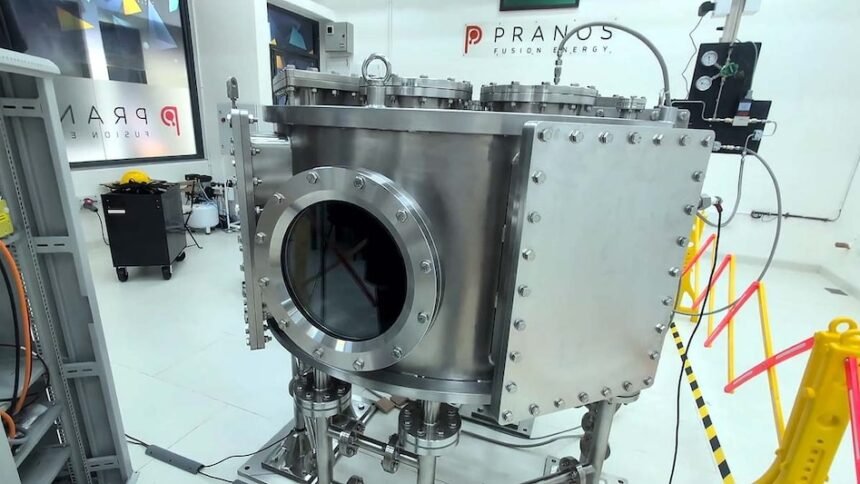
In late August 2026, a twelve-person startup in Bengaluru finished building a tokamak — a machine that confines superheated plasma inside a magnetic bottle, the same basic architecture behind the world’s fusion-energy programmes. The build took about eight months, according to the company. The machine, named PRAGYA, is widely described as India’s first privately developed compact tokamak. It is also small, modest in its physics parameters, and — a distinction that matters more than most headlines suggest — it is not a power plant.
That distinction matters because coverage of PRAGYA has often blurred it. What Pranos Fusion has built is a research instrument — a genuine engineering achievement, but a specific and bounded one, best understood on its own terms.
What PRAGYA actually is
PRAGYA is a low-aspect-ratio compact tokamak — sometimes described as a spherical tokamak — with a 0.4-metre major radius and a 0.18-metre minor radius. Its toroidal magnetic field runs at 0.1 Tesla, with a plasma current of 25 kiloamperes. To put those numbers in context: the Institute for Plasma Research’s ADITYA-U, India’s workhorse public-sector tokamak, is roughly twice the size with about fifteen times the field strength. The SPARC machine being built by Commonwealth Fusion Systems — the device PRAGYA’s successors would ultimately be measured against — targets 12 Tesla.
The machine was completed on 21 August 2026 and unveiled on 3 September 2026 at the Jawaharlal Nehru Centre for Advanced Scientific Research (JNCASR) in Bengaluru. The eight-month build timeline is the company’s own figure — credible at this scale, but a company claim, not an independently audited one.
A crucial distinction
PRAGYA is a testbed, not a reactor that will feed electricity to the grid. It is designed to run 10–12 plasma shots a day — roughly 3,000 a year — for about two decades, generating data on plasma control, high-temperature-superconductor magnets, and diagnostics. Confusing a testbed with a power plant is the single most common error in coverage of this story.
A twelve-person build
Pranos Fusion was founded in May 2024 in Bengaluru by Dr Shaurya Kaushal, a computational physicist with a JNCASR PhD, and Roshan George. It was co-incubated at JNCASR (Department of Science and Technology) and the Institute for Plasma Research (Department of Atomic Energy) — an unusually strong institutional pedigree that helps explain how a twelve-person team could attempt hardware of this kind. Building it demands precision manufacturing of the kind LMW’s aerospace arm has demonstrated for ISRO and DRDO.
An earlier pre-seed round brought ₹3.5 crore from Industrial47 plus a ₹20 lakh Startup India Seed Fund grant. In March 2026 came $6.8 million (about ₹63 crore), co-led by pi Ventures and Ankur Capital, with Industrial47 and angels including Groww co-founder Lalit Keshre and the Razorpay founders. Stated use of funds: commissioning the tokamak, developing high-temperature-superconductor magnets, and growing the team.
PRAGYA’s toroidal field measures 0.1 Tesla. The SPARC machine it ultimately aspires to be measured against targets 12 Tesla — a 120-fold difference in the single parameter that most determines what a tokamak can do.
What has actually been demonstrated
Here the record requires care. Several outlets reported in early September 2026 that PRAGYA had generated plasma — but the company has issued no formal first-plasma announcement of its own. Until it does, treat plasma generation as reported, not confirmed.
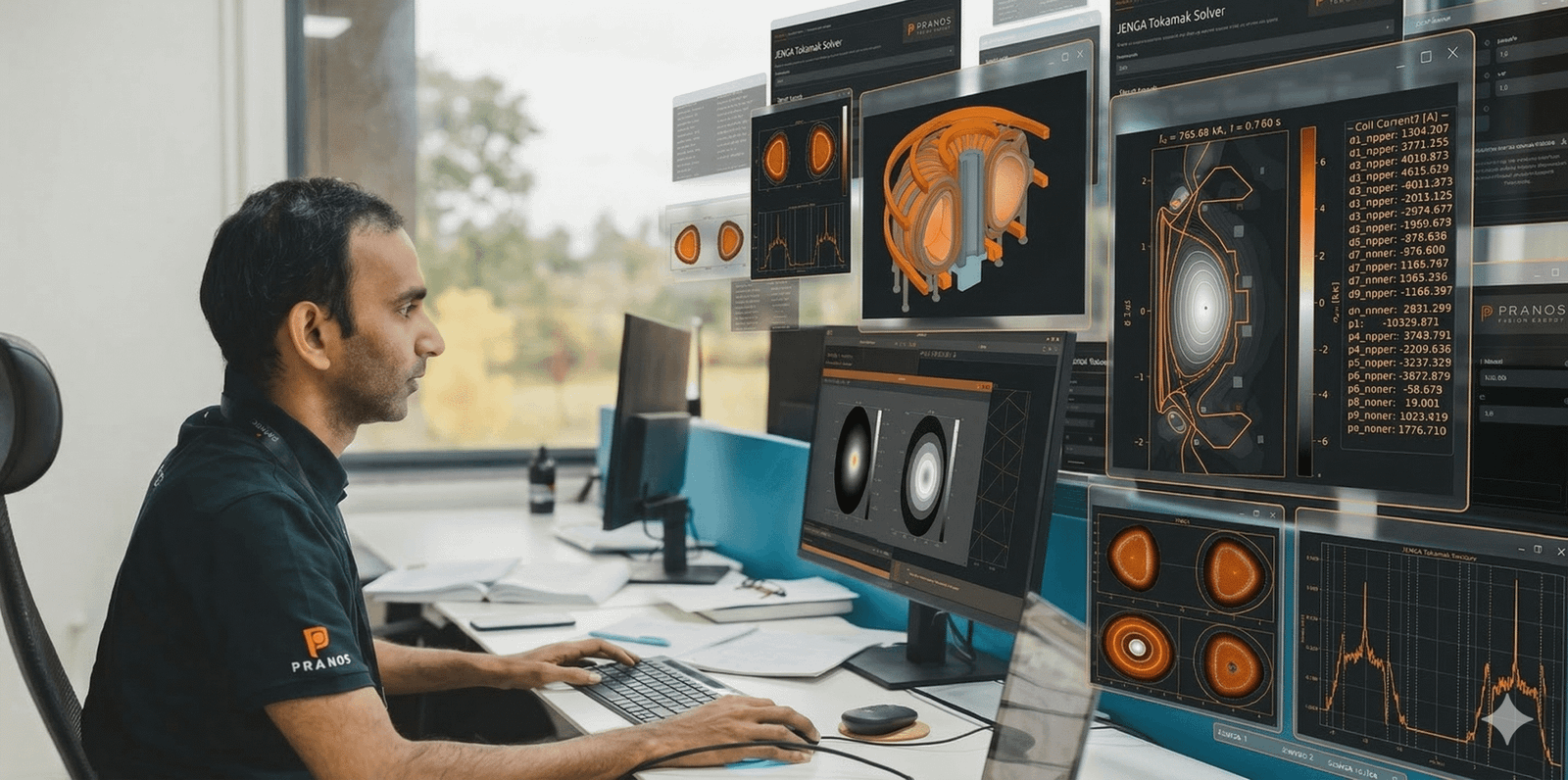
Firmer ground is the company’s three-layer strategy. Beyond the PRAGYA testbed sits JENGA, tokamak design and plasma-control software the company expects to become its first revenue product, with pilots expected next year. The third layer is MAGGA, an in-house high-temperature-superconductor magnet programme still in R&D. The software-first path may prove the more interesting near-term story: control tooling is something a twelve-person team can sell long before it can sell a reactor.
The roadmap — and the gap between ambition and achievement
The roadmap is aggressive: operational high-temperature-superconductor magnets by 2027, a net-gain reactor called PraniQ targeted for 2030, and an eventual 50–100 MW full-scale reactor ambition. IAEA recognition — it lists Pranos among India’s private fusion companies — is genuine. But every date is a company target, not a delivered milestone, and the distance between a 0.1-Tesla testbed and a net-gain machine is measured in physics, not press releases.
None of this diminishes what is real. India’s fusion programme has long belonged to public institutions — IPR’s tokamaks, ITER membership. A private startup building even a small tokamak, on venture capital, on an eight-month timeline, is a genuine structural shift. The software layer, the magnet R&D, and the twenty-year experimental programme are all substantive. The story needs no inflated superlatives; the hardware, honestly described, is enough. Pranos isn’t alone in breaking the state monopoly on strategic hardware — Sagar Defence did the same for uncrewed naval systems, winning a twelve-boat Navy order.
Sources & further reading
- Inc42: Pranos Fusion nets $6.8M — funding round details
- Wikipedia: PRAGYA tokamak — device overview and timeline
- TechStory: Pranos Fusion raises $6.8M — startup background
Frequently Asked Questions
Is PRAGYA a power plant?
No. PRAGYA is a plasma testbed — a research instrument designed to run thousands of plasma shots per year for roughly two decades, generating data on plasma control, magnets, and diagnostics. It will not generate grid electricity.
Has PRAGYA actually produced plasma?
Several outlets reported first plasma in early September 2026, but Pranos Fusion has not issued a formal first-plasma announcement of its own. It should be treated as reported, not confirmed.
What is PraniQ?
PraniQ is the company’s planned net-gain fusion reactor, targeted for 2030. It is an ambition and a fundraising roadmap — not an existing or under-construction machine.
Who is backing Pranos Fusion?
The company raised $6.8 million (about ₹63 crore) in March 2026 in a round co-led by pi Ventures and Ankur Capital, with Industrial47 and angel investors including Groww co-founder Lalit Keshre and the founders of Razorpay.