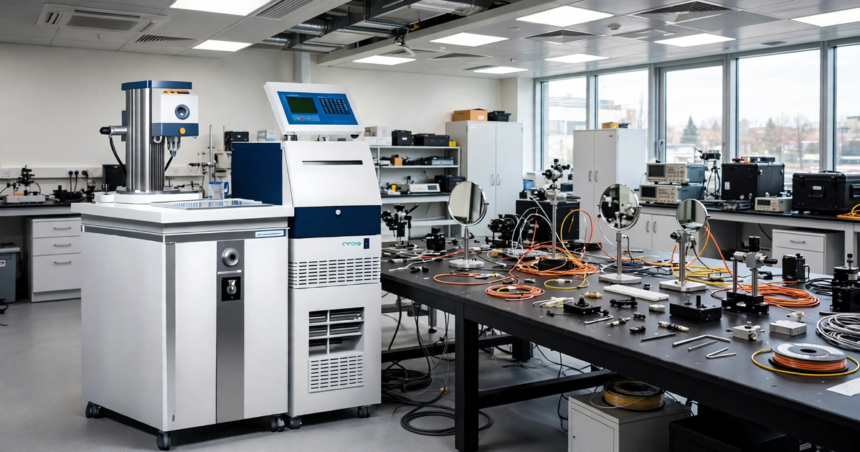
Every quantum computer, every hack-proof quantum link and every ultra-sensitive telescope shares the same quiet problem: at the end of the chain sits a detector that has to notice a single particle of light — one photon — and not miss it, and not imagine one that was never there. It is one of the hardest measurements in modern physics, and it has to happen a few degrees above absolute zero. A Delhi startup called Quanastra has set out to build that detector in India, from the superconducting chip up.
The hardest measurement in physics
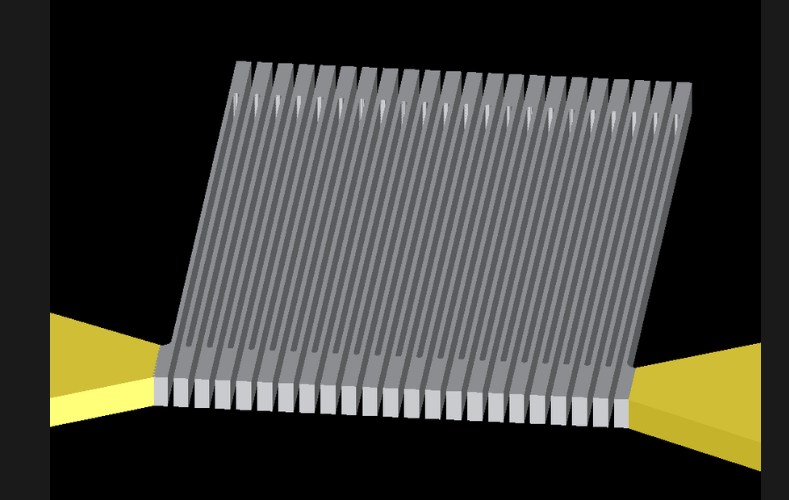
The device at the heart of Quanastra’s work is the superconducting nanowire single-photon detector, or SNSPD. A wire just nanometres wide is cooled until it superconducts, and when a single photon strikes it, the superconductivity breaks in a tiny spot — a flicker big enough to measure. Done right, the detector combines very high detection efficiency with very low dark counts and very low timing jitter, the exact combination that quantum communication, quantum computing and quantum imaging all need, and that no other single-photon detector delivers together.
Until now, that combination has mostly come from a handful of specialist suppliers abroad. Quanastra’s answer is to build the whole stack at home: the detector chips, the cryogenics that cool them, the readout electronics that catch the flicker, and the thin films everything is made from.
The whole stack, built in Delhi
Founded in 2024 by Dr Vidur Raj, a Ramanujan Fellow, Quanastra works out of Delhi with its own cleanroom, optical laboratory, mechanical and electronics workshops, and cryogenic and vacuum infrastructure. Its catalogue runs deep for a company so young: custom SNSPD chips in seven configurations, from fibre-aligned cavity and waveguide-integrated chips to large-area free-space detectors, fractal designs for polarisation-independent measurements, photon-number-resolving detectors and mid-infrared devices.
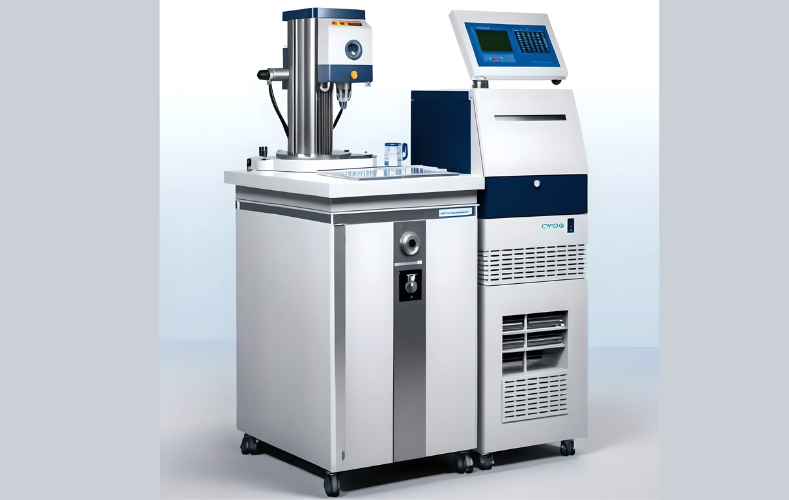
Those chips come together in complete systems. The company’s Vortex is a two-channel, high-efficiency single-photon detection system that integrates detector chips, sub-3 K closed-cycle cryogenics, high-speed readout electronics and optical interfaces into one deployable unit. Around it sits everything a quantum lab needs to keep the coldest parts cold and the fastest signals clean: custom cryogenic systems, DC and RF wiring for ultra-low temperatures, cryogenic low-noise amplifiers, and superconducting and optical thin-film solutions on multiple substrate types.
Chosen by the National Quantum Mission
The work has already earned national recognition. Quanastra is one of eight startups selected for support under India’s National Quantum Mission, the ₹6,003.65-crore programme backing indigenous quantum computing, communication, sensing and materials, and it is supported by the I-Hub Quantum Technology Foundation at IISER Pune. The company says its SNSPD prototypes have already been delivered to Indian quantum communication testbeds, and its detectors are built for the mission’s own benchmark: indigenous SNSPDs with detection efficiency above 90% at telecom wavelengths.
More Read

The honours have kept coming. Quanastra was named among the NASSCOM Emerge 50 2026 League of 10, selected from 750 applicants, and the company says it has filed four patents — two already granted and two under expedited examination — with more than seven further patent families in advanced development. The company says it has raised more than $5 million in seed funding as it scales production to meet growing demand from quantum researchers.
Where the detectors go
Single-photon detectors are the enabling layer of the quantum age, and Quanastra’s systems are designed for all of it: quantum key distribution and quantum networks, photonic quantum computing and qubit readout, quantum sensing, LiDAR and remote sensing, spectroscopy, biomedical imaging and space instruments. The company’s roadmap runs further still, towards quantum photonic integrated circuits and unified detector platforms for quantum imaging, ultra-high-resolution spectroscopy and quantum AI.
India’s quantum ambitions need more than algorithms and qubits — they need the instruments that make quantum signals visible at all. In a Delhi laboratory, Quanastra is building those instruments, photon by photon.
Keep reading: Probably Right Is Not Enough: Inside Pramaana Labs, the AI That Proves Its Answers · The Cameras Were Already There: Inside iHelp Robotics’ Sentinel, the AI That Watches Over the Elderly · More Industrial Automation & Technology stories
Like stories like this? Add Exceptional Technology as a preferred source on Google to see more of our reporting in your search results and Discover feed.