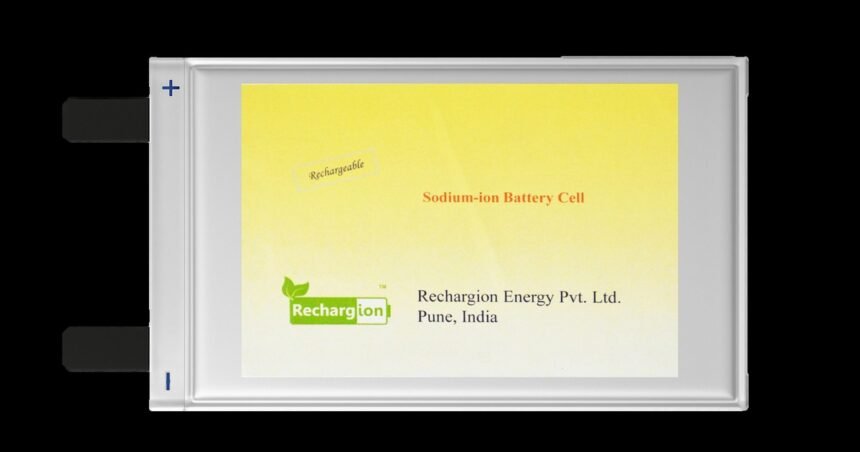
Almost every lithium cell installed in India arrives from somewhere else — along with the cathode, the anode and the electrolyte inside it. The raw materials are concentrated in a handful of countries, the price is set elsewhere, and the supply chain can be switched off by geopolitics. In a Pune laboratory, a husband-and-wife team of battery scientists decided that India should not have to accept that bargain. Their answer is built from one of the most abundant materials on Earth: salt.
The company is Rechargion Energy, a Pune startup founded in 2021 as an official spin-off of CSIR–National Chemical Laboratory (NCL). Its founders are Dr Vilas Shelke, a physicist with more than two decades of research experience, and Dr Manjusha Shelke, a chief scientist at NCL who has spent her career working on battery chemistries, together with director Dr John Normanton. The company says its mission is simple: a sodium-ion battery made in India, from materials India already has.
The materials bet: hard carbon, not imported lithium
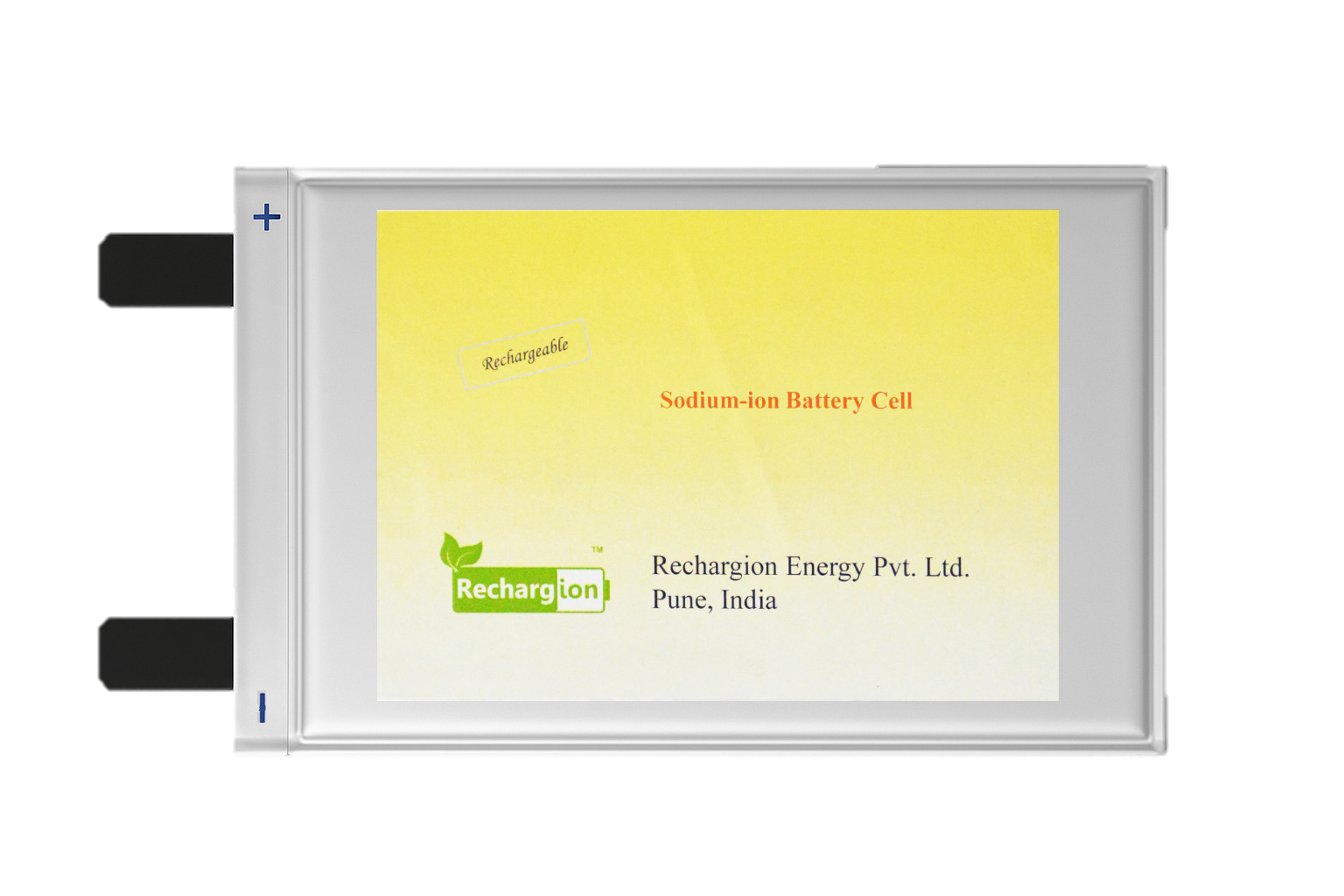
Rechargion’s work centres on materials rather than cell design. The company says it has patented its hard carbon — the anode material that sodium ions move in and out of — along with proprietary electrode materials and sodium compounds, and it uses a polymer as an anode material, which it describes as the change that makes the cells commercially viable. Its official site adds a symmetrical aluminium–aluminium current collector structure to the recipe.
The commercial case is cost and supply. The company says all the raw materials are domestically available and considerably cheaper than lithium equivalents, and the cells use no cobalt or nickel. In 2023, the company put the projected cost at Rs 11 to 12 per watt-hour with a battery life of 12 to 15 years. Sodium, the company points out, is widely available in India — including, in its telling, from seawater — while aluminium is abundant too.
Safety is the other argument, and sodium-ion chemistry has a genuine advantage there. The company says a sodium cell can be discharged to zero volts for transport without damage, which a lithium cell cannot, and the chemistry is less prone to thermal runaway. Its cells, the company says, offer faster charging, a wider temperature range and better thermal stability than their lithium-ion counterparts.
More Read
Images: Rechargion Energy.
Proven safe: two months of testing at ARAI
Claims are easy; independent testing is harder. In August 2025, the Automotive Research Association of India (ARAI) completed a two-month evaluation of Rechargion’s cells at its Chakan centre, testing them under the IEC 62660 protocol. The tests covered vibration, mechanical shock, crushing, high-temperature endurance, short circuit, overcharge and forced discharge. The validation report was handed to the founders by ARAI’s director, and the company says this makes it the first in India to achieve IEC 62660 compliance for sodium-ion batteries — alongside the Indian IS 16893 standard.
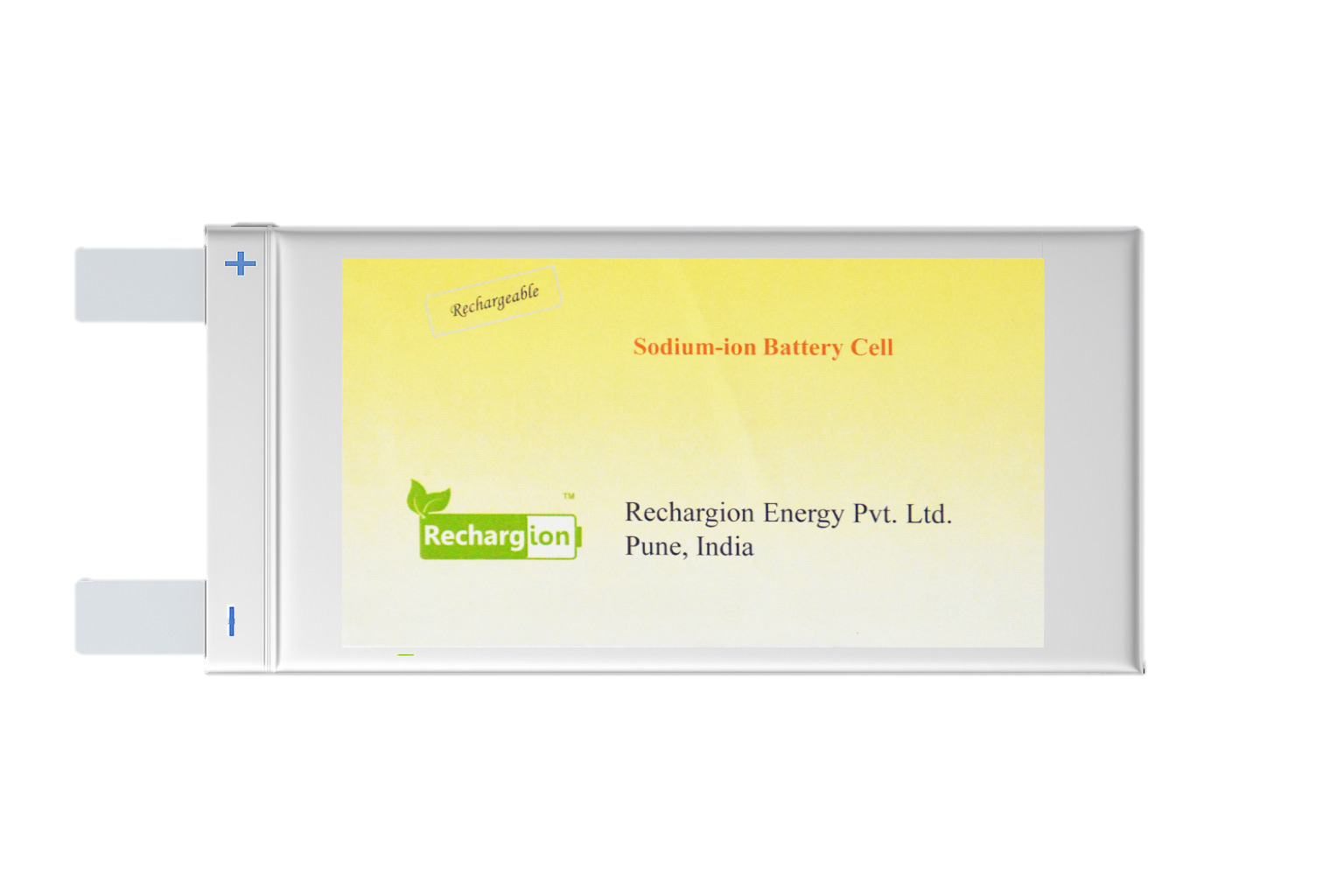
That validation sits on a manufacturing base the company has been building since June 2024, when it inaugurated what it describes as India’s first dedicated sodium-ion cell fabrication pilot plant. Its product range on its official site runs from the compact NaBh02 pouch cell (1–2 Ah) through the NaBh06 (4–6 Ah) to the NaBh10 (8–10 Ah), all at 3.7 V. The company says its cells have demonstrated a cycle life of 10,000 cycles, translating into a potential battery life of over 25 years, and it is setting up a facility to produce 500 cells a day.
From pilot plant to first customer
The step from laboratory to market came in September 2026, when Rechargion announced the first commercial deployment of its 1 kWh locally manufactured sodium-ion battery. The deployment was unveiled at the Energy Efficiency Summit 2026, as a standalone renewable energy system at the CII Godrej Green Business Centre in Hyderabad. The battery is charged by a rooftop solar installation, and the stored energy directly powers an outdoor display at the facility.
The configuration is deliberately simple, and that is the point. The company says the setup avoids power transmission as well as DC-to-AC conversion before supplying the connected application, cutting the energy losses of a conventional setup. The deployment also marks the Confederation of Indian Industry (CII) as Rechargion’s first customer for a commercially deployed 1 kWh locally manufactured sodium-ion battery — a working example, on a real building, of solar generation, sodium-ion storage and direct DC power delivery in a single system.
The demonstrations behind it show the range the company is aiming at: a solar storage demonstration shown to a United Nations Industrial Development Organisation (UNIDO) team, a sodium-ion-powered bicycle, and even a small drone flown on a 3.7 V pouch cell. The backing, too, has come through government and development channels rather than venture capital alone: the Ministry of Heavy Industries through the ARAI-AMTIF accelerator, UNIDO, the US–India Science and Technology Endowment Fund, Social Alpha and the Venture Center at NCL. In January 2026, the company won the CII ASCEND Innovation Challenge, and in February 2026 it took the Climate Redesign Award at Delhi Climate Innovation Week.
What comes next
Rechargion’s business model is to supply cells, not finished packs: it plans to sell its cells to battery pack manufacturers, who will assemble them with battery management systems for solar storage, two- and three-wheelers and stationary energy storage. The company says its ambition is commercial-scale manufacturing by 2027, built on a domestic supply chain for every raw material.
That is the larger prize. If sodium-ion cells made from Indian materials can be produced at scale, tested to international safety standards and deployed on Indian rooftops, then the country’s energy storage stops being an import bill and starts being an industry. Rechargion’s 1 kWh system in Hyderabad is small — one battery, one display, one building. But it is the first one with a customer, and it runs on salt.
Keep reading: From Scooters to the Grid: Inside Ola Electric’s Shakti Gen2 Home-to-Grid Battery Range · Cut Into Quarters, Built for Gigawatts: Inside Solex Energy’s TAPI RQ, India’s First Quarter-Cell Solar Module · More Energy & Power stories
Like stories like this? Add Exceptional Technology as a preferred source on Google to see more of our reporting in your search results and Discover feed.