


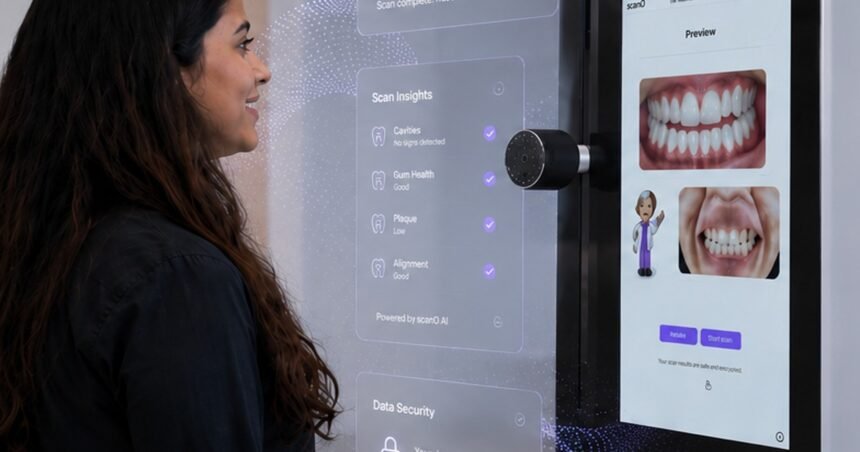
Most people discover a dental problem only when it starts to hurt — by which time a small cavity has become a root canal, and a small stain on the gums has become something far more serious. The Pune startup scanO wants to flip that order entirely: a twelve-second, contactless scan in a clinic reception, a school hall or a shopping mall, before a patient ever sits in the dentist’s chair, that can spot more than 40 oral conditions while there is still time to treat them simply.
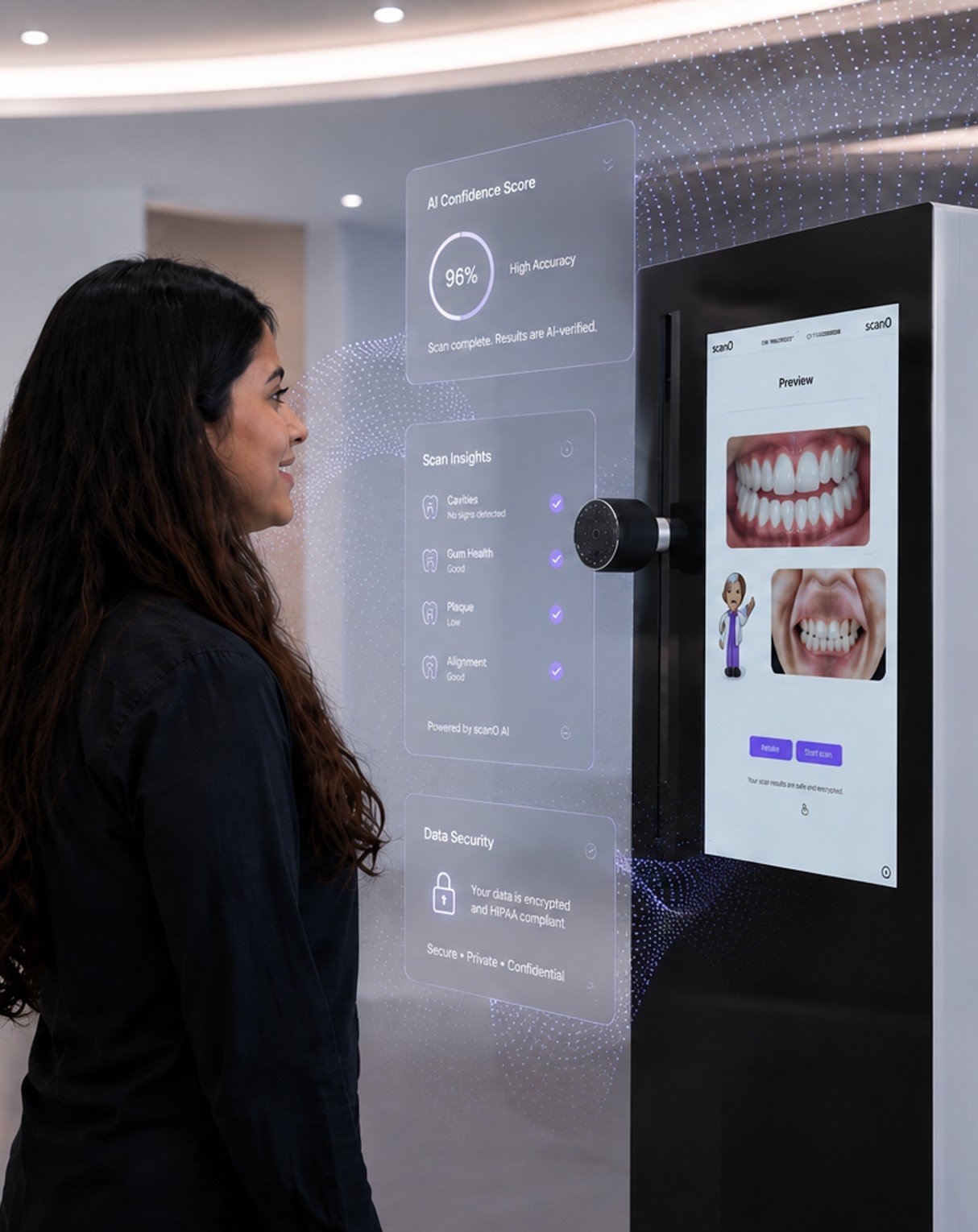
Twelve seconds at the kiosk: a visitor being screened by scanO Air. (Image: scanO)
The kiosk in the reception
scanO, founded in Pune in 2020 by Rajat Kabade and Dr Vidhi Bhanushali, builds its whole business around one piece of hardware: scanO Air, an AI-powered oral-health screening kiosk. A visitor stands in front of it, holds steady for a few photographs, and walks away with an oral-health report — no chair, no instruments in the mouth, no technician required. The company says the scan takes about twelve seconds, and that its AI can screen for more than 40 conditions, from cavities, stains, calculus and gum disease to misaligned teeth and structural problems.
The idea is deliberately built for places dentistry rarely reaches. The company says scanO Air is designed for clinic receptions, and just as easily for schools, screening camps, malls and corporate parks — anywhere people already are, rather than anywhere they have made an appointment to be. That is how a screening tool becomes a public-health tool: the company says its systems have now processed more than 1.6 million scans, and are used by more than 1,000 clinics across nine countries, including India, the UAE, Singapore, Malaysia, the United Kingdom, South Africa and Zambia.
Three photos, three AI models
Behind the kiosk sit three named computer-vision models, each trained by domain experts labelling images. ToothAI handles hard tissue — the teeth themselves — and the company says it was trained on more than 1.2 million annotated images to detect over 40 dental conditions. PredictAI shows patients how a cavity, stain, calculus deposit or gum problem could look if it worsens, turning an abstract warning into something visible. And TissueAI, launched in August 2025, moves into soft tissue for the first time: using a set of 16 high-resolution intraoral photographs, it flags early changes that could indicate conditions including mouth ulcers, lichen planus, erythroplakia and candidiasis, for the dentist to review.
More Read

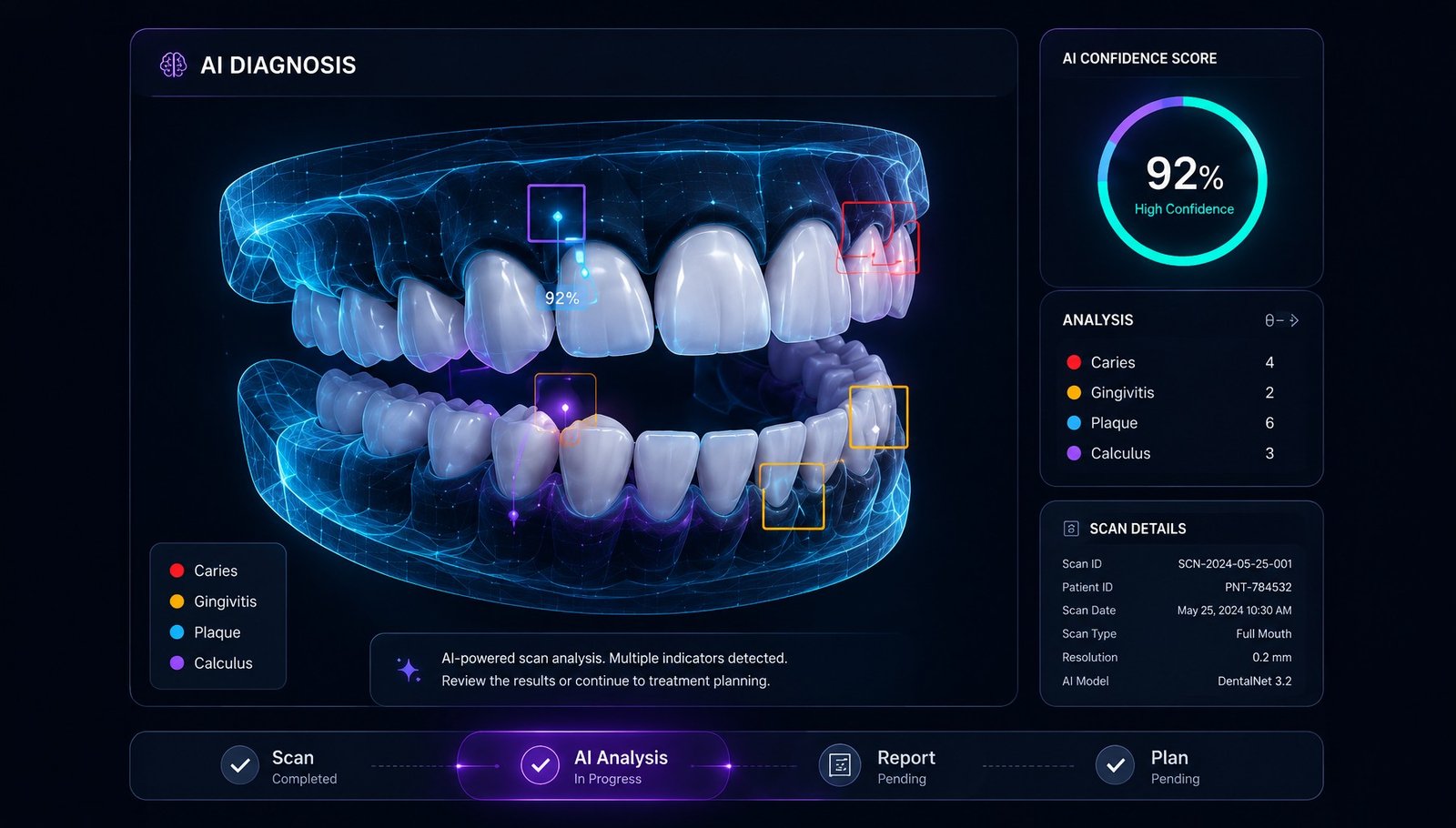
What the AI sees: scanO’s diagnosis view marking findings for the dentist. (Image: scanO)
The numbers behind the models are striking. The company says its AI achieves 94% mean sensitivity and 91% specificity, with an area-under-curve score of 0.97 for cavity detection, and it points to 23 published studies behind its approach. Its dataset is deliberately diverse: the company says it covers skin tones across the Fitzpatrick I–VI range, along with tobacco and areca-nut staining and fluorosis presentations from endemic regions — the patterns, it says, that Western dental datasets often miss. The platform holds CDSCO Class B registration in India and MDR CE marking in Europe, and the company says a US FDA 510(k) application is in progress.
Why early matters most in India
The stakes are highest exactly where screening is thinnest. India records more than 135,000 new oral cancer cases every year and accounts for nearly half of the world’s oral cancer deaths, a crisis the company says is fuelled by late detection and limited preventive screening. A soft-tissue screening tool that flags a suspicious change during a routine visit — before it becomes a symptom — is designed to catch precisely those cases earlier, when treatment is simpler and survival is far better.
The same logic runs through the rest of the platform. scanO Care, the patient app, gives people their own annotated scans, a plain-language report, recall reminders and treatment progress, so the scan becomes the start of a relationship with a clinic rather than a one-off test. scanO Engage, the practice software, turns every scan into scheduled care, charts and treatment plans. And scanO Copilot, an AI front desk, books appointments and sends recalls around the clock. The company says the result is visible in the clinic’s own numbers: case acceptance rising as patients see their own mouths on screen, and front-desk hours freed from scheduling and recall work.
Recognised on the national stage
In October 2026, scanO was named one of the six winners of the Ericsson Innovation Challenge 2026, chosen from more than 800 entries and showcased at India Mobile Congress 2026 in New Delhi — recognition for a solution that pairs AI screening with 5G-enabled real-time specialist consultation. The company, accelerated by Google for Startups, is already looking beyond the clinic: its homepage announces scanO Nova, an autonomous mobile screening unit for camps, schools and the patients who never reach a clinic, launching in December 2026.
That is the heart of scanO’s story: a Pune-built AI system that turns the most neglected corner of healthcare — the routine dental check — into something fast, contactless and available wherever people gather. Twelve seconds, forty conditions, and a report in the patient’s pocket: prevention, finally, as easy as the problem it prevents.
Keep reading: A Vaccine Made for One Person: Inside PopVax’s RNA Foundry · Hours, Not Days: Inside BioCipher Labs, the Bengaluru Startup Decoding Infections With AI · More Chemicals, Materials & Life Sciences stories
Like stories like this? Add Exceptional Technology as a preferred source on Google to see more of our reporting in your search results and Discover feed.







