Much of India’s fruit and vegetable harvest loses value before it ever reaches the market. Grading is still mostly done by hand: slow, inconsistent, and rough on the produce. The machines that do the job well exist — giant optical sorters built for European and American packhouses — but they are too expensive and too large for a regional mandi, a collection centre, or a smallholder farm.
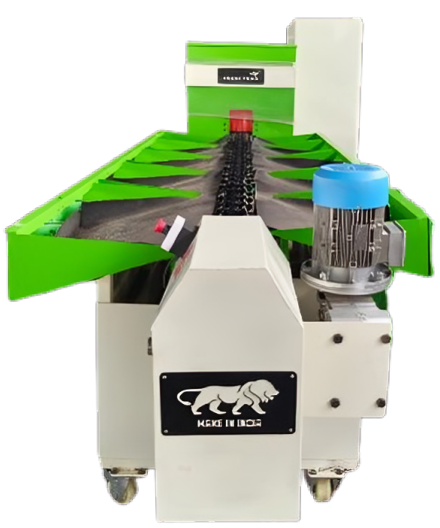
A Hyderabad startup says the answer is to shrink the machine and put it where the harvest is. Segritech builds compact, AI-powered optical grading machines that sit at the farm gate or collection point and sort fruit at up to 12 pieces a second — the company claims a grading accuracy of 95%.
Segritech, founded in 2022 by Hetendra Singh, Sri Kusulu Devalla and Vijay Pratap Singh, came out of an unlikely beginning: the founders ran a fresh-produce supply-chain venture, Tikkly.com, and were forced to pivot during the COVID-19 pandemic. Their own problem — every fruit sorted by hand, at great cost and inconsistency — became the product. The company now designs, fabricates and assembles its machines in-house in Hyderabad, and it was named to YourStory’s Tech30 2026 cohort.
The machine: four kinds of light, one camera chamber
Segritech’s range has two models: the Mini Sort, priced at Rs 10 lakh plus GST, and the Fast Sort, priced at Rs 20 lakh plus GST. Farmers load produce into the machine, and each fruit passes through a camera chamber where it is rotated so the system can inspect nearly its entire surface.
Inside, CMOS and RGB cameras work alongside near-infrared and ultraviolet imaging to capture high-speed images of the produce. Custom computer-vision and deep-learning models analyse the surface of each fruit to identify skin characteristics, fungal marks, sunspots and physical scars. The machines currently grade pomegranates, apples, oranges, mangoes, kiwis, avocados, tomatoes and potatoes.
“The machine processes 10 to 12 fruits per second, giving us a throughput of about two to three tonnes an hour at a 95% accuracy rate,” Hetendra Singh told YourStory.
More Read
Proof on the field: paying deployments
The claims that matter are the deployed ones. Segritech has completed four paying deployments, including one for Swiggy Instamart at its Bengaluru warehouse. In Bhuj, Gujarat, a pomegranate deployment involving 80 to 100 farmers recorded a 30% increase in price realisation through more precise grading, per the company. Its machines are deployed commercially for grading pomegranates and apples, with a paid pilot underway for oranges.
The startup sells business-to-business and to governments: farmer producer organisations, mandi aggregators and retail warehouse networks. It is also in discussions with the Rajasthan government to introduce automated grading under a programme targeting 8.1 million farmers.
The business behind it
Segritech has raised Rs 80 lakh in seed funding to develop the technology and grow the team: an initial Rs 10 lakh from Avishkar at IIIT Hyderabad, followed by a 2024 round in which Rs 45 lakh came from the TIH Foundation at IIT Bombay and Rs 25 lakh from VIT Vellore. Over the next 12 to 18 months, the company aims to deploy more than 100 grading machines.
What’s next: harvest robots with a sense of touch
Beyond post-harvest sorting, the company is developing autonomous harvesting robots equipped with tactile sensors and specialised robotic dexterity to pick delicate fruit such as pomegranates. The robots are currently at technology readiness level 5 — prototype stage — and the company aims to have them operating in field conditions within six months.