


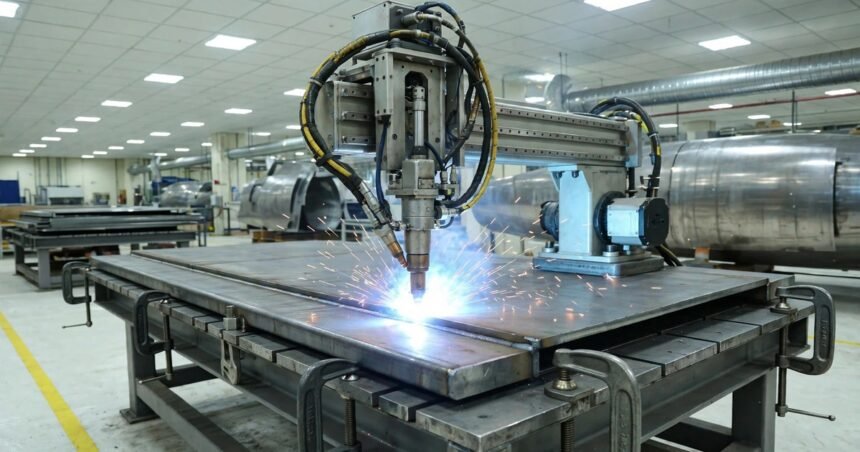
On a steel plate in a fabrication hall in Kochi, two kinds of energy meet at a single seam. A laser beam melts a pinpoint line of metal while an arc torch follows in the very same pass, filling the joint with molten wire — one smooth, deep weld where conventional welding would need several slow passes, and a seam so clean it barely distorts the plate around it. The system doing it was designed and built in India, and on 11 November 2026 it was unveiled to the country: the first indigenously designed and manufactured hybrid laser arc welding system, built by SFO Technologies together with Cochin Shipyard.
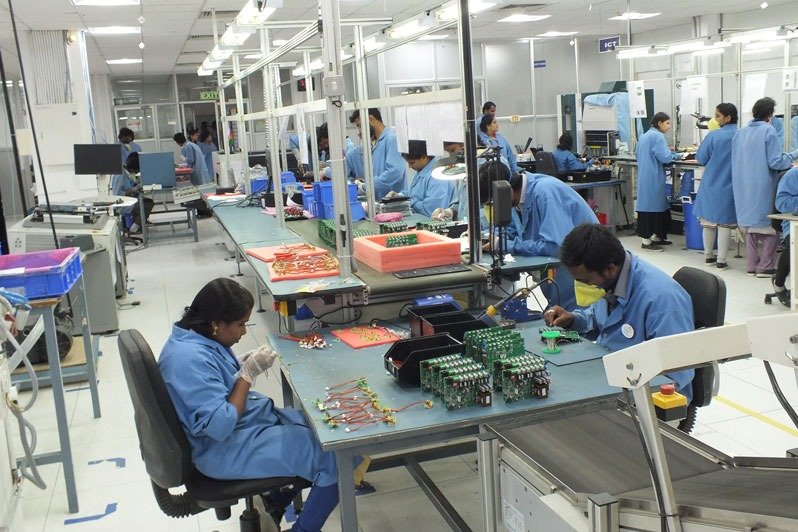
SFO Technologies’ electronics assembly floor in Kochi. (Official photo: SFO Technologies)
Two beams, one seam
Hybrid laser arc welding — HLAW — pairs two welding methods in a single head. The laser brings deep, narrow penetration; the arc brings gap-bridging and filler metal; and a robotic gantry with advanced automation moves the combined head along the joint in one steady pass. The whole system is powered by a high-power fibre laser source that SFO Technologies developed in-house, so the heart of the machine is Indian engineering, not an imported module.
The company says the result is faster welding speeds, deeper penetration, lower distortion and more consistent welds than either method can deliver alone — and far fewer passes on thick plate. In a shipyard, where welding is the work that decides how fast a hull comes together and how true it stays, that is the difference between a schedule that slips and one that holds.
Built for the shipyard, ready for much more
The system was jointly developed by SFO Technologies and Cochin Shipyard, and unveiled at the inauguration of the Advanced Laser Engineering Centre and HLAW R&D Facility at NeST Hitek Park, Kalamassery. Cochin Shipyard chairman and managing director Jose V. J. and SFO Technologies chairman and managing director N. Jehangir opened the centre together.
More Read
Shipbuilding is the first home for the technology, but the partners designed it for far wider work: defence, heavy engineering, railways, energy, and the large tanks and wagons that carry India’s industry. The development also cuts India’s dependence on imported laser welding platforms, putting a high-end industrial technology that shipyards once had to buy from abroad into domestic hands. The new centre will focus on research, testing, validation and commercialisation of advanced laser technologies, positioning Kochi as an emerging hub for industrial innovation.
“By developing the high-power fiber laser source in-house and integrating it with advanced welding, robotics and automation, we have demonstrated that high-end manufacturing technologies can be conceived, engineered and built in India,” said Jehangir. Jose V. J. said the partnership showed how engineering innovation could answer real industrial needs: “Cochin Shipyard’s collaboration with SFO Technologies has enabled the joint development of a technology that is relevant to shipbuilding and other manufacturing industries. The Indigenous Hybrid Laser Arc Welding has the potential to improve productivity, quality and competitiveness across Indian manufacturing.”
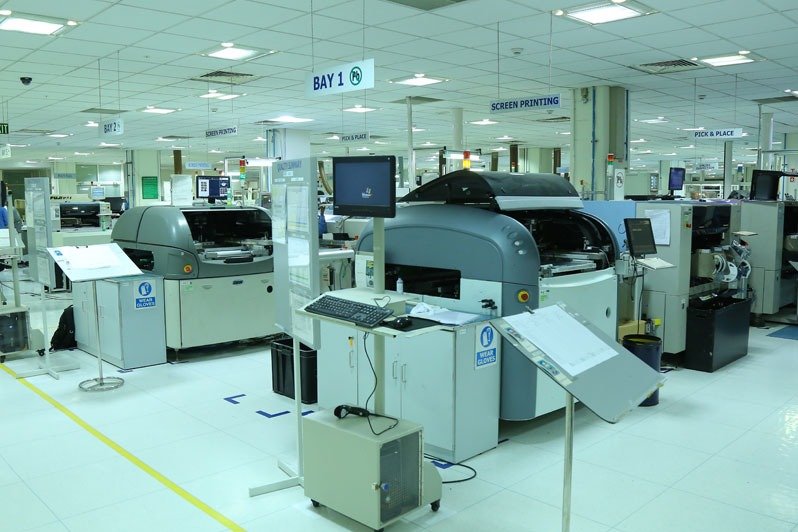
SFO Technologies’ surface-mount production line in Kochi. (Official photo: SFO Technologies)
Three decades of precision, from Kochi to the Moon
SFO Technologies was founded in 1990 and is the flagship company of the NeST Group, headquartered in Kochi. Across more than three decades it has built its reputation in the places where failure is not an option: engineers at its Kochi facilities assemble high-reliability systems for lunar missions, wire radar components for Rafale fighter jets, and build the electronic backbone of servers powering the artificial-intelligence boom.
The same photonics expertise behind the welding head runs through the company’s work. SFO builds the complex wired structures for the RBE2 AESA radar on the Dassault Rafale under a contract from Thales, produces sonar power supplies and fibre-optic torpedo systems, and has developed high-power fibre lasers with the Defence Research and Development Organisation’s Centre for High Energy Systems and Sciences (CHESS). It built the Primary Power Distribution System for the indigenous SARAS MKII aircraft, supplied RF packages that flew on ISRO’s Chandrayaan and Aditya missions, and turns out around one million relays a month from its Kochi components park. The company has been described as India’s largest exporter of electronics hardware.
That is what makes the welding system more than a single machine. It is the visible edge of a deep bench: lasers, fibre optics, robotics and precision manufacturing, all built up in Kochi over 35 years, now pointed at one of Indian industry’s most basic and most important jobs — joining steel. The ships, tanks and wagons that come off Indian fabrication lines in the years ahead may well be held together by a weld that was conceived, engineered and built at home.
Keep reading: The Fan That Sips Power: Inside Atomberg, the IIT Bombay Startup That Rebuilt India’s Ceiling Fan · The 18-Year-Old Building the Tiny Metal Frames Inside Every Chip: Inside Micronex’s ₹80-Crore Sanand Plant · More Manufacturing & Engineering stories
Like stories like this? Add Exceptional Technology as a preferred source on Google to see more of our reporting in your search results and Discover feed.







