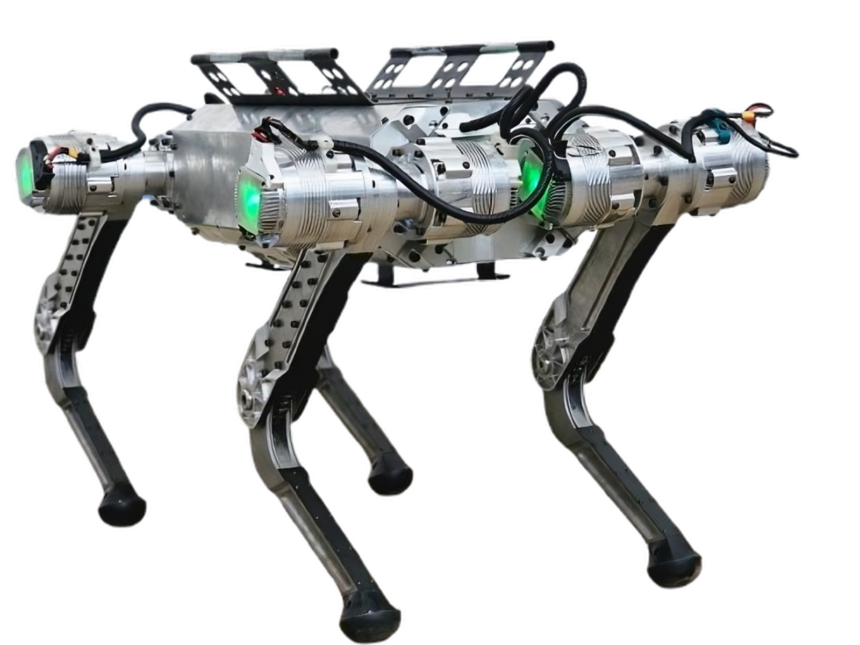
A four-legged robot towing a full-sized car is the kind of demo that usually belongs on a Silicon Valley stage. Last month it happened in Bengaluru — with a robot whose motors, gears, drives and legs were built in India.
Bengaluru-based Strider Robotics, a deep-tech startup incubated at ARTPARK, the robotics and AI innovation hub at the Indian Institute of Science, has demonstrated that its M3 autonomous quadruped robot can tow a Honda Amaze passenger car. On September 25, 2026, the M3 pulled the sedan with its engine switched off and nobody in the driver’s seat — two passengers remained inside, one holding the handbrake as a safety measure — in a demonstration the company described as a Technology Readiness Level 6 (TRL 6) milestone.
Forty kilograms on its back, a car behind it
The M3 is the latest platform in Strider’s M-series of quadruped robots. In its standard configuration it is designed to carry around 20 kilograms of payload; the company says it has also been tested with 40 kilograms strapped to its chassis, which it describes as one of the country’s highest-payload quadrupeds maintaining stability across uneven terrain. In earlier demonstration campaigns, the robot performed sit-to-stand recovery, controlled locomotion and stair climbs under load — the same stability, scaled up, that generated the traction to pull a stationary, loaded vehicle.
Built for the places wheels can’t go
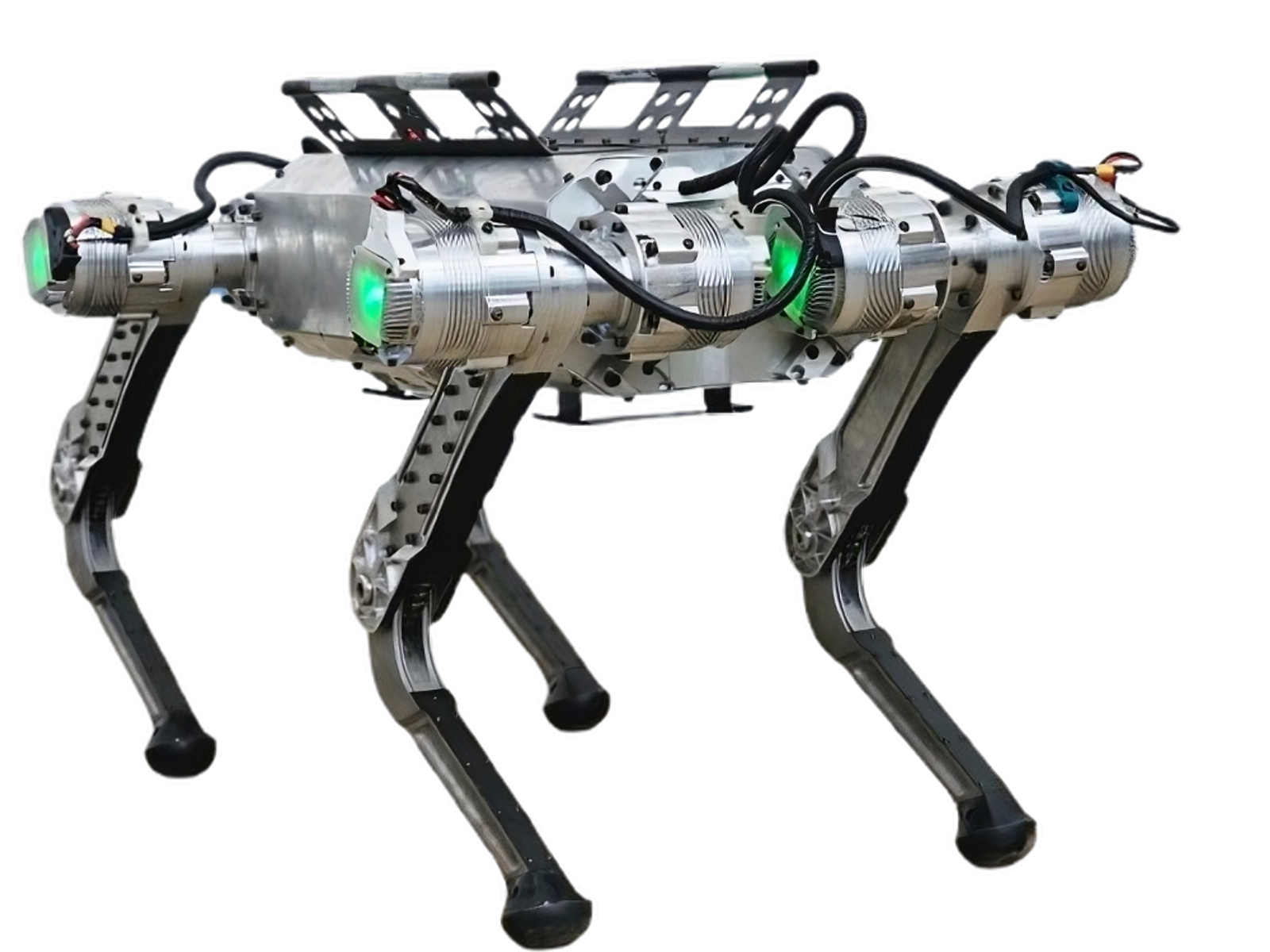
Strider’s robots are aimed at industrial inspection, material handling and asset monitoring in environments where wheeled or tracked systems struggle: oil and gas facilities, power plants, mining sites, refineries and large industrial infrastructure, where routine inspections can expose workers to hazardous conditions. The M3 integrates high-torque actuators, multiple sensors and autonomous locomotion to carry inspection equipment — thermal cameras, LiDAR, gas detectors — across stairs, rubble and uneven ground.
Alongside the hardware, Strider is developing an AI-powered software platform for navigation, mission planning, asset monitoring and data analytics. The company says the software is hardware-agnostic, designed to run on third-party quadruped robots too — so an industrial customer could deploy its inspection capabilities without being tied to a single hardware platform.
From an IISc lab to industrial pilots
The company’s roots run through the Stochastic Robotics Lab (StochLab) at the Centre for Cyber-Physical Systems at IISc Bengaluru, where the founders have researched legged robotics since 2018. Strider was incorporated as a private limited company in 2024, after earlier M1 and M2 iterations, and remains incubated at ARTPARK. The company says the M3 contains more than 80 percent indigenous content by component cost, including its actuators — locally developed motors, gears, drives, legs, battery systems, software and locomotion control.
The startup is now moving from prototype development to commercial deployment, with field pilots reported to be underway with a major oil and gas company and an automotive manufacturer.
One honest caveat: the 40-kilogram payload figures, the TRL 6 claim and the indigenous-content numbers are the company’s own reports; independent test data and the pilot customers’ names have not been published. But as a hardware story — a heavy-duty quadruped built in Bengaluru, moving from lab benches to refineries and car-pull demonstrations in two years — Strider Robotics is exactly the kind of genuinely engineering-led work this showcase exists to feature.