Most rockets burn their engines exactly once: ignition at liftoff, cutoff when the propellant runs out. Restarting an engine in mid-air — cutting it, coasting, and lighting it again — is the capability that makes reusable boosters, multi-burn orbital stages and precision satellite deployments possible. From the Chennai coast on October 10, a Chennai startup says it has demonstrated exactly that with an indigenous hybrid rocket.
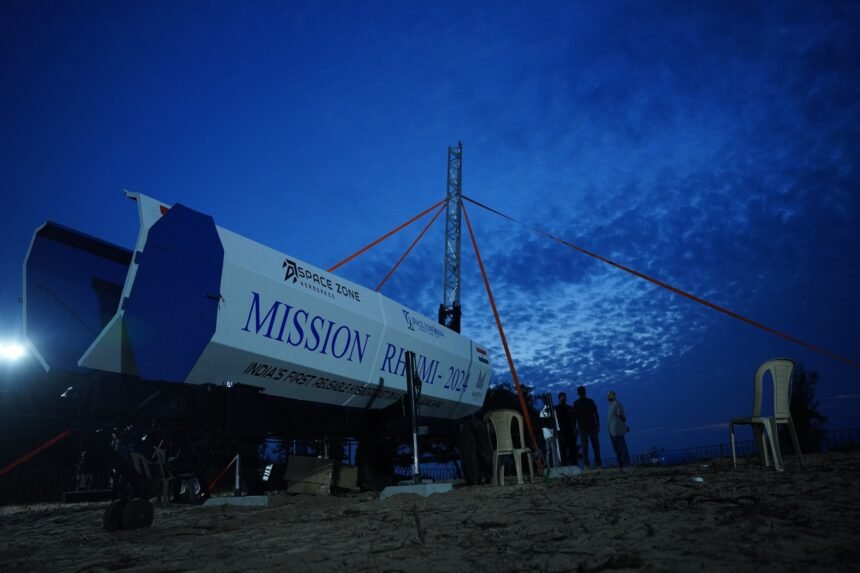
Space Zone India Private Limited, the Chennai-based space company founded by Dr. Anand Megalingam that describes itself as a space science education and research firm, flew two hybrid rockets simultaneously from the Thiruvidanthai coastline on Tamil Nadu’s East Coast Road on the morning of October 10 as part of Mission RHUMI TWIN 2026. DT Next reported the twin liftoff at around 7 a.m. IST, with student-developed scientific instruments integrated into the vehicles to collect atmospheric data. The mission was backed by the Martin Group and the US-based Global Help International Foundation, and was attended by the Tamil Nadu Governor as chief guest.
Nine seconds on, three seconds off, five seconds on
One of the two vehicles, designated RRR-1 (RHUMI Restart Rocket), was flown as a dedicated engine-restart demonstration. According to the company, RRR-1 executed a programmed sequence in flight: the engine burned for approximately nine seconds, was deliberately shut down for three seconds — during which the vehicle coasted on its trajectory without thrust — and was then reignited for a further five seconds. The full sequence ran for 17 seconds, with 14 seconds of powered operation split across the two burns. The flight was supported by onboard instrumentation and tracking systems monitoring the rocket’s trajectory and propulsion performance.
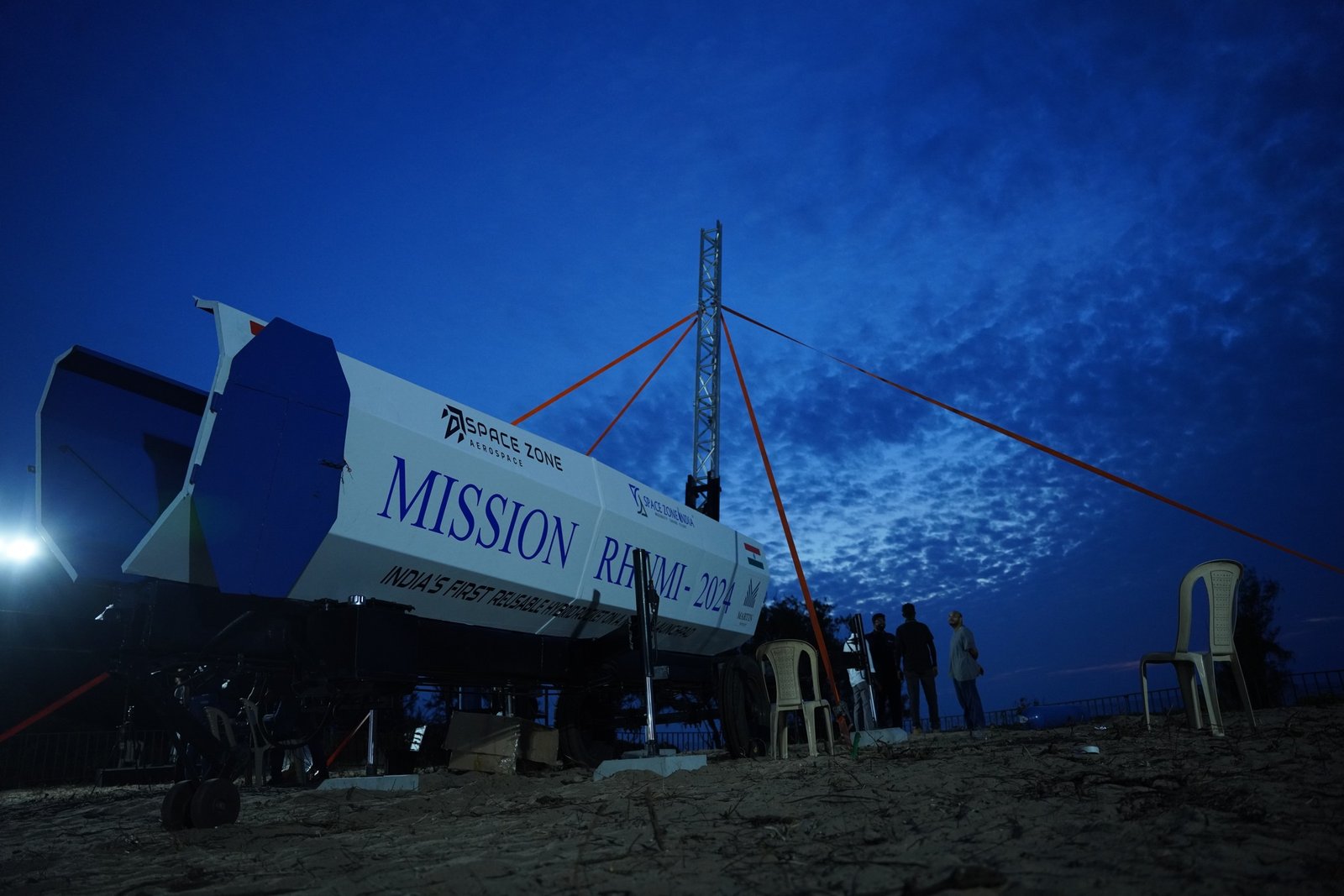
Why hybrid propulsion makes this possible
RRR-1 uses hybrid rocket propulsion, which pairs a solid fuel with a separately supplied oxidiser — the oxidiser flow is what the mission team throttles to shut down and restart the motor. Solid rocket motors cannot be restarted once lit; liquid engines can but are complex and expensive. Hybrids sit between the two: restartable and controllable with far simpler plumbing, which is why the company sees the technology as a path toward reusable launch vehicles and flexible satellite launch systems.
A track record of firsts from the coast
Space Zone India has history on this same stretch of coastline. In August 2024 it flew RHUMI-1, India’s first reusable hybrid rocket, from a mobile launcher at Thiruvidandhai — a suborbital flight that carried three Cube satellites and 50 PICO satellites tasked with gathering atmospheric and climate data, Odisha TV reported. The company’s rockets are designed to be free of fireworks and TNT, using hybrid propulsion for safety and lower operating cost.
One honest caveat: the October 10 restart demonstration is the company’s report; independent flight telemetry confirming the reignition has not yet been published, as the space news outlet Space Exploration noted in its launch coverage. For a company built on education and open student participation, releasing that data would strengthen the claim. But as a hardware milestone — two hybrids off the pad together, one of them relit mid-flight — Mission RHUMI TWIN 2026 is exactly the kind of ambitious, genuinely engineering-led work this showcase exists to feature.