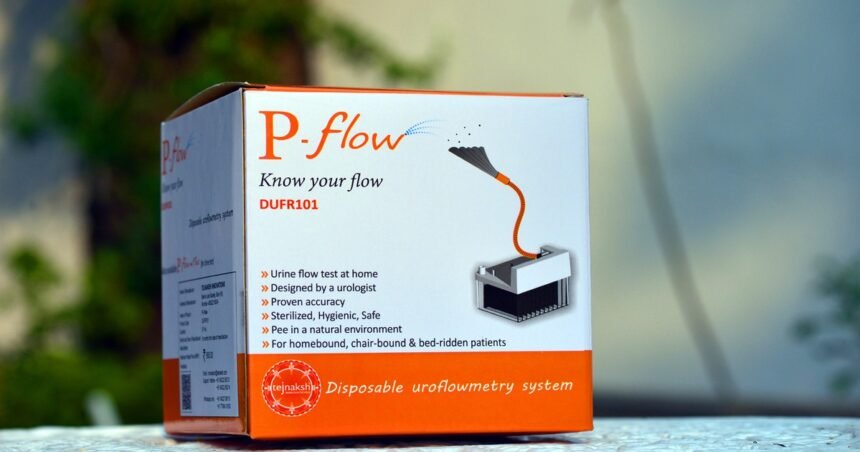
For most patients, a urine flow test still means a hospital visit: a room, a technician waiting outside, and a machine wired to a computer. Tejnaksh Healthcare, a Mumbai company, has spent years shrinking that whole appointment into a box you can use at home — and now a peer-reviewed study says the box measures just as well as the machine.
The device is called Pflow, a disposable uroflowmetry system that brings one of urology’s most common diagnostic tests into the patient’s own bathroom. The company says it was designed by a urologist, and it is built for the people the clinic system serves worst: homebound, chair-bound and bedridden patients, and anyone who would rather take the test in private than in a hospital corridor.
Physics instead of electronics
What makes Pflow unusual is what it leaves out. Conventional uroflowmetry machines are gravimetric: the patient voids into a funnel on a weight transducer, and electronics turn the changing weight into a flow curve. Pflow works the other way round — with gravity and geometry alone.
The device is a compact block of medical-grade polypropylene, roughly 20 cm on each side, holding two horizontal rows of calibrated chambers. Urine enters through a funnel and fills the upper chambers in sequence; each chamber drains through a calibrated aperture at about 1 mL per second into a matching lower chamber. Because every chamber has a known volume, the pattern of filled chambers reconstructs the flow curve — voided volume, voiding time, peak flow rate and average flow rate — without electricity, sensors, batteries, software or an internet connection. The paper describing the device puts its manufacturing cost at roughly Rs 240 a unit, a fraction of a conventional electronic system.
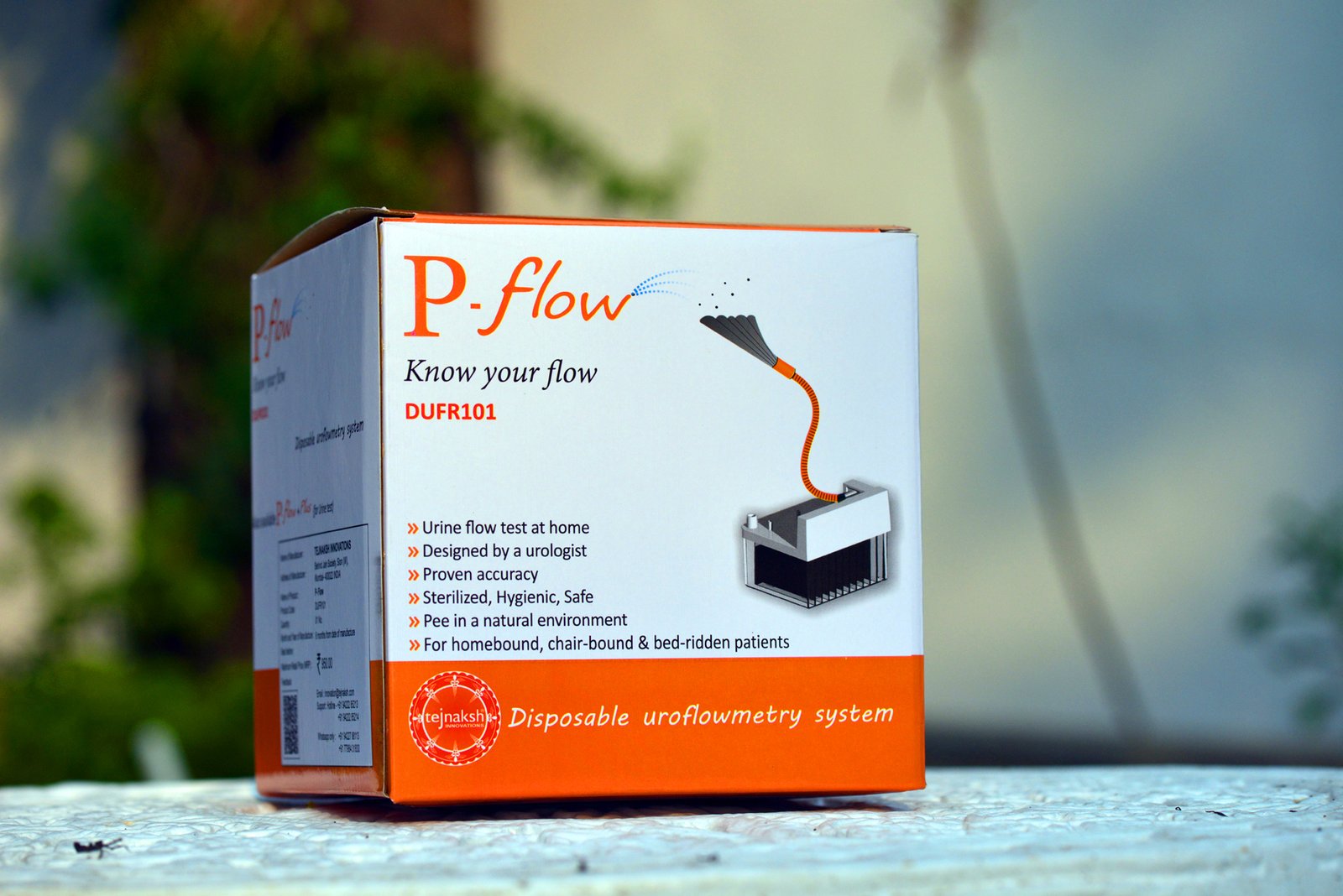
That simplicity is the point. With no electronics to maintain and nothing to plug in, the test can travel anywhere a clinic cannot — a village health centre, a primary-care practice, a patient’s home — and the used kit is simply disposed of, sterile and hygienic, with no cleaning or calibration between patients.
More Read
Tested head-to-head, in the same void
The validation behind Pflow is unusually rigorous for a device this simple. In a prospective study published in the Indian Journal of Urology, researchers tested the device against conventional gravimetric uroflowmetry in 372 patients across two tertiary urology centres — Muljibhai Patel Urological Hospital in Nadiad and the Institute of Urology in Dhule — over twelve months from July 2023 to July 2024.
The design removed the usual excuse for disagreement: the study device sat directly on the conventional machine’s weight transducer, so both systems measured the very same void, at the very same moment. Across the 372 patients, the two methods produced near-identical results — voided volume of 271 mL against 270 mL, voiding time of 40 seconds against 38, peak flow rate of 15 mL per second against 14.4, and average flow rate of 9 against 10. Correlations between the two methods ran from 0.799 to 0.963, and agreement for voided volume was rated excellent.
Tejnaksh Healthcare announced the publication on 24 October 2026, calling it scientific validation of a device the company first launched for home use. The paper itself points to where the idea goes next: a patient photographing the used unit and sending the picture for a centrally generated report — tele-urology built on a device that needs no power at all.
A test people can actually take
Uroflowmetry matters because it is the first, simplest window into lower urinary tract trouble — prostate enlargement, urethral stricture, bladder and neurological disorders. But a test that requires a clinic visit, a full bladder on schedule and a stranger in the next room is a test many patients postpone. Pflow’s pitch is dignity as much as diagnostics: no technician watching, no hospital environment, a report delivered confidentially to the phone.
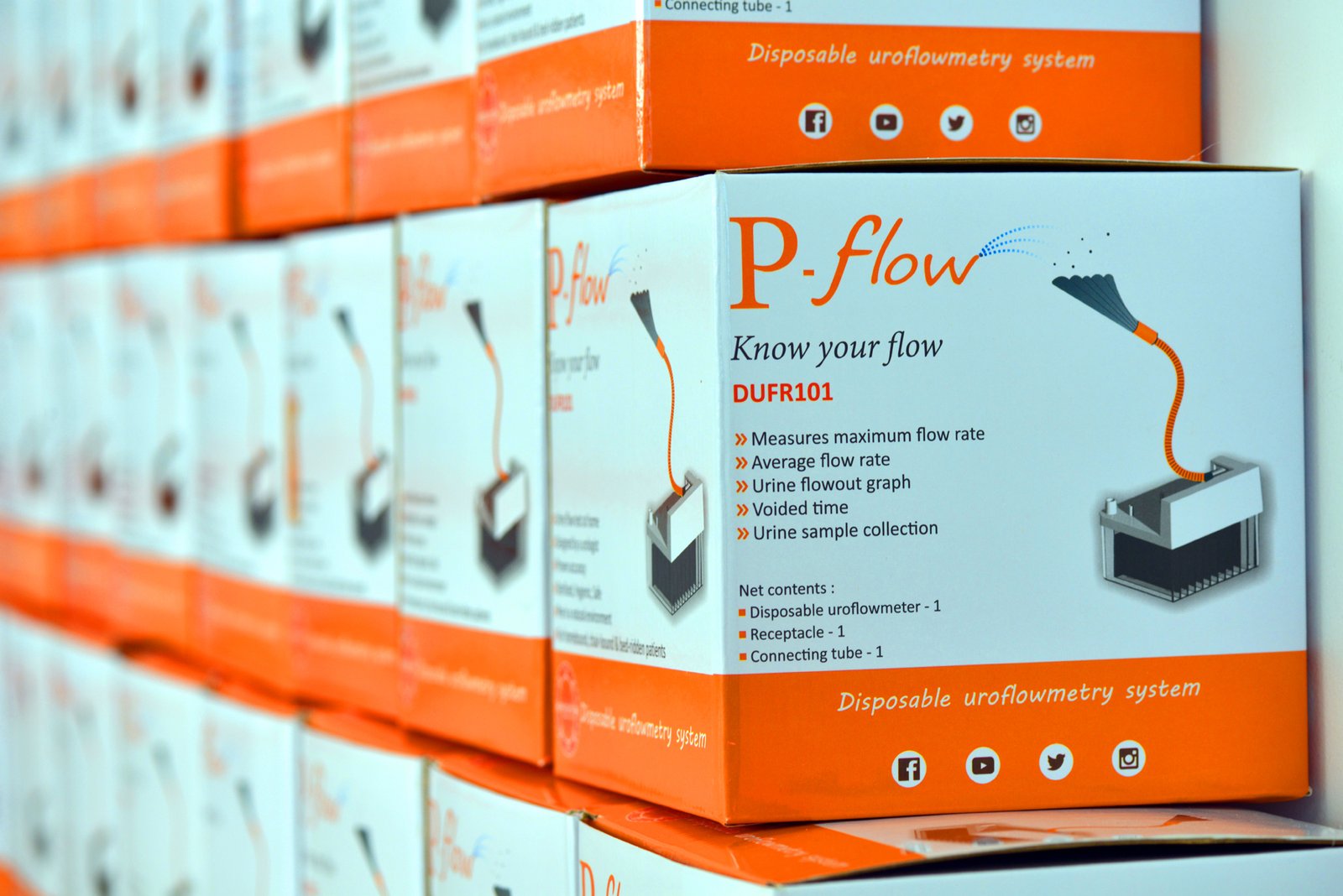
The kit is sold directly to patients and through doctors — the company lists the single-use system at Rs 999 on its official store — and it has already had its television moment, appearing on Shark Tank India. For a country where prostate and urinary problems are common and urologists are concentrated in big cities, a Rs 999 box that matches a hospital machine is not a gadget. It is the test reaching the patient, instead of the patient travelling to the test.
Keep reading: From Burnt Fields to New Fabric: Inside Canvaloop, the Surat Startup Turning Farm Waste Into Clothes · An Operating System for Rural Health: Inside CureBay, the Bhubaneswar Company Bringing the Hospital to India’s Villages · More Chemicals, Materials & Life Sciences stories
Like stories like this? Add Exceptional Technology as a preferred source on Google to see more of our reporting in your search results and Discover feed.