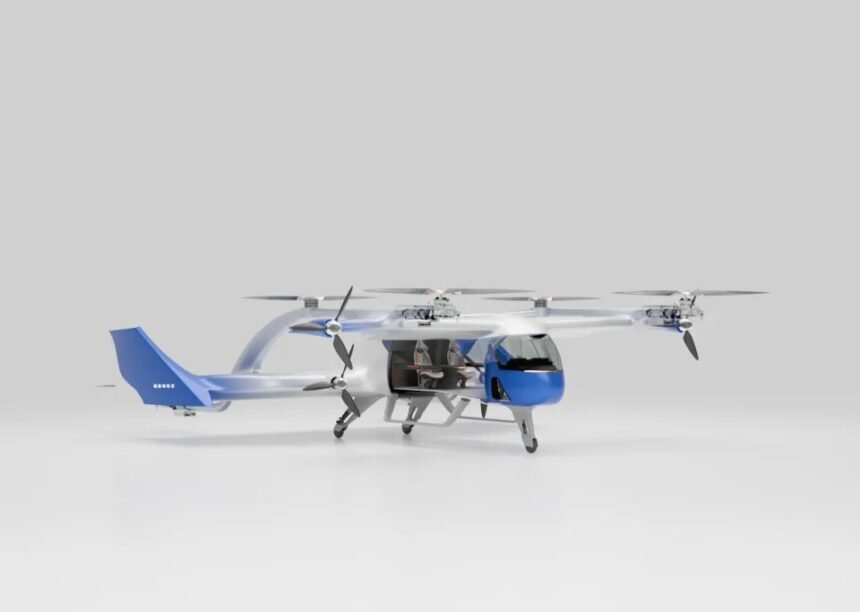
India builds rockets that reach the Moon and satellites that watch its weather, but almost nothing it builds takes off with civilians inside — the country’s entire commercial aircraft fleet is imported. A Chennai startup founded by an IIT Madras aerospace professor is betting that the first truly Indian aircraft won’t be a conventional plane at all. It will be electric, it will take off vertically, and it will fly over the traffic jams rather than through them.
The ePlane Company — legally Ubifly Technologies, founded in 2019 by Prof. Satya Chakravarthy — has spent seven years working toward one machine: the e200X, a battery-electric vertical take-off and landing (eVTOL) aircraft it describes as India’s first full-scale electric air taxi. On 20 July 2026, the company unveiled PT-01, the first full-scale prototype, at its new 60,000 sq ft production facility on the IIT Madras Discovery Campus; in early October it announced assembly completion and the start of the ground-testing campaign.
Seven years from classroom to carbon fibre
Chakravarthy spent 25 years in aerospace research at IIT Madras, where the company says he created the world’s first university curriculum dedicated to electric aviation, before spinning ePlane out of the institute in 2019. Rather than jumping straight to a full-size aircraft, the team validated its ideas through the ATVA demonstrator in 2021 and the larger e50 in 2023 — logging what the company reports as more than 10,000 km of cumulative subscale flight testing across vertical flight, transition and control-law behaviour before cutting carbon fibre for PT-01. The core subsystems — propellers, airframe, landing gear and battery packs — were developed in-house rather than bought off the shelf, the company says, giving it unusual control over performance, cost and iteration speed.
Ten motors, no tilt rotors
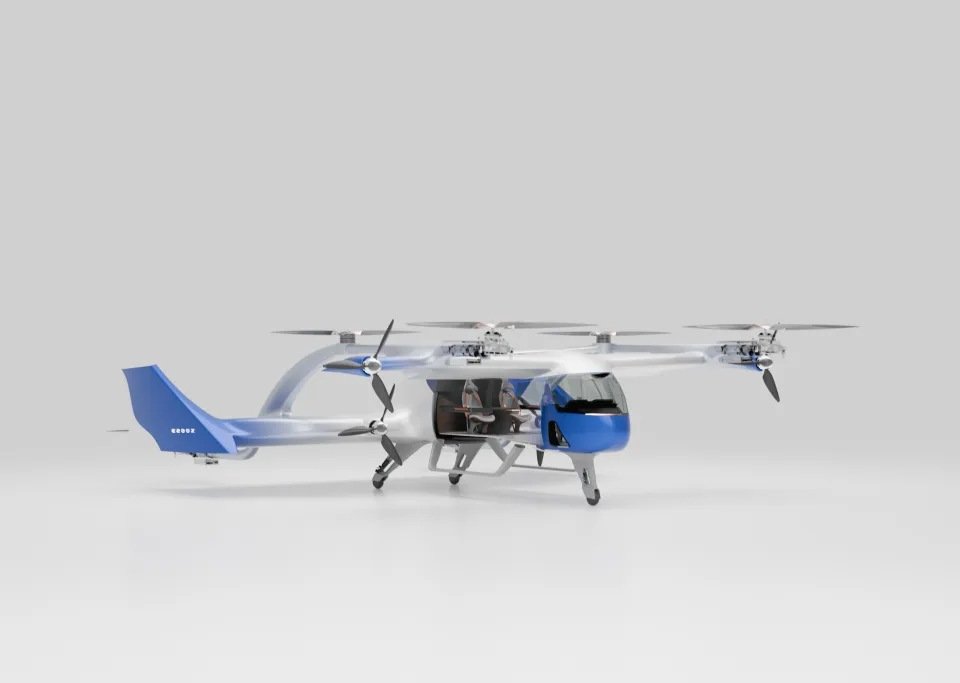
The e200X is built around what the company calls “Synergistic Lift”: ten independent electric propulsion units — six dedicated lift rotors and four forward propellers — with separate systems for vertical and forward flight instead of complex tilt rotors. The vertical and forward propulsion systems are structurally and electrically isolated, the company says, so a failure in one regime cannot cascade into the other, and the aircraft is designed, it states, to the 10⁻⁹ safety probability required for commercial air travel.
The numbers: a 2.2-tonne carbon-fibre composite airframe, an 8 × 11 m footprint the company describes as the smallest in its class — compact enough, it says, to operate from existing helipads and standard hospital rooftops — a 160 km/h cruise speed, and a 110 km range on a single charge, enough for up to three typical intracity trips without downtime. It carries one pilot plus 200 kg: two passengers, or a trauma patient with a paramedic, or 200 kg of cargo. The flight deck runs HENSOLDT avionics — a firm order the company confirmed in August 2026 — on an NVIDIA IGX Thor computing platform; and before a single part was assembled, the aircraft was developed and tested as a digital twin in NVIDIA Omniverse, Entrepreneur reported.
Certification is the moat
Hardware gets headlines; paperwork decides who flies. In May 2023, the company received Design Organisation Approval from the DGCA for electric aircraft — the first such approval for an electric aircraft in India — and in December 2024 the regulator accepted its Type Certification application for the e200X, which the company describes as the only accepted DGCA type-certification application for an Indian passenger eVTOL built directly to EASA and FAA airworthiness standards. It has patents filed across 30 countries with more than 20 additional IPs in development, and it has raised about $21 million — including a $14 million Series B — from backers including Speciale Invest, Antares Ventures and Naval Ravikant, CNBC-TV18 reported. The company notes it reached full-scale prototype stage on that sum, a fraction of what international eVTOL programmes have consumed.
More Read
Ambulance first, taxi later
The commercial plan deliberately starts where the economics are strongest: emergency medical transport. The company says it already holds commitments for more than 800 aircraft, a significant portion from emergency medical transport operators, Moneycontrol reported — and in August 2026 it signed an MoU with Apollo Hospitals toward India’s first electric air-ambulance network. On 8 October 2026, it signed another MoU with Noida International Airport to develop vertiports, charging stations and operating procedures for eVTOL services. Other pieces are falling into place too: a modular cabin programme with AMS Heli Design, and the electrical wiring interconnection system from SASMOS HET Technologies.
PT-01 is now in ground testing, with certified flight trials targeted for mid-2027 — the first flights conducted without a pilot — and commercial operations aimed at 2028, beginning with air ambulance services and expanding to passenger air taxi and cargo. “PT-01 shifts us from subscale testing straight into full-scale validation,” Chakravarthy told The Times of India.
Most eVTOL startups burn hundreds of millions before a full-scale prototype exists. The ePlane Company got there on roughly $21 million, in a country that had never certified an electric aircraft before it asked. If PT-01 flies the way it was simulated, India’s traffic problem may finally have an answer that needs no roads at all.