



Every drone that lands itself, every power grid that stays in sync, every stock exchange that timestamps a trade depends on a signal from satellites more than 20,000 kilometres away — a signal so faint by the time it reaches Earth that it can be jammed, spoofed, or simply lost indoors. VyomIC, a startup founded by IIT Madras alumni, is building an alternative much closer to the ground: a constellation of Indian satellites in low Earth orbit designed to deliver centimetre-level positioning and nanosecond-level timing that keeps working where today’s navigation gives out.
The company’s ambition got a powerful endorsement on 31 October 2026, when the Indian National Space Promotion and Authorisation Centre (IN-SPACe) offered VyomIC Rs 12.55 crore to develop precision clocks for deep-space navigation, as part of a Rs 67.15 crore package for four Indian space startups building indigenous space technologies. IN-SPACe chairman Dr Pawan Goenka said the investments are key to reducing India’s reliance on foreign technology and putting Indian innovation on the global map.
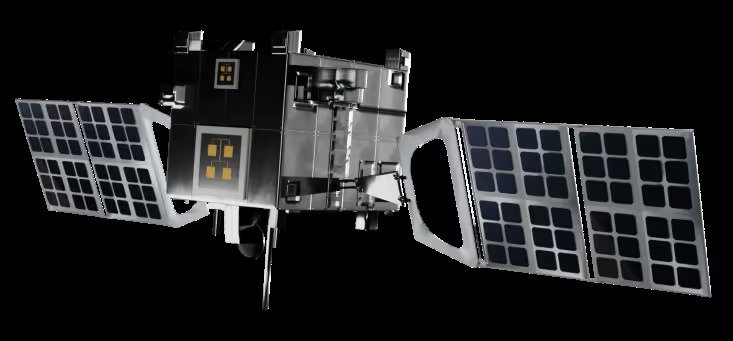
VyomIC was founded in 2023 by Lokesh Kabdal, Vibhor Jain and Anurag Patil, who led Avishkar Hyperloop, IIT Madras’s student hyperloop team that raised $1.25 million and built a 422-metre vacuum test tube, and later ran drone swarm deployments for government users. The company says it was flying those fleets that showed them exactly where satellite navigation gives out — in cluttered streets, under dense canopy, and in signal-contested skies. Its answer is the VyomIC Navigation Satellite System (VNSS), which the company describes as India’s first and largest private positioning, navigation and timing constellation: a planned fleet of 125 to 150 satellites flying at around 1,000 kilometres, each weighing 30 to 50 kilograms with a five-to-seven-year service life.
Closer, stronger, faster
Orbit is the central design choice. A satellite a few hundred kilometres up delivers a far stronger signal than one 20,000 kilometres away, and the company says its signal will be around 100 times stronger than today’s navigation signals — harder to jam, easier to receive indoors, and quick to lock on because the satellites sweep rapidly across the sky. Around that, VyomIC describes atomic clocks, encrypted signals and AI-based processing aimed at 5 cm positioning and 5 nanosecond time synchronisation, even without continuous ground-station access. The company says its signals are designed to be authenticated and encrypted at source, protecting them against spoofing and tampering.
The company has also worked on real-time kinematic positioning engineered for machines moving through cluttered environments rather than surveyors standing still in open fields — the difference between a drone landing on a platform and a person following a map. The customers it names follow directly from that experience: drones, unmanned ground vehicles, mining machinery and urban air mobility, alongside finance, telecommunications, power grids and data centres that need precise timing rather than position. The company positions its constellation as complementary to ISRO’s NavIC, arguing that the applications it targets need accuracy and update rates beyond what any current system offers.
From rooftop trials to orbit
VyomIC raised $1.6 million in a pre-seed round in September 2025 led by Speciale Invest, with BYT Capital and DeVC participating, and the company says the funds are advancing its low Earth orbit positioning, navigation and timing payload, its spaceborne demonstration mission and team hiring. Its phased test programme runs from rooftop payload trials to a four-satellite link test and finally an in-orbit demonstration using ISRO’s PSLV Orbital Experimental Module platform. In August 2026, the founders were among twenty Indian space startups who met the Prime Minister on National Space Day. A constellation built in India, encrypted at source and autonomous in orbit is a sweeping bet — and with IN-SPACe now backing its precision clocks, VyomIC’s quiet timing hardware is becoming part of India’s sovereign navigation story.
More Read

Keep reading: 55 Boxes That Flew India’s GPS Back Into Orbit: Inside Ananth Technologies, Hyderabad’s Quiet Space Giant · Rehearse the Fight on the Ground: Inside Threye, the Delhi Startup Training IAF Mirage 2000 Pilots in Virtual Reality · More Aerospace & Defense stories
Like stories like this? Add Exceptional Technology as a preferred source on Google to see more of our reporting in your search results and Discover feed.







