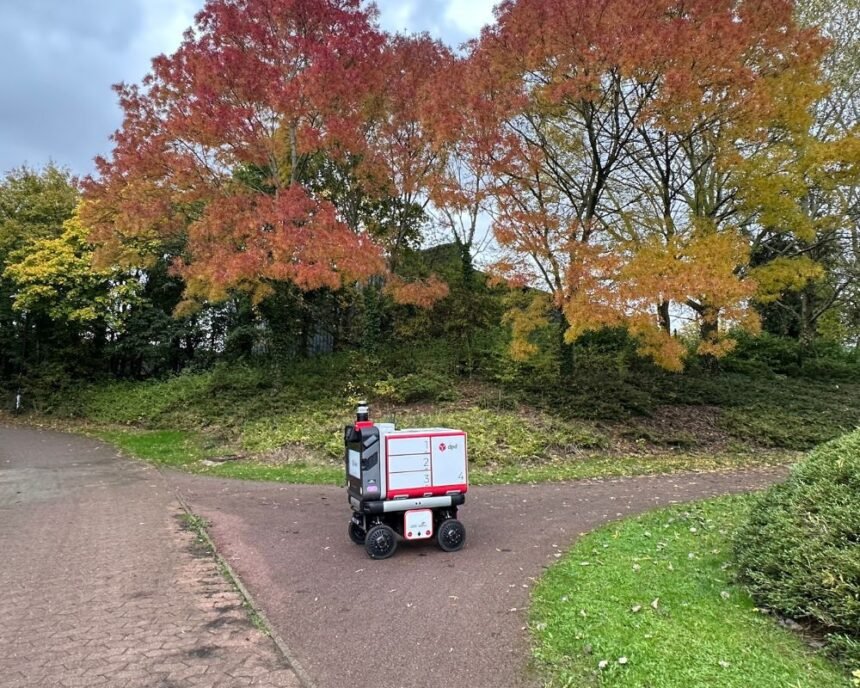
Most delivery robots live where the map is simple: a sidewalk, a kerb, a GPS signal that never drops. The hard part of logistics is not the last mile on the pavement — it is the messy middle between buildings, through elevators and badge-secured doors, across hospital campuses where a blood sample has to travel from the second floor of one wing to the ground floor of another without a nurse walking it there. A startup manufacturing its robots in Noida decided to build for exactly that stretch: one machine that handles the whole journey, indoors and out.
The company is Ottonomy, founded in late 2020 by Ritukar Vijay and Pradyot Korupolu, joined by Vijay’s college mate Hardik Sharma and former colleague Ashish Gupta. The company is headquartered in Sunnyvale, California, but its centre of gravity is Indian: a team of more than 60 people working mostly across Delhi NCR, and a Noida production facility where, the company says, the robots are manufactured from scratch in India. Vijay tells YourStory that roughly 40% of the supply chain is domestic, with components like LiDAR sensors and semiconductors still imported.
The engineering is in making one robot credible in two worlds at once. The Ottobot is designed for Level-4 autonomy with a four-wheel swerve drive the company calls “crab mode” — each wheel steers independently, so the robot can spin in place and weave through tight corridors rather than doing tank-style turns. The cargo rides in modular compartments that can be swapped for different jobs, from secure medical transport to multi-order last-mile drops. Instead of leaning on GPS alone, Ottobots navigate on what the company calls High Information Maps, which let them keep working in areas where satellite signals are unavailable. The behaviour sits on top: Contextual AI, the company’s term for the layer that first identifies what kind of environment it is in — a cancer centre versus a warehouse — and then decides how fast to move, when to yield to a wheelchair, and which routes are appropriate.
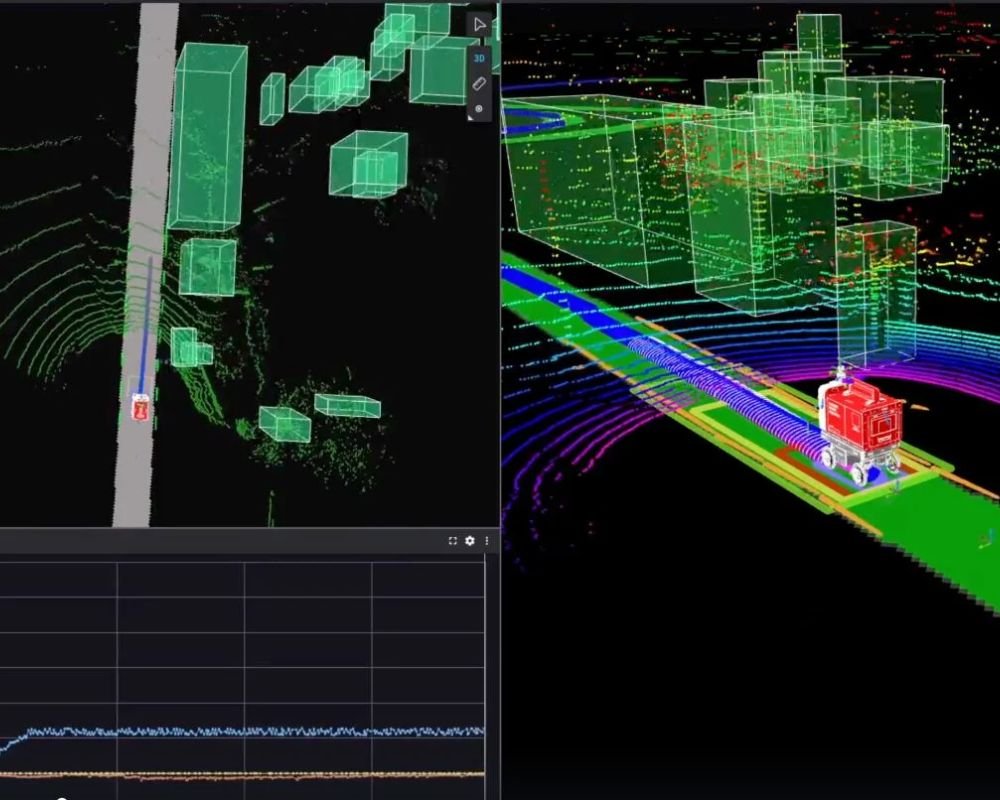
At CES in January 2025 the company pushed that perception layer further with Contextual AI 2.0, which runs vision-language models on Ambarella’s N1 edge-AI system-on-chip — putting multi-modal AI reasoning directly on the robot instead of in the cloud. The same year, Ottonomy unveiled Ottumn.AI, its orchestration platform for managing mixed fleets of robots, drones and smart infrastructure (elevators, access doors) under one system, built to the VDA5050 interoperability standard and demonstrated at the India AI Impact Summit 2026. It is a bet on what Vijay calls Physical AI: intelligence embedded in machines that do physical work in human-centric environments, rather than intelligence demonstrated in a controlled lab.
The deployment record is what separates this from a demo video. Ottobots are moving blood samples and vaccines between buildings at Wellstar Kennestone Hospital in the United States with a full chain of custody; Sodexo is running them at sites including a remote mining village in Australia; DPD is deploying Ottobot locker robots in Milton Keynes in the UK; and airports — Cincinnati/Northern Kentucky, Rome Fiumicino, with pilots at Pittsburgh and Munich — have tested them in terminals. In India, Ottonomy has partnered with drone-logistics company Skye Air Mobility for multi-modal last-mile delivery and signed up for a pilot at Hyderabad airport. Customers take the robots on a Robots-as-a-Service subscription, and the company reports 15 customers across healthcare, industrial campuses, airports and last-mile logistics.
The company’s numbers: a fleet of about 50 robots, orders for 500 more, a 2026 revenue target of around $5 million of which roughly 60% was secured from signed contracts, per Inc42. The patent portfolio is harder to wave away — 24 patents granted from 29 filings covering robotics, autonomy and system design — and the third-party signals are real: an RBR50 Robotics Innovation Award in 2023, and a win in the Accenture Tech Next Challenge 2026 in the Supply Chain and Engineering category. Around $8 million has been raised over six years from investors including pi Ventures, CoreNest, Connetic Ventures, Wellstar Catalyst and ADR Ventures.
More Read
Ottonomy’s founder started building autonomous driving software for unmanned vehicles in India back in 2007; the founding team built its first Ottonomy prototype in an Indian guest house during the pandemic, testing it in a basement. Six years on, the bet is that the unglamorous journey — picking up the specimen on level two, riding the elevator down, crossing the campus, and handing it to the lab — is where autonomous robots earn their keep first. If the company is right, Made-in-India robots will be doing that job in hospitals and campuses on four continents.