Dust is the silent tax on Indian solar power. In the country’s arid and agricultural belts, a film of dust, pollen and crop residue can settle on solar modules within days, dragging generation down by double-digit percentages long before manual crews can cover every row. The conventional fix — tankers of water, labour crews and inconsistent brush strokes — fights for the same scarce water farmers need, and irregular wet cleaning can leave mineral residue that accelerates panel wear. Pune-based Taypro has spent years engineering a different answer: fleets of autonomous robots that clean gigawatts of solar panels with no water at all.
Taypro Pvt Ltd, the Indian cleantech company led by co-founder and CEO Yogesh Kudale, calls itself a field-executed intelligence platform rather than a hardware vendor. Its robots — the GLYDE, GLYDE-X, NYUMA, NYUMA-X and HELYX family — run on a patented dual-pass cleaning method tuned for dry climates. Pass one is non-contact: controlled airflow lifts loose dust without dragging grit across the glass. Pass two follows with an ultra-soft microfiber wipe that removes the adhered residue single-pass systems leave behind. Separating dust-lift from contact wipe delivers higher cleaning quality with lower abrasive wear, and the company says the GLYDE platform removes over 99% of dust per automated cycle.
Hardware built for Indian duty cycles
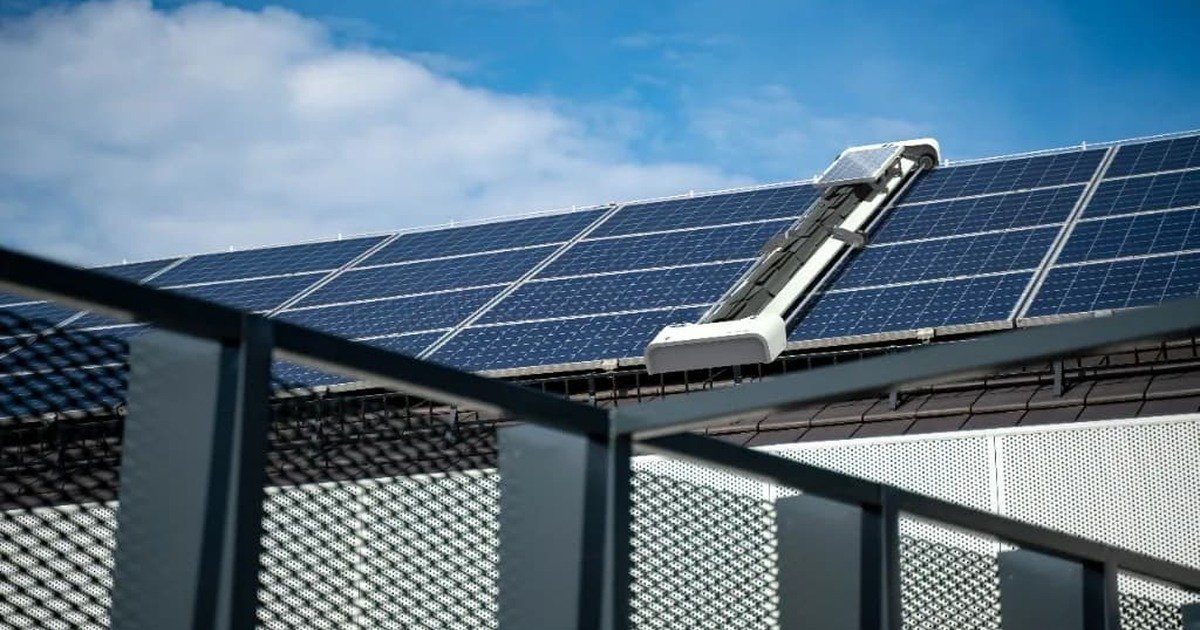
The engineering detail is where Taypro shines. Single-axis tracker plants, whose tables are never perfectly aligned thanks to wind loading and foundation settling, are served by the GLYDE-X and NYUMA-X, which carry a patented 360° articulating flexible bridge: the robot autonomously transfers between tracker tables — even misaligned ones — without any fixed bridge civil work at crossing points. At 26 kg, the tracker platforms impose far less structural load than heavier 40 kg-class machines, a point the company stresses for aging Indian plants where structural margin matters. The robot navigates with edge, obstacle and angle detection, cleans up to 3,600 modules (about 2.2 km) on a single charge, and returns to a shadow-free docking station that locks in wind-safe up to 180 km/h.
Fixed-tilt sites get the fully autonomous GLYDE family with continuous self-alignment that holds the robot on-row across undulated terrain — the reality of many Indian utility blocks in Himachal Pradesh, Maharashtra and Karnataka — while the semi-automatic HELYX covers scattered and distributed blocks on a pick-and-place model. Every platform is self-powered through onboard solar charging, and the company’s manufacturing and technology stack in Chakan, Pune, supports production of over 500 robots a month.
A fleet that learns every time it cleans
What elevates Taypro from robot-maker to infrastructure company is NECTYR, its fleet intelligence platform. Each of the 11 billion-plus annual panel passes across more than 5 GW of daily-cleaned assets — spanning 150-plus live plant installations in deserts, agricultural belts and coastal zones — generates labelled telemetry on soiling rate, weather correlation, battery consumption and fault signatures. Self-learning models refine soiling prediction, battery-aware routing in cloudy conditions, and weather-gated scheduling the company says reaches 95% accuracy, autonomously tightening cadence after dust events and standing down when rain or wet-element detection makes cleaning pointless.
NECTYR also builds a health profile for every robot — motor current, battery curves, brush torque, sensor signals — and flags deviation signatures that precede bearing wear or brush end-of-life before a breakdown happens. Operators see live robot position on the plant layout with root-cause fault classification, so field teams dispatch with the right spares instead of exploratory truck rolls.
More Read

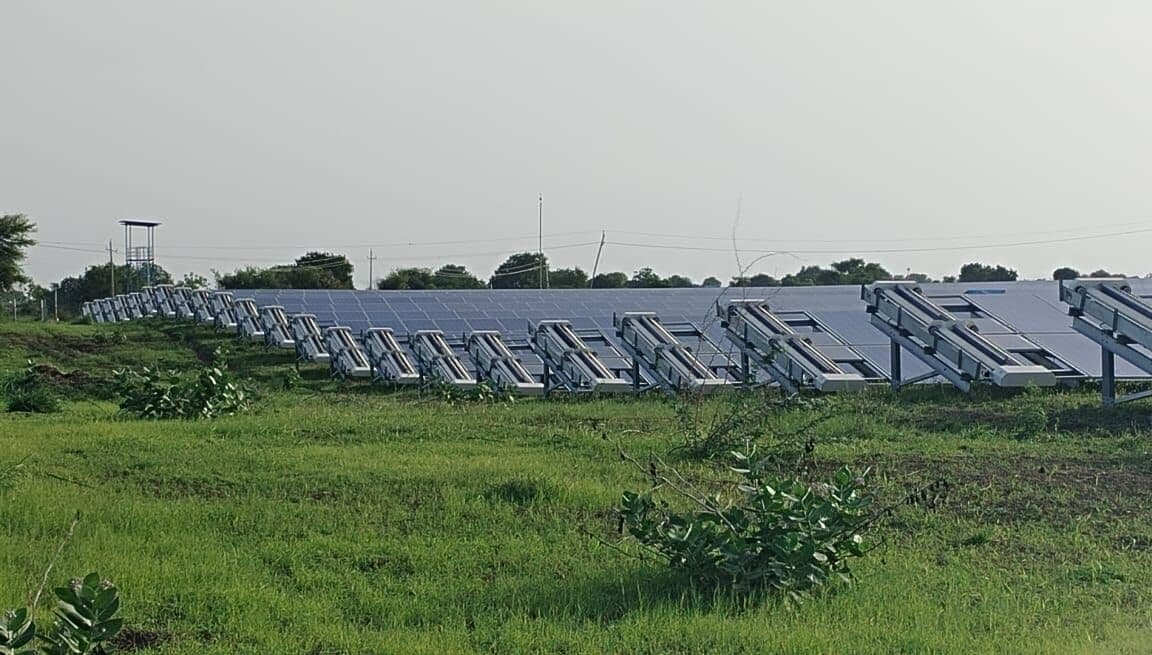
The payoff is measured in water the company says stays in the ground: more than 700 million litres saved annually across its deployments, with customers offered either outright CAPEX purchase with AMC or an Opex pay-per-panel-cleaned model. The company’s platforms are TÜV NORD validated and carry a 25-year product warranty tied to annual AMC renewal. With strong deployments in Rajasthan, Gujarat and Karnataka, Taypro is now expanding into the Middle East and Southeast Asia, regions facing the same high-dust, water-stressed conditions — and it has set itself a target of 100 GW of robotic cleaning deployment by 2030.
Keep reading: India’s First Mass-Scale LFP Cell: Inside NASH Energy’s 600 MWh Bengaluru Plant · Fuel From the Barber’s Floor: Inside Techofest Global, the Gujarat Startup Turning Human Hair Into Bioethanol · More Energy & Power stories
Like stories like this? Add Exceptional Technology as a preferred source on Google to see more of our reporting in your search results and Discover feed.