Every coconut season, the same quiet crisis plays out across Kerala’s groves. The palms are heavy with fruit, but the climbers who once scaled them are disappearing. Climbing a 20-metre coconut tree with rope and skill is dangerous, exhausting work, and younger workers are walking away from it. In Kozhikode, a young engineer looked out of his window at the coconut trees near his home and asked a beautifully simple question: what if a robot could climb the tree instead?
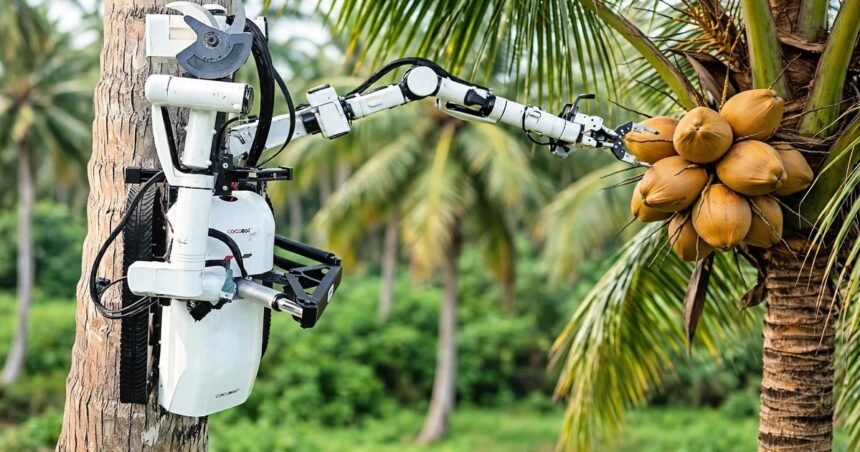
The answer is Cocobot, a compact tree-climbing robot built by Altersage Innovations, a Kozhikode startup founded by Ashin P Krishna. The machine clamps onto a coconut trunk, climbs it in under a minute, and cuts down ripe nuts while its operator stays safely on the ground, guiding it from a compact remote console. It is a small machine solving a very large problem — and it is already being demonstrated to farmers across the coconut belt.
Altersage’s story begins in 2020, when Ashin, then a polytechnic student, sketched the idea of a tree-climbing robot. He built his first prototype in 2021, and by January 2024 Cocobot had successfully scaled a tree. The project gathered support from Kerala’s innovation ecosystem along the way: funding and incubation from the Kerala Startup Mission and its Maker Village in Kalamassery, IIM Kozhikode, the Kerala Agriculture University’s Raftaar agri-business incubator, and NABARD, along with the Vadakara Coconut Producers Company. In 2023 the prototype won first prize at Vaiga, the Kerala government’s 36-hour agri hackathon. Altersage Innovations was formally founded in August 2024, with Gokul Krishnan as chief technology officer and Alosh Denny leading artificial intelligence.
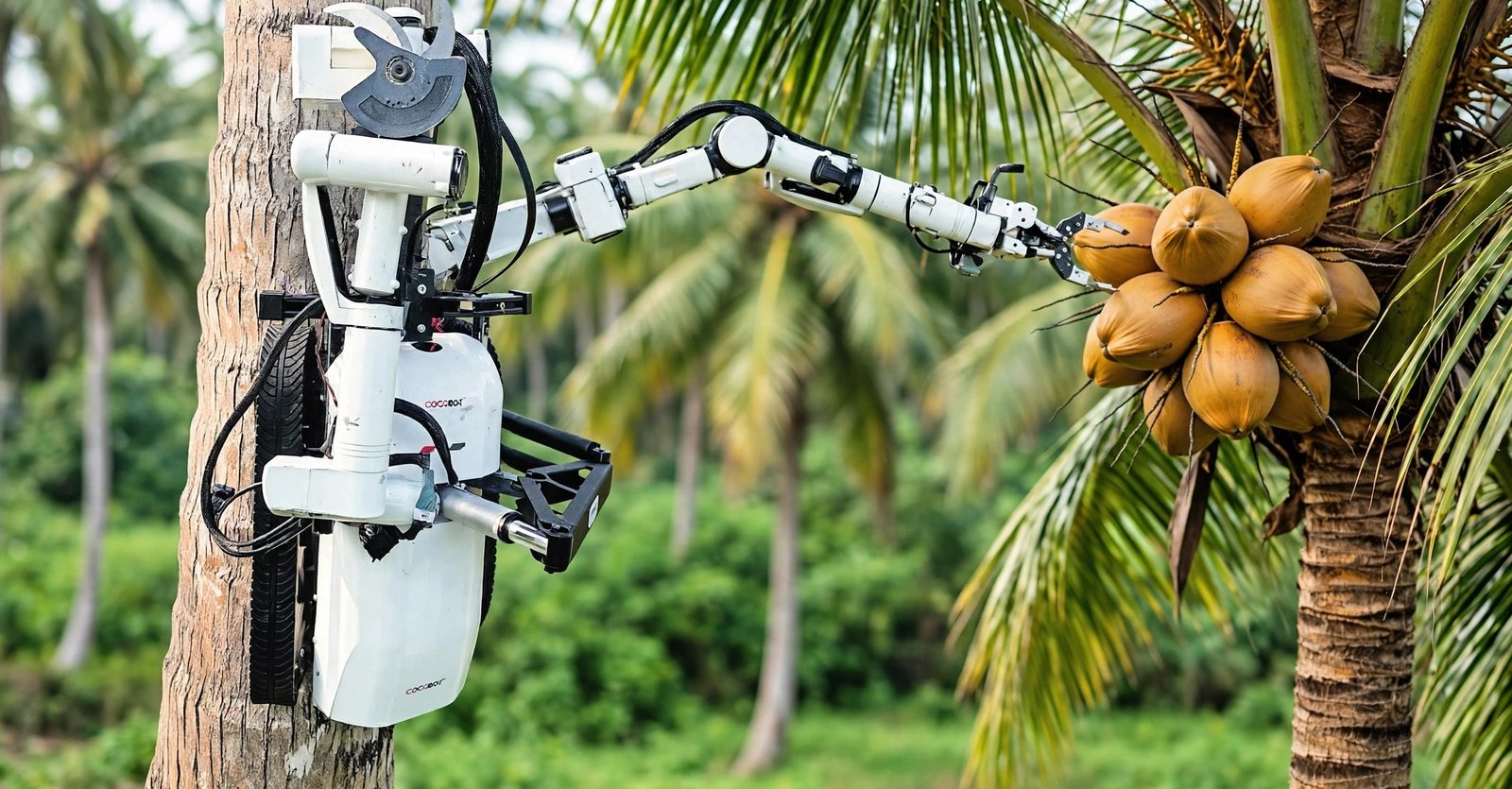
The second-generation Cocobot, unveiled in February 2026, weighs just 11 kg — light enough for one person to carry to the tree. It attaches in only five seconds, using a locking system that adapts to the shape of each individual trunk, with no nuts, bolts, belts or chains. Flip a switch and the robot climbs a 20-metre palm in under a minute. Once at the crown, its joystick-controlled robotic arms cut down ripe coconuts and leaf stalks, finishing a tree in about five minutes. A camera on the machine feeds the console screen, so the operator can spot the mature nuts — and the arms can even make a small incision in a husk to check ripeness before cutting. Powered by rechargeable batteries, Cocobot runs for about two hours on a full charge, and its locking system is designed to hold it safely in place even if it stops mid-climb.
The intelligence inside Cocobot is what sets it apart from earlier climbing machines. The company says the robot is trained on datasets of coconut clusters, so its vision system can identify mature nuts and harvest selectively rather than stripping a tree bare. Today the machine is semi-automatic, with one operator guiding it — where traditional harvesting typically needs three or more skilled climbers. The next generation, now in the final stages of development, is designed to be fully automatic: climbing, detecting ripe nuts and harvesting entirely on its own, driven by artificial intelligence.
More Read
The need for such a machine is hard to overstate. According to figures cited from the Coconut Development Board, of nearly 33,000 climbers trained over 12 years, only 673 remain active. Harvesting costs have climbed with the shortage: in Goa, farmers pay around ₹100 per tree for small jobs, and ₹2,200 plus ten coconuts for a full day’s work on 30 trees. Cocobot’s pitch is that one trained operator, working safely from the ground, can cover far more trees in a day than a climbing crew — and open up harvesting work to people who could never climb a palm themselves, including women and differently-abled operators.
That promise is already being tested in the field. In October 2026, Cocobot was demonstrated at the Krishi Vigyan Kendra in Margao, Goa, where officials said a proposal would be sent to the state government to include the robot in agriculture department subsidy schemes so it can reach farmers at supported rates. Goa’s coconut economy makes the stakes clear: Salcete taluka alone has 6,192 hectares under coconut, producing 164 million nuts in 2025-26. The company says inquiries have also come in from Indonesia, Sri Lanka and the Philippines, and Marico, the maker of Parachute coconut oil, has shown interest in the machine.
Altersage is building Cocobot as a platform, not a one-off gadget. The team is working on two ways for farmers to use it: a per-tree service model, run through a mobile app, in which trained entrepreneurs in each panchayat arrive with the robot and harvest for local farmers — a model the company says could create two to three entrepreneurs per panchayat — and outright purchase for large farmers and agro-companies, with the company saying the investment can be recouped within two years. The company has previously aimed for a market price under ₹1 lakh, and says operators could earn ₹18,000 to ₹20,000 a month from harvesting work. Beyond coconut, the same climbing platform is being adapted for tender coconuts and for spraying, and an ArecaBot for arecanut harvesting is under consideration.
From a balcony idea in Kozhikode to demonstrations in Goa and interest from across Asia, Cocobot is a reminder of what Indian engineering does best: taking a problem that touches millions of ordinary lives and answering it with a machine that is clever, compact and built for the field. The coconut palm has stood in India’s groves for centuries, harvested by hand at real risk to the climber. With Cocobot, the climb is becoming the robot’s job — and the harvest, safer and steadier, for everyone.
Keep reading: The Little Tractor That Beat the World’s Farm Robots: Inside FarmRobo’s iMog, the Autonomous Robot for Small Farms · From Notebook to Network: Inside KhetiBuddy, the Pune Company Digitising India’s Farms Acre by Acre · More Food Processing & Agri-Tech stories
Like stories like this? Add Exceptional Technology as a preferred source on Google to see more of our reporting in your search results and Discover feed.