Most satellite missions start with years of bespoke engineering. XDLINX Space Labs, a Hyderabad startup founded in 2022, starts from the opposite idea: a ready-to-launch satellite platform that a customer can configure for almost any mission, from Earth observation to defence intelligence, without having to master rocket science. The company calls it Mission-as-a-Service — it handles design, supply chain, build, integration, qualification and operations, and the customer gets a spacecraft ready to fly.
The idea proved itself fast. XDLINX’s first satellite, JANUS-1, was a software-defined 6U nanosatellite designed and developed in just 10 months and launched aboard ISRO’s SSLV-D2 rocket on 10 February 2023. JANUS-1 demonstrated multi-tenancy payload capabilities — one small satellite hosting more than one payload — and showed that a compact, configurable spacecraft could reach orbit on a fraction of the traditional cost and timeline. The company says its platforms use 75% indigenous subsystems and cost far less than traditional satellites.
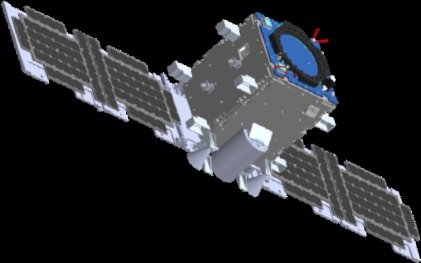 An XDLINX satellite platform render. (Image: XDLINX Space Labs)
The platform at the heart of the company’s story today is the XDSAT M600, a micro-satellite platform for missions up to the 300 kg class. In May 2026, XDLINX announced that the M600 had achieved successful in-orbit qualification after flying as part of GalaxEye’s Mission Drishti, launched on 3 May 2026 aboard a SpaceX Falcon 9. In-orbit qualification is the moment a platform graduates from promising hardware to space-proven hardware: the design, avionics, power, communications, attitude control and propulsion have all now performed in the real space environment. The company says the M600 is indigenously designed, engineered, developed, integrated and delivered in India, and is built for Earth observation, defence, maritime intelligence, climate monitoring and communications missions.
That qualification unlocked the next stage of the company’s ambition. XDLINX now offers five satellite bus platforms spanning 10 kg to 300 kg, covering most low-Earth-orbit mission needs, and says it is under contract to deliver a sovereign constellation of 15 satellites over the next two years. It also says more than 20 satellite missions are planned across the next two years.
The payloads riding on those buses are where the company is pushing hardest. Elevation-1, its next major project, carries a miniaturised space-grade E-band payload for high-speed communications — the company describes it as the world’s first E-band payload in orbit, with a roadmap to data rates beyond 10 Gbps. A 190 kg-class satellite carrying multispectral optical and synthetic aperture radar sensors together is slated for a SpaceX Transporter flight, and the company is also preparing a largely self-funded imaging satellite for launch aboard ISRO’s SSLV, to prove its software-defined platform without waiting for an external customer.
More Read

Back on the ground, XDLINX has been building the infrastructure to match its flight rate. In May 2026 it inaugurated an Advanced Space Systems Integration and Testing Lab in Hyderabad in the presence of ISRO leadership, giving it in-house capacity to integrate and qualify satellites for high-reliability missions. In December 2025 it signed an agreement with the GMR Group to establish a satellite research and development facility at GMR Aerospace Park in Hyderabad. It has also partnered with Sisir Radar to build India’s first private L-band SAR satellite, targeted for launch by 2027, and signed an agreement with Japan’s BULL Co. to advance sustainable space operations.
The work has drawn serious backing. XDLINX raised $7 million in a seed round led by Ashish Kacholia of Lucky Investments, with participation from E2MC, Mana Ventures and a family office, to accelerate next-generation payloads for defence and commercial missions and expand its presence in the US and UK.
What XDLINX is really selling is speed to orbit. A customer with an imaging idea, a communications need or an intelligence requirement no longer has to build a satellite programme from scratch — it can pick a proven Indian platform, fit its payload, and fly. With a space-qualified bus, a sovereign constellation under contract and a pipeline of missions ahead, the Hyderabad startup is turning satellite manufacturing into something India can order off the shelf.
Keep reading: Mules to Machines: Inside BonV Aero, the Odisha Startup Flying Cargo to 16,500 Feet · Chandrayaan Live: India’s Journey to the Moon — and What’s Next · More Aerospace & Defense stories
Like stories like this? Add Exceptional Technology as a preferred source on Google to see more of our reporting in your search results and Discover feed.