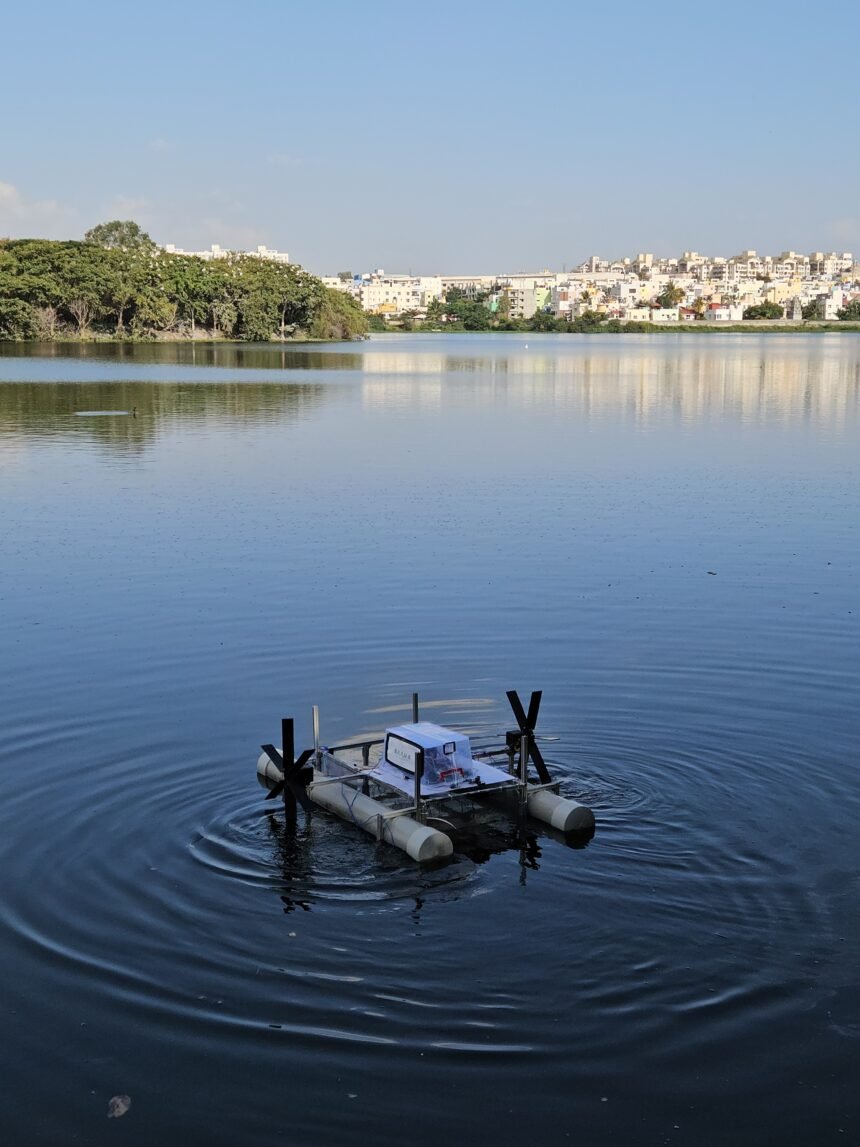
On a Bengaluru morning, a small twin-hulled boat glides across Madiwala Lake with nobody at the helm. It follows a route its operators marked on a digital map, scoops up the plastic bottles, leaves and floating waste in its path, and keeps going for hours — no nets, no hands in the water, nobody steering. The boat is SCRUB 2.0, built by a team of engineering students from the city’s R.V. College of Engineering, and it is their answer to a problem every Bengaluru resident knows: the city’s lakes get cleaned, and then they fill up with waste all over again.
Today, that cleaning is still mostly manual. Workers go out with nets and boats, and sometimes bare hands, to pull floating waste off the water. Machines exist that can help, but they still need a person to operate them. The SCRUB team, led by Krishna Purwar, decided to take the person out of the boat entirely — and to make lake cleaning something that can run on its own, day after day, instead of as a one-off drive.
The result is a small fleet of robots, each built for a different job on the water. The surface cleaner, SCRUB V1, is a twin-hull platform with a conveyor collection system for floating waste and aquatic vegetation. It is solar-assisted, runs in dual-mode control, and has been tested in real lake conditions. Its sibling, SCRUB V2, takes a simpler approach: a passive-intake prototype whose forward motion guides waste into its intake, with fewer moving collection parts and a compact, transportable design.
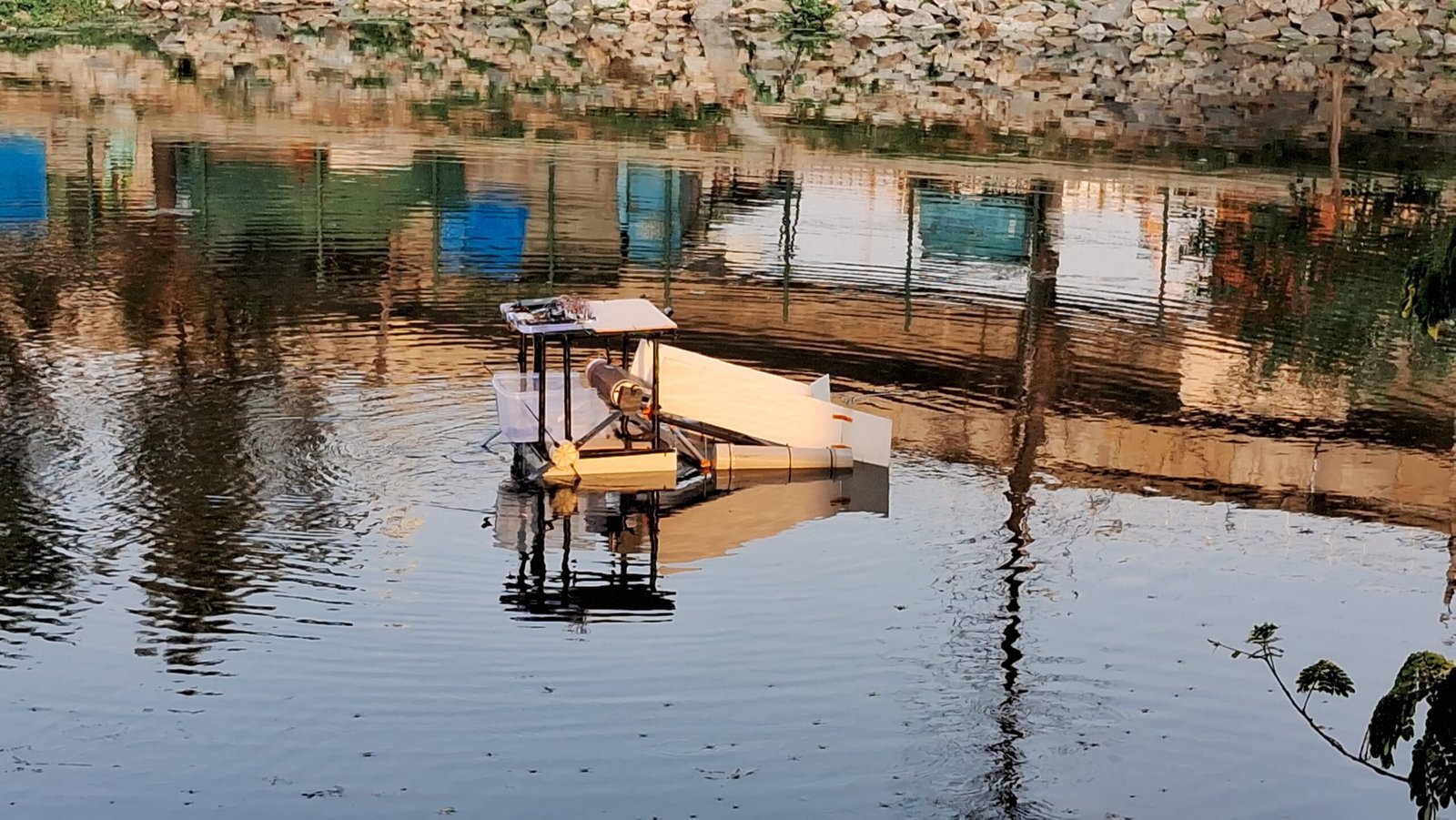 SCRUB’s V1 surface cleaner on a lake trial. (Image: SCRUB Robotics)
What makes the boats different from a remote-controlled cleaner is the autonomy. Operators mark locations on a digital map, and the boat uses GPS-guided navigation to travel from point to point on its own. The team says its latest prototype can collect up to 25 kilograms of floating waste on a single trip, with a range of 500 metres and a runtime of up to five hours. AI-based vision helps it spot floating waste as it moves, so it works through a stretch of water methodically rather than drifting.
Then there is the part of the problem you cannot see from the bank. SCRUB V4 is the team’s water analyst: a dedicated water-analytics platform that measures indicators like pH, dissolved solids and turbidity, tags every reading with GPS coordinates, and feeds them into the team’s SCRUB Observatory software, which maps water quality across a lake instead of relying on a single sample. A lake can look clean in a photograph and still be in trouble, and the team built V4 to give lake managers the numbers behind the picture.
More Read
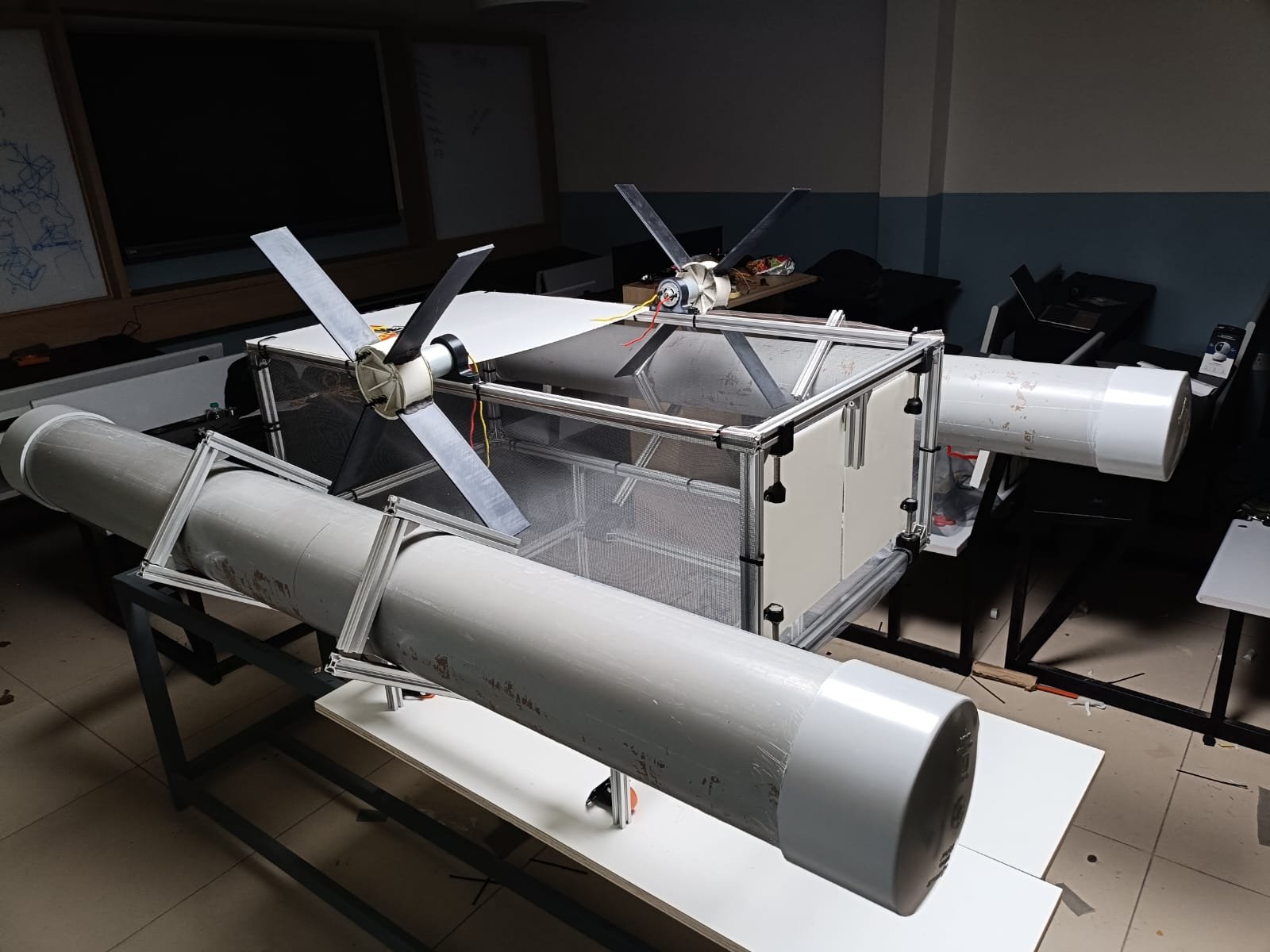 SCRUB’s V2 passive-intake prototype. (Image: SCRUB Robotics)
The robots have already proved themselves on real water. The team validated its early prototypes at Kengeri Lake in coordination with Bengaluru’s municipal body, and ran its most recent on-water trials at Madiwala Lake in September 2026, collecting spatial water-quality data as the boats worked. The team has also published a patent application for its integrated system, and is now opening conversations with municipalities, campuses, lake trusts and CSR programmes for site-specific pilots and managed deployments.
A river interceptor concept, SCRUB V3, is next in development: a floating-boom design that would guide river and canal debris towards shore-based collection, taking the same idea from still lakes to flowing water.
What the team is building is not a single machine but a way of looking after urban water that keeps going after the cameras leave. Cleaner lakes need cleaning that repeats — and a small robot that quietly does the rounds, trip after trip, is a practical way to make that happen.
Keep reading: Where Divers Can’t Go: Inside Planys, the Chennai Startup Sending Robots Beneath the Waves · Beneath the Surface: Inside Vikra Ocean Tech, the Chennai Startup Building India’s Own Ocean Robots · More Shipbuilding & Maritime stories
Like stories like this? Add Exceptional Technology as a preferred source on Google to see more of our reporting in your search results and Discover feed.