Picture a factory robot that finds its way the way you do — not by following a laser-scanned map, but by looking around, recognising a doorway here and a lift shaft there, and heading for the spot you pointed at in a photograph. That is exactly what a robot did on a factory floor in October 2026, in a demonstration by Bengaluru’s Ati Robotics and the Robotics Research Center at IIIT Hyderabad. No LiDAR, no dense 3D map — just a camera, a set of walkthrough images, and AI smart enough to turn pictures into a route.
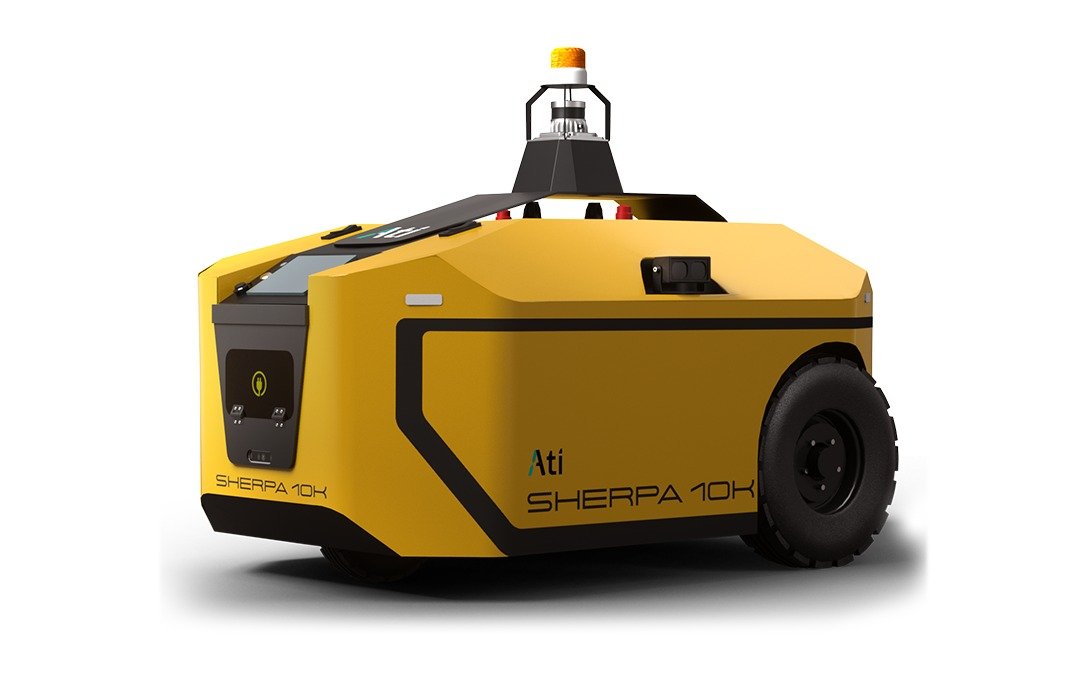 Ati’s Sherpa 10K autonomous mobile robot. (Image: Ati Robotics)
Navigating the way people do
Most factory robots today navigate with LiDAR, bouncing laser pulses off their surroundings to build a precise map, then localising themselves inside it with a technique called SLAM. The IIIT Hyderabad team asked a different question: could a robot navigate from what it sees, the way a person navigates a familiar building? In the demonstration, reported by The Times of India and the Deccan Chronicle, an autonomous mobile robot travelled to a designated object on Ati’s factory floor using images captured during an earlier walkthrough, a 3D AI model that worked out the layout from pairs of images, and vision-language models that let it interpret what it was seeing.
The trick is to throw away most of the map. Instead of measuring every surface, the system represents a space through a small set of landmarks — what Professor Madhava Krishna of the Robotics Research Center describes as scenes like “next to the door” or “opposite the elevator”. An operator can even set a destination by pointing at a pixel in an image, rather than typing in coordinates, and the system matches what the camera sees to that spot, estimates the spatial relationships, and plots a route. Because the robot reasons about landmarks and images rather than fixed coordinates, it can adjust its plan on the fly, predict obstacles, and keep moving when a factory floor changes around it — which, on a real production floor, it constantly does.
Three years from lab to factory floor
This was not a one-week experiment. The collaboration between IIIT Hyderabad and Ati began in 2023, and the research behind it has been presented at leading international forums including the IEEE International Conference on Robotics and Automation, NeurIPS, and the Conference on Robot Learning, according to Professor Sourav Garg of the centre. The October demonstration moved that work out of the laboratory and onto a working factory floor — the moment a research idea becomes an industrial capability.
The team has now transferred the code to Ati Robotics to deploy in warehouse environments, where the company says its focus is the “last two metres” of robot movement: docking precisely, approaching pallets, and threading narrow bays. That is the unglamorous, exacting work that decides whether automation actually saves time on a shift — and it is where a robot that understands a scene, rather than just a map, earns its keep.
More Read
The robots already doing the rounds
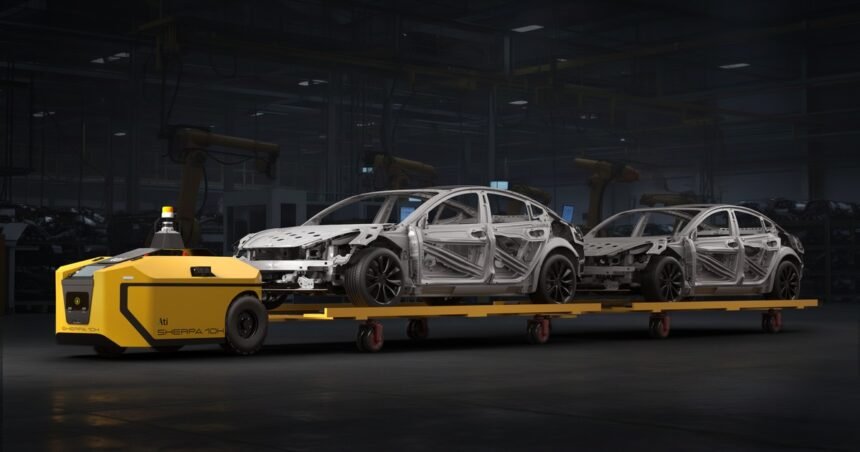
Ati Robotics — formerly Ati Motors — is no newcomer to factory floors. Founded in Bengaluru in 2017 by Saurabh Chandra, the company builds the Sherpa family of autonomous mobile robots: tugs, bin movers, pallet movers, and lifting platforms, all designed and engineered in-house, from the electric drivetrain to the autonomy stack. The company says its flagship Sherpa Tug has logged more than 500,000 kilometres across more than 50 factories, and that hundreds of Sherpa robots now work across 40 manufacturers, including Airbus, CEAT, Forvia, Hyundai, Samsung, and TVS Motor. A $20 million Series B round in January 2025, co-led by Walden Catalyst Ventures and NGP Capital, took its total funding past $37 million and is funding expansion in North America and Asia.
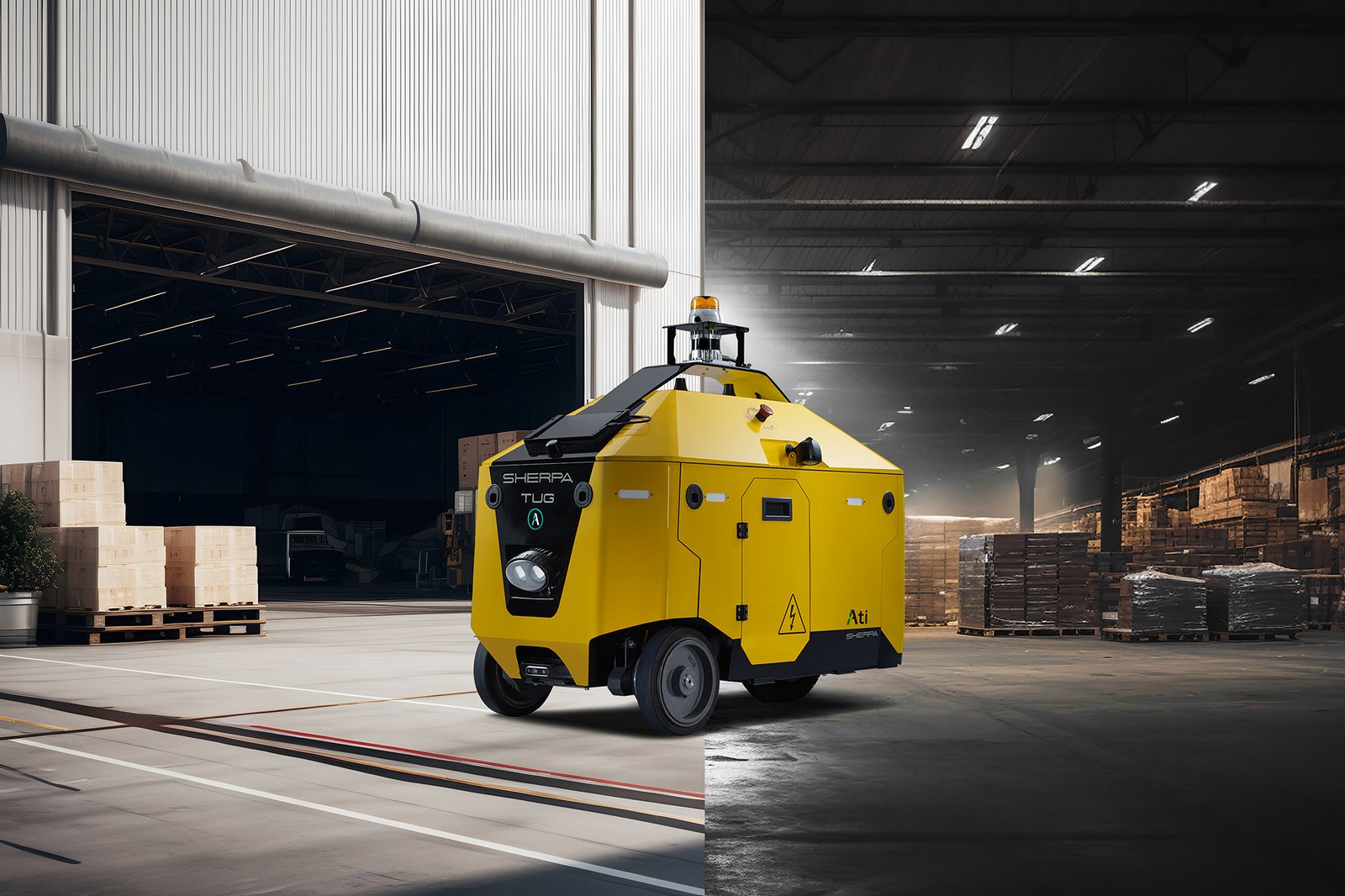 The Sherpa Tug, built to move between indoor and outdoor work. (Image: Ati Robotics)
The newest member of the family shows where the platform is headed. The Sherpa Mecha, launched in 2025, is a wheeled, dual-arm mobile manipulator — 19 degrees of freedom across two carbon-fibre arms, a 900 mm reach, and a 12 kg payload — built to tend machines, handle bins, and inspect parts alongside human operators. It rides on the same field-proven Sherpa base as the tugs, which is exactly why the LiDAR-free navigation work matters: every smarter way of moving makes every machine in the family more capable.
Why cameras change the economics
LiDAR is powerful, but it is also expensive, complex, and hungry for maps that must be rebuilt whenever a line moves. A camera-based system that navigates from landmarks and walkthrough images promises something factory managers will love: robots that drop into an existing floor, learn it the way a new worker would, and keep working when the layout shifts — no re-surveying, no infrastructure overhaul, no waiting for a fresh map. For India’s manufacturers, who run some of the world’s most dynamic and space-constrained shop floors, that flexibility is worth as much as the hardware itself.
That is the larger story behind one quiet factory-floor demonstration: Indian engineers are not just building robots, they are teaching them to perceive the world more like we do. From a Bengaluru startup and a Hyderabad research lab comes a navigation idea that could make autonomous factories cheaper, more adaptable, and easier to run — and put India at the front of a genuinely different way of moving machines through the world.
Keep reading: From Bihar to SEMICON: Inside Swadeza, the Startup Teaching AI to Verify India’s Chips · At the Speed of Light: Inside LightSpeed Photonics, the Hyderabad Startup Replacing Copper With Light in AI Data Centres · More Industrial Automation & Technology stories
Like stories like this? Add Exceptional Technology as a preferred source on Google to see more of our reporting in your search results and Discover feed.