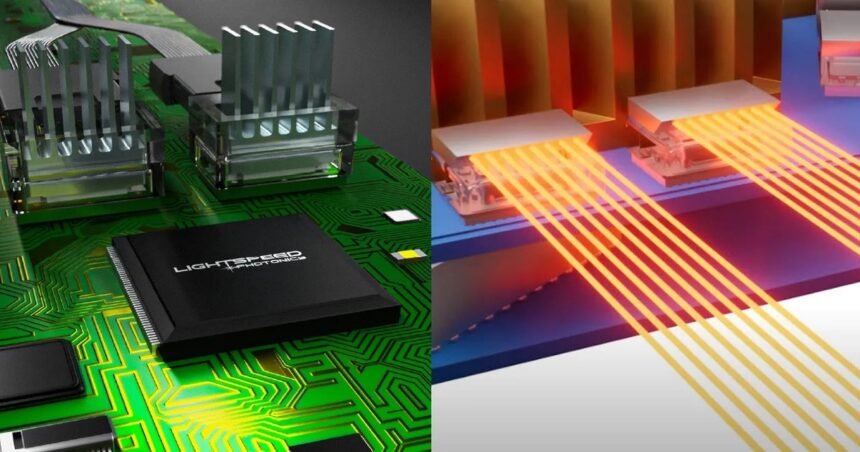
Inside every AI data centre, the hardest problem is no longer just computing — it is moving data. A single AI query may look like a few lines of text, but behind it, processors exchange enormous volumes of information with each other, and the copper wires and bulky transceivers that used to carry that traffic are running out of room, speed and power headroom. A Hyderabad-founded company has spent years building a different answer: carry the data on light, right next to the chip, in a component small enough to be soldered onto a board like any other electronic part.
The company is LightSpeed Photonics, founded in 2021 by Dr Rohin Y and Ramana Pamidighantam, with operations in Hyderabad and Singapore. Its flagship is a solderable optical interconnect — a fingernail-sized, near-packaged optics component that the company says transfers data at 400 gigabits per second while drawing about 2 watts, all inside a compact 9 mm × 9 mm footprint. Inside that tiny package sit lasers that turn electrical signals into light, photodetectors that turn light back into electricity, and the microcontrollers, driver ICs and transimpedance amplifiers that keep the whole system working as one.
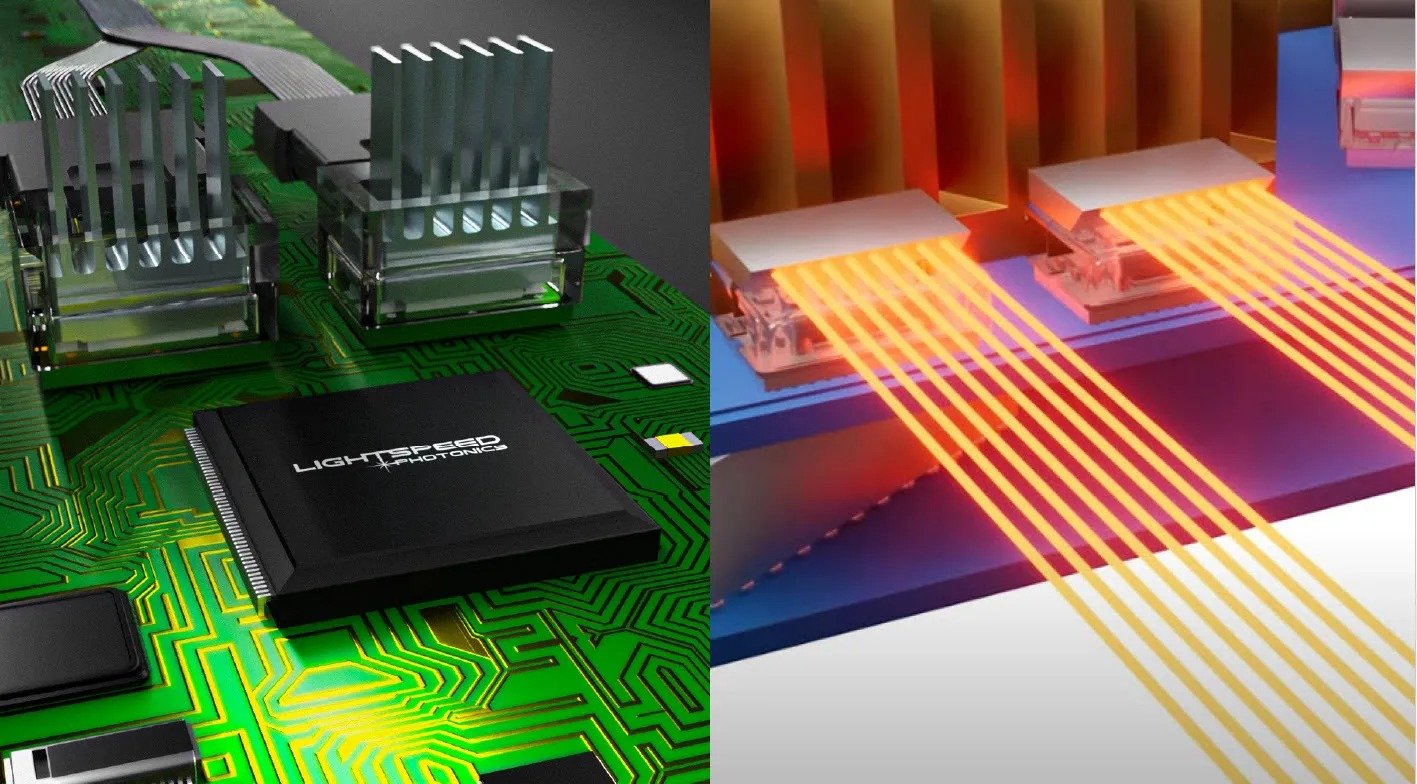
What makes the design stand out is not just its size, but how ordinary it is to manufacture. Conventional pluggable transceivers sit at the edge of a server, far from the processor, and as data rates climb, electrical signals weaken over that distance, forcing in extra retimers and signal-processing chips just to recover them. LightSpeed’s component is soldered at board level — the fibre simply clips on — and, crucially, it is built to withstand the surface-reflow temperatures used in standard electronics assembly. The company says that reflow tolerance, achieved by bringing together polymer optics, high-frequency substrates, silicon germanium and III-V materials through heterogeneous integration, is its core intellectual property, built up over years of interdisciplinary engineering.
The payoff, the company says, is dramatic: its 400-gigabit interconnect is 20 times smaller than a conventional pluggable transceiver, consumes five times less power, and delivers up to four times lower latency. That power story matters enormously at data-centre scale. Networking, the company notes, has grown from around 10% of a data centre’s energy use to nearly 25%, and is headed towards 40% as AI clusters densify. In one illustration shared by founder and CEO Rohin Y, the pluggable optics on a 51.2-terabit switch can draw about one and a half kilowatts — a figure the company says its technology can bring down to around 250 watts.
LightSpeed’s interconnect is also deliberately easy to adopt. Unlike co-packaged optics that are integrated directly into a processor package, this is a near-packaged, board-level part that slots into existing architectures without a costly system redesign. It is protocol-agnostic, supporting Ethernet, PCIe and Compute Express Link, and the company is demonstrating PCIe-over-fibre technology supporting PCIe 5.0 and PCIe 6.0 — a route to physically separating compute, memory and storage while keeping them talking over PCIe, so future data centres can be built as disaggregated pools of resources rather than fixed servers. At the 2026 Optical Fiber Communications Conference in Los Angeles, the company demonstrated exactly that: a CPU and a GPU connected through 50 metres of optical fibre, functioning together as a distributed system.
More Read

The road to this point took five to six years of deep engineering. With advanced photonics packaging capability still developing in India, LightSpeed refined its early prototypes with collaborators in Singapore and elsewhere in Asia, while training its own specialised team from scratch. The work earned an early spotlight at the 2023 VLSI Design Conference startup forum in Hyderabad, where LightSpeed shared first place. The company has raised about $8.5 million including grants, including a $6.5 million pre-Series A round led by pi Ventures, and says it is now running pilot engagements with OEMs and system builders, with production scale-up to follow and an India photonics packaging pilot line planned. Its roadmap already points to the same form factor reaching 800 gigabits per second.
“Our mission is to break through the data bottlenecks that limit the scale of AI and advanced computing,” says Rohin Y. As AI models grow larger and data centres grow denser, the company that lets light do the talking, right where the computing happens, could quietly become one of the most important pieces of India’s AI infrastructure story.
Keep reading: From a Hyderabad Lab to the World’s 6G Standard: Inside WiSig Networks, the Startup Building India’s Own 5G · Speak to India in India’s Own Languages: Inside CoRover’s BharatGPT, the Homegrown AI Joining the Government’s AIKosh Platform · More Industrial Automation & Technology stories
Like stories like this? Add Exceptional Technology as a preferred source on Google to see more of our reporting in your search results and Discover feed.