Picture a science experiment rising gently into the sky — no roaring engine, no launch tower, no countdown. Just a giant balloon, lifting a small box of cameras, sensors and student-built instruments higher and higher, until the sky turns black, the Earth curves below, and the clouds look like a sea. Then, hours later, that same little box floats back down, is tracked, recovered, and handed back with its data intact. That is the quiet, beautiful idea at the heart of Aerolaunch India, a Chennai company making near-space access something schools, researchers and small teams can actually reach.
Aerolaunch India was founded with a simple mission, in the company’s own words: to make near-space access achievable. Its journey began by building and launching a pico-satellite using a weather balloon — and that first flight became the foundation for a reliable, scalable weather-balloon launch platform. Today the company offers end-to-end high-altitude balloon launches, taking care of everything from payload fabrication to launch and recovery, so a customer can focus on the idea they want to fly.
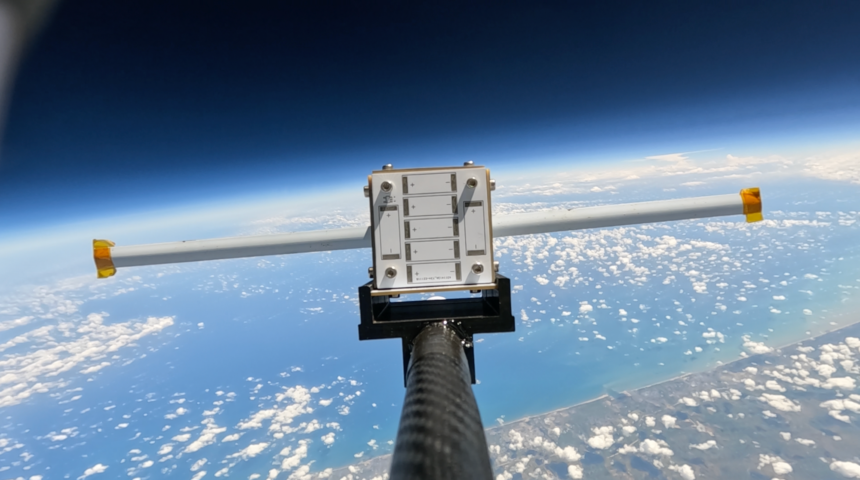
An Aerolaunch India payload high above the clouds. (Image: Aerolaunch India)
A launch, handled end to end
Launching a weather balloon into the stratosphere sounds simple until you list everything it actually involves. The payload has to be built to survive cold, thin air and a long fall. It has to be tested. Permissions and licensing have to be arranged. The launch site has to be chosen, the flight simulated, the balloon tracked as it drifts, and the payload found again after it lands — sometimes far from where it started.
Aerolaunch India handles that whole chain. The company says it manages payload fabrication and testing, launch-site selection, simulation and risk assessment, launch permission and licensing, pre-launch preparation and launch, tracking and recovery, and finally the collection of data and visuals. Its team is on site for the launch itself, and tracks the payload’s location and monitors its descent so the recovery can be carried out with care.
More Read

That end-to-end promise is what turns a balloon launch from a one-off adventure into a dependable service. A school does not need to become a balloon company to fly a student experiment. A research team does not need to build a recovery operation from scratch. A brand does not need to learn stratospheric flight to capture imagery from the edge of space. Aerolaunch India takes care of the launch, so its customers can focus on what they want to learn, measure or show.
What flies, and why it matters
The company’s launch scopes read like a tour of what near space is good for. For education, it runs workshops where students build and launch payloads to collect real-time atmospheric data, combining electronics with practical experience. For scientific research, its launches give researchers a platform to conduct experiments and gather data at high altitudes, with a perspective no ground-based lab can offer. For student projects, it provides a way to test theories and collect data for real, with full support to keep the launch safe and successful.
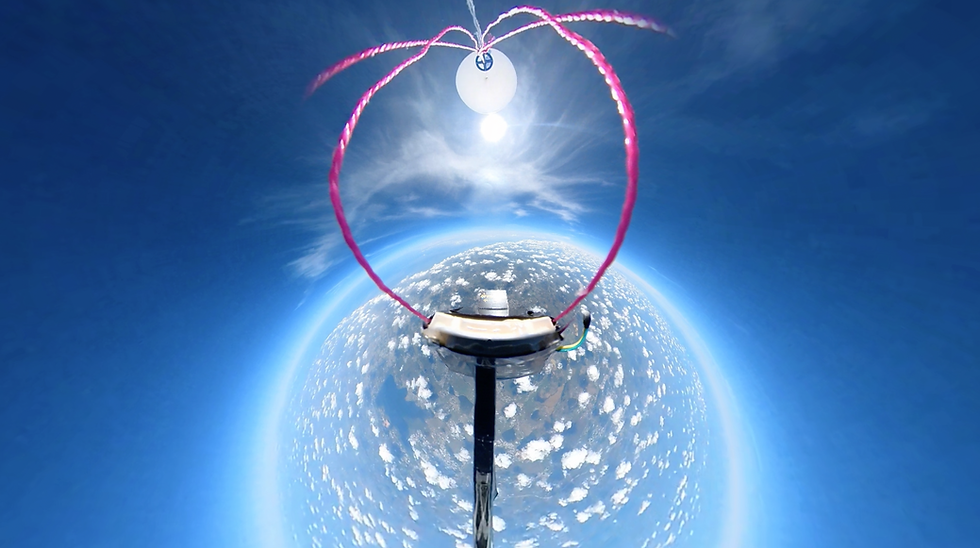
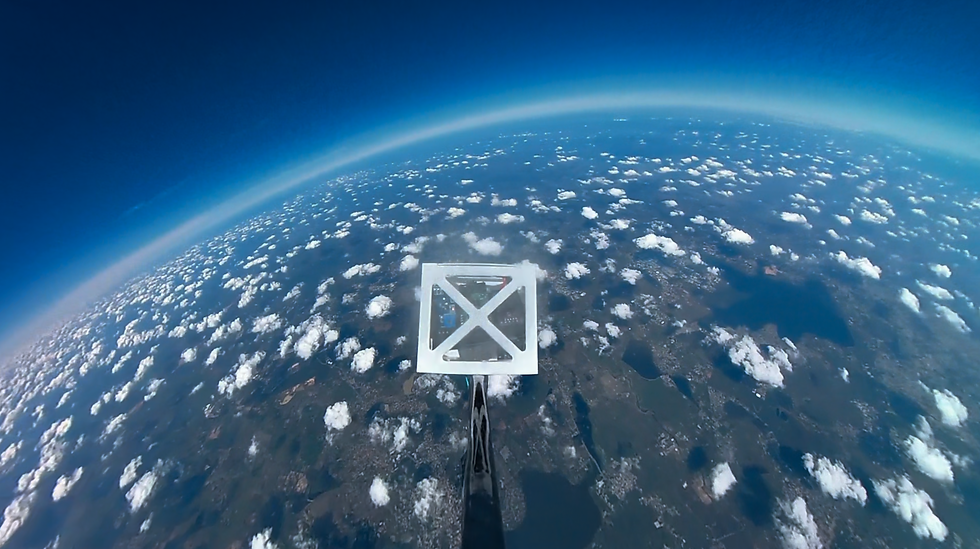
Balloon and payload above Earth, with the planet curving below. (Image: Aerolaunch India)
There is a creative side too. Aerolaunch India’s launches capture breathtaking views from the stratosphere for aerial videography, and open doors for high-altitude imagery and videos for branding and marketing campaigns. The same flight that carries a sensor can carry a camera — and the footage that comes back, of a payload floating above a curved Earth, is the kind of image that stops people mid-scroll and makes them look twice.
The numbers on the company’s own site tell a story of steady, growing work: the company says it has completed 7 launches, trained more than 100 young minds, and collected more than 10,000 data packets from the edge of space. Its booking page notes that standard launches go below 25 kilometres, with 30 kilometres available for specific research launches — a reminder that even a “standard” Aerolaunch flight climbs far above the cruising altitude of any airliner, into air so thin and cold that it counts as the edge of space.
Why a balloon beats a rocket for this job
Not every idea needs a rocket. A rocket is the right tool for putting something into orbit and keeping it there. But for an experiment that needs a few hours at high altitude, a photograph from above the clouds, or a sensor reading from the stratosphere, a balloon is gentler, simpler and far more affordable — and, crucially, the payload comes back. Aerolaunch India describes its service as affordable and hassle-free, and that accessibility is the whole point: space should not be a place only governments and billion-dollar companies can reach.
That is why the company’s work lands so well in classrooms and small labs. A student who builds a payload, watches it rise, tracks it across the sky and then holds the recovered data in their hands has not just read about near space — they have touched it. A researcher who can fly an instrument without a rocket budget can test an idea this year instead of waiting for a slot on a much larger mission. And a country with a deep pool of young engineers gets one more doorway into aerospace, through a technology that is elegant precisely because it is simple: a balloon, a payload, a careful plan, and a team that knows how to bring it all safely home.
What Aerolaunch India is building, at its core, is access. Access to the stratosphere for students, researchers and creators. Access to data from above the weather, images from above the clouds, and the thrill of a launch that anyone can follow from the ground. No rocket required — just a balloon, a good idea, and a team in Chennai that knows how to fly it and bring it back.
Keep reading: Engines, Airframes, Autopilots — All Made in Noida: Inside Raphe mPhibr, India’s Homegrown Drone Powerhouse · One Bus, Any Mission: Inside XDLINX Space Labs, the Hyderabad Startup Building India’s Ready-to-Fly Satellites · More Aerospace & Defense stories
Like stories like this? Add Exceptional Technology as a preferred source on Google to see more of our reporting in your search results and Discover feed.