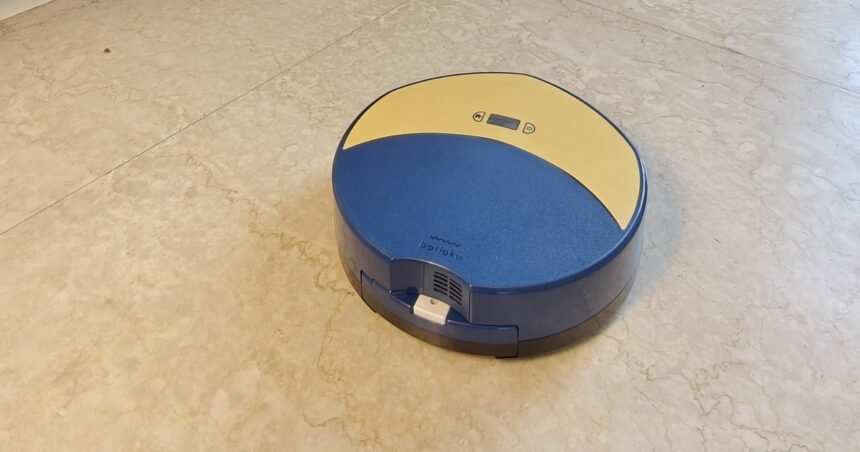
Picture a small robot gliding across a living-room floor in Bengaluru, quietly picking up the fine dust that settles on Indian homes every single day — the dust from the street outside, the hair, the tiny kitchen particles that a broom just pushes around. It slips into corners, steers around chair legs without bumping into them, and keeps going for three hours on a single charge. That little machine is Jiva, and it was not adapted for India from a design made somewhere else. It was researched, designed and built in India, from the ground up, for Indian homes.
Jiva is the first product of Botloka, a Bengaluru consumer-robotics startup founded in 2021 by Pooja Ravishankar. The company’s name is a portmanteau of “robot” and “loka”, the Sanskrit word for world — and its ambition, in its own words, is “bots for all, engineered in India for the world”. Jiva is where that ambition starts: a home robot vacuum cleaner shaped by five years of engineering and four generations of prototypes.
Designed for Indian dust, not imported assumptions
Most robot vacuums sold in India were designed for homes very different from Indian ones. Botloka’s starting point was the opposite question: what does an Indian home actually need a cleaning robot to handle? The company’s answer is built into Jiva’s design — fine dust, hair, kitchen particles, uneven surfaces and compact spaces, all things the team says imported designs were never tuned for.
The centrepiece is what Botloka calls its Sealed Airflow Architecture. The company says the sealed design preserves up to 85% of the fan’s suction at the floor head, so the cleaning power is not lost on the way from the motor to the floor. The fan itself delivers a true 5 kPa of suction, and the robot is shaped for corners rather than just open floor — the places where dust actually gathers in a home. The company also fits a 470 ml dustbox with an H11 HEPA filter it says removes 99.7% of microparticles, so the robot can go up to five days without emptying.
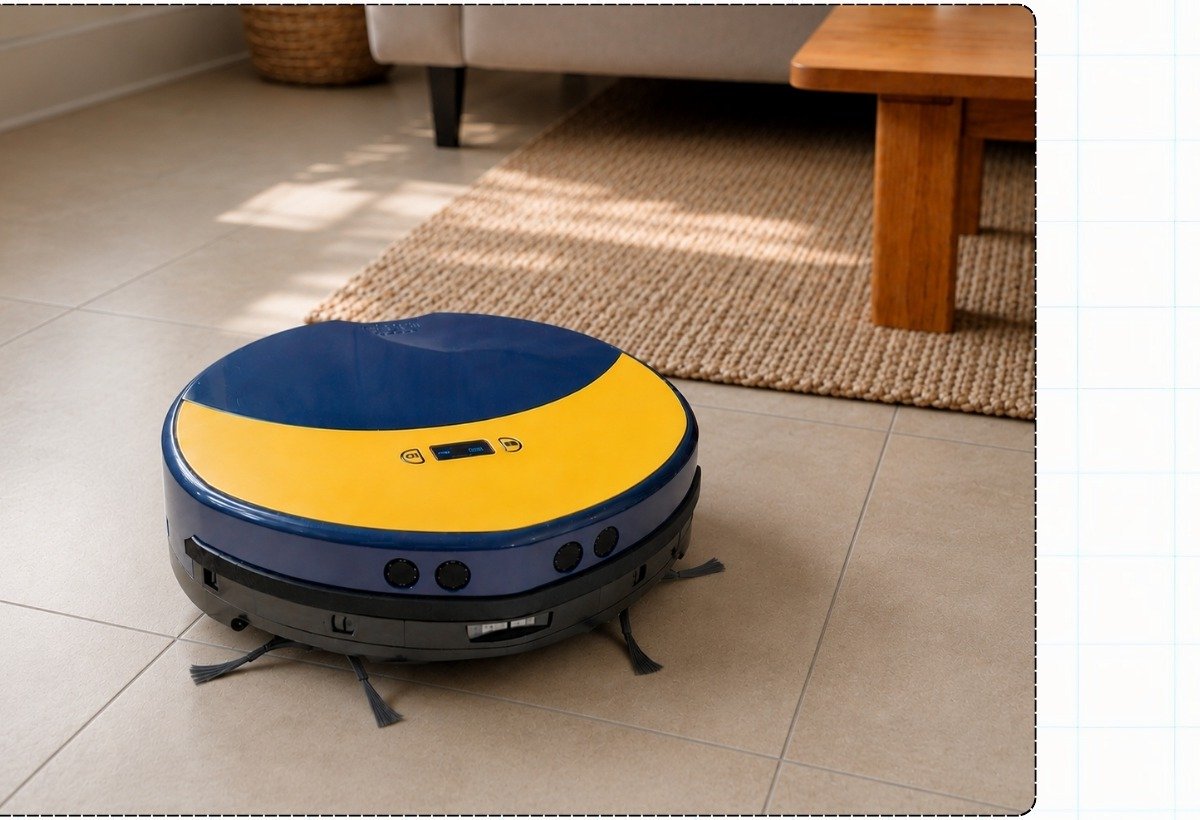
Jiva V1 cleaning a home floor. (Image: Botloka)
More Read

Navigation without a camera in your home
One of Jiva’s most thoughtful choices is what it leaves out. The robot navigates with SPAD sensors — a new-age sensor technology — fused with ultrasonic sensing, and the company says its design is completely camera-free. There is no camera mapping your rooms, which Botloka positions as a privacy-first approach: the robot finds its way around obstacles with precise sensing, without ever taking a picture of your home.
The numbers from the company’s own user manual tell a practical story: Jiva V1 weighs 2.575 kg, measures 330 x 323 x 91 mm, and runs on a 14.8 V, 5000 mAh lithium-ion battery. The company says it cleans for up to 180 minutes in ECO mode and 100 minutes in MAX power mode — long enough to cover a full home in a single run.
Five years, four prototypes, every layer in-house
Botloka’s journey to Jiva was deliberately slow and hands-on. Over five years, the team took the robot from rough prototypes to production-ready hardware across four generations. Every technology layer, the company says, is developed in-house in Bengaluru — from circuit design and PCB bring-up to part design, moulding, assembly and programming. Its in-house team works across electronics, mechanical engineering, software and AI, which the company describes as the hard part it genuinely enjoys: getting every discipline to play in sync, like a full orchestra.
The founder’s own story is woven into the product. Pooja Ravishankar is an engineer-MBA who spent nearly a decade at bigbasket.com heading Data Science and Category Marketing before starting Botloka in 2021. As a mother, she says she has lived the reality of juggling work, kids and endless cleaning — and that experience is why Botloka focuses on robots that actually fit Indian homes. Alongside her is Ravishankar GS, VP of Hardware Engineering, an IISc alumnus whose career spans telemetry interfaces for India’s early satellite programmes and leadership roles at Wipro Technologies.
The work has earned institutional backing along the way: Botloka is an Entrepreneur-in-Residence incubatee at IISc’s Foundation for Science, Innovation and Development (FSID), has received a grant under the Ministry of Electronics and IT’s TIDE 2.0 initiative, and is supported by NSRCEL at IIM Bangalore. The company says it has raised around ₹1.75 crore through founder capital, grants, seed and angel funding.
Why a homegrown robovac matters
The opportunity Botloka is chasing is large and largely unclaimed. Ravishankar estimates that India sells around 3 lakh robot vacuum cleaners a year, compared with more than 60 lakh in China — a gap that shows just how early the category still is in India. A robot designed in India, serviced in India, with spare parts available locally, has a very different relationship with its buyers than an imported box with no one to call when it breaks.
And Jiva is only the beginning of the plan. Botloka says it wants to build a robotics platform for household applications, with ambitions to eventually design, manufacture and export robots — a fleet of robot helpers to take over the boring chores, so people can focus on what truly matters. The vacuum cleaner is the first helper. If Jiva finds its way into Indian homes the way its makers hope, it will have proved something bigger than a cleaning gadget: that a consumer robot can be truly Indian, designed from the beginning for the homes it will serve, and built to a standard the world would want to buy.
Keep reading: No LiDAR, No Map: Inside Ati Robotics, the Bengaluru Startup Teaching Factory Robots to Navigate Like Humans · From Bihar to SEMICON: Inside Swadeza, the Startup Teaching AI to Verify India’s Chips · More Industrial Automation & Technology stories
Like stories like this? Add Exceptional Technology as a preferred source on Google to see more of our reporting in your search results and Discover feed.