Hold a pinch of black, fluffy powder between your fingers and you are holding something stranger than it looks. Each speck is made of tubes so small that 200,000 of them laid side by side would barely match the width of a single human hair — yet, the company that makes them says, the material is around 100 times stronger than steel at a tenth of the weight, and a far better conductor of electricity than copper. That powder is the product of Bengaluru-based NoPo Nanotechnologies, and after fifteen years of quietly perfecting how to make it, the company is now scaling up to supply it to battery makers and chip researchers around the world.
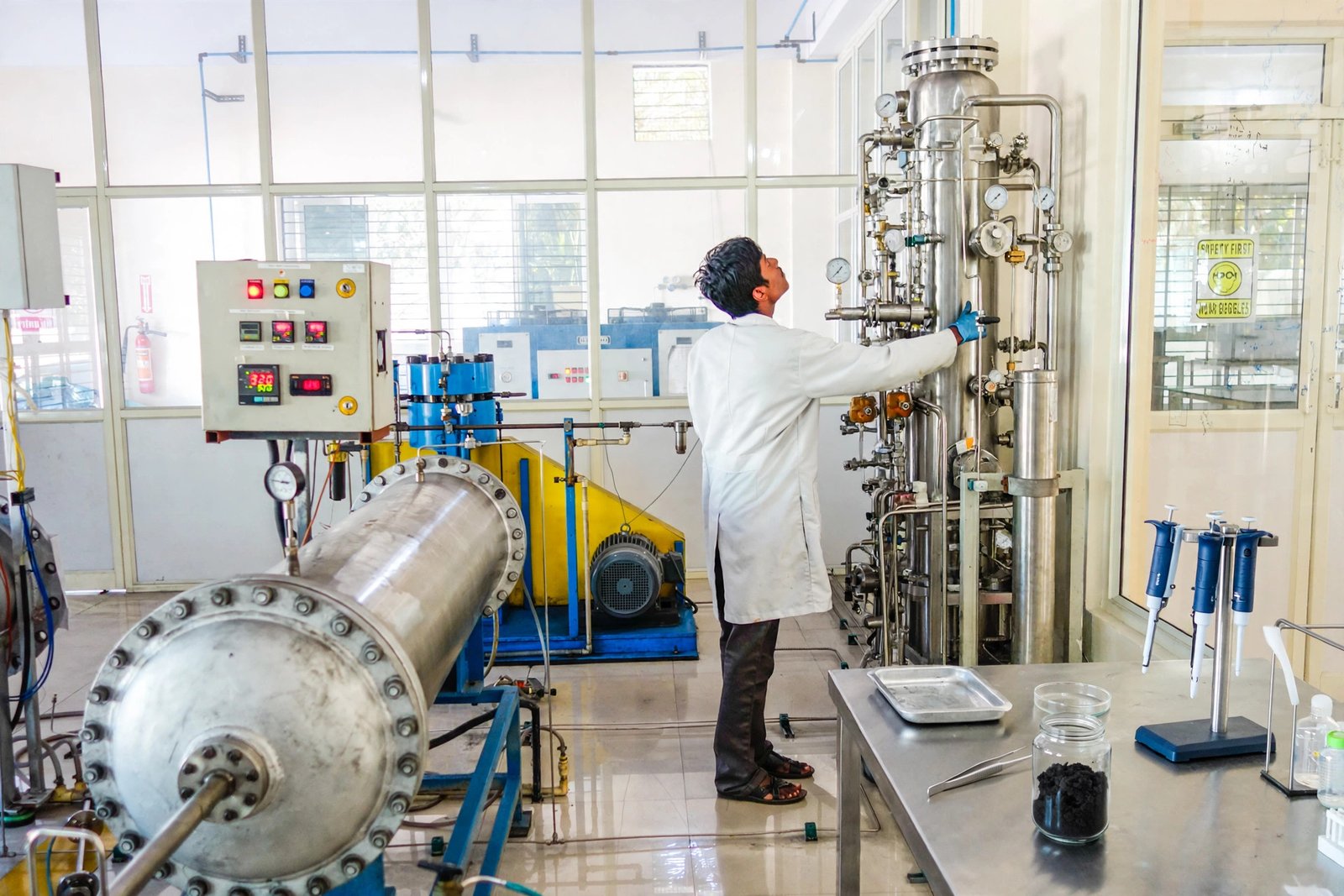 Illustration of NoPo’s HiPCO laboratory in Bengaluru, based on the company’s facility photographs.
From “not possible” to now possible
NoPo’s story starts with a childhood dream of Mars. Founder and CEO Gadhadar Reddy wanted to go to space, and kept running into the same wall: getting there needs materials that are lighter, stronger and more capable than anything we routinely build with. When he returned to India in 2011 determined to build that material here, he was repeatedly told it could not be done in India. He took the scepticism as a name — NoPo, short for “not possible” — and set out to prove otherwise. Today, the company cheerfully reads it as “now possible”.
He did not start from scratch. NoPo’s co-founder Dr Robert Kelley Bradley had been the PhD student who built and fine-tuned the first HiPCO reactors at Rice University in the United States, working under chemistry Nobel laureate Richard Smalley, one of the pioneers of carbon nanotube science. After Smalley’s death in 2005, that work stalled at Rice. Reddy and Bradley revived and re-engineered it in Bengaluru in 2011, and Anto Godwin and Arunima Patel joined the founding team as the process matured from a science project into a factory.
The hardest part is making every tube the same
NoPo makes single-walled carbon nanotubes — tubes whose walls are a single layer of carbon atoms rolled into a cylinder. The company says its tubes average just 0.8 nanometres in diameter, and that consistency is the whole game. A nanotube’s electrical behaviour depends on its size: the company explains that by sorting tubes by diameter, it can select bandgaps ranging from 0 to 2 electron volts, choosing whether a batch behaves as a semiconductor or a conductor. Make the tubes even slightly differently from batch to batch, and the properties drift with them.
That is why NoPo’s HiPCO — high-pressure carbon monoxide — process is run like a precision instrument. The reaction runs at temperatures above 1,000°C and at high pressure, continuously, for as long as reactants are supplied. The company says it actively controls more than 200 production parameters to keep every run identical, and then separates the nanotubes by diameter and by chirality — the twist of the carbon lattice that decides whether a tube is semiconducting or metallic. The company has even developed the ability to isolate single-chirality nanotubes, a feat only a handful of players worldwide can claim.
More Read

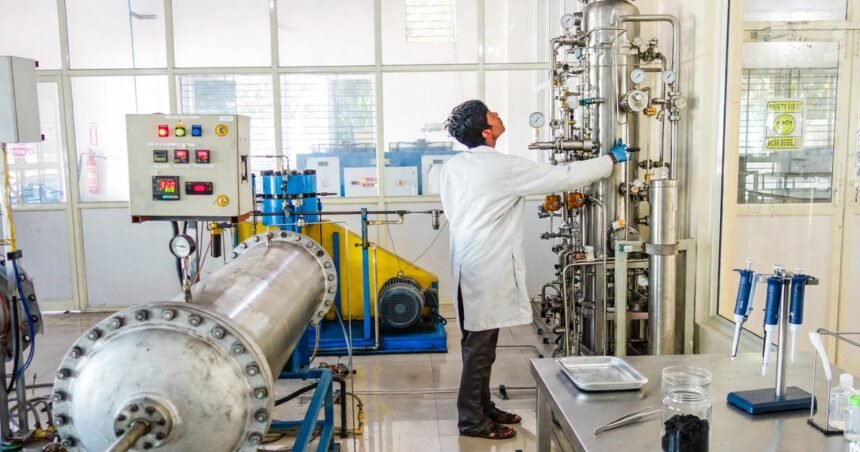
The engineering behind that control is almost entirely homegrown. NoPo’s 16,000-square-foot research and development facility in Bengaluru houses eleven proprietary nanotube production reactors and advanced testing equipment, and the company says more than 90% of the components in those reactors — pressure vessels, heating and temperature-control systems, mixers, filters and catalysts — are designed, manufactured and sourced within India. When Covid-era delivery times for commercial gas compressors stretched to nearly two years, the team simply built its own.
What the material does for batteries
NoPo’s first big market is the battery in your pocket, your scooter and, increasingly, your car. Battery makers want to pack more energy into silicon anodes, but silicon swells and cracks as it charges and discharges. The company says its nanotubes stabilise silicon anodes, helping batteries achieve higher energy density, faster charging, improved safety and longer cycle life — and that a low loading of its material can replace a far larger loading of conventional carbon black in an anode slurry, because the nanotubes conduct so efficiently.
The interest is already concrete. The company says around fourteen battery companies are actively testing its materials, and that it supplies its nanotubes as ready-to-use dispersions that slot directly into existing anode slurries, rather than as raw powder. It has also begun a Technology Development Board-funded feasibility study into sodium-ion batteries, a lower-cost chemistry that could matter enormously for India, where the raw materials for lithium cells mostly come from elsewhere.
And for chips beyond silicon
The second frontier is semiconductors. As silicon transistors approach their physical limits, researchers are looking for a material that can carry a current through a channel just a few atoms wide. The company says a nanotube transistor can be roughly 1 nanometre wide and 10 nanometres long, against more than 30 by 30 nanometres for a transistor at a 2-nanometre process node, and that nanotube devices have been demonstrated running at clock speeds above 100 gigahertz. A leading chip manufacturer in Taiwan is now evaluating NoPo’s material inside its own manufacturing processes, the company says, at the research and development stage.
None of this is a single invention. The company has filed seven patents, five of which have already been granted, covering reactor design, catalyst production, high-temperature gas mixing, purification and nanotube applications from sensors to high-strength fibres. Its purification process removes catalyst particles to produce material that is more than 99% single-walled nanotubes, suitable for electronics, healthcare and battery work alike.
Clean water, from the same tube
The same physics opens a third door: water. A single-walled nanotube is so narrow that it lets a single file of water molecules pass through while blocking salts, and the company says its membranes can transport water molecules up to 100 times faster than any known pore. In the XPRIZE Water Scarcity competition, NoPo became the only Indian team to qualify, won a semi-final round and took a finalist award after demonstrating a membrane that achieved three times the water flow of conventional desalination membranes over the same area. The work has also drawn support from government programmes including NITI Aayog, the Indian Navy, Karnataka’s Elevate 100 initiative and the Technology Development Board.
Scaling up in Bengaluru
All of this is now moving from laboratory to factory floor. NoPo has recently inaugurated a pilot production line, and the company says it is setting up a production plant in Bengaluru that it expects to be the world’s second-largest carbon nanotube production facility, and the first of its kind in this part of Asia — built specifically to supply battery manufacturing lines directly. From a first reactor that yielded a milligram after days of running, production has scaled to grams per hour, with commercial orders measured in metric tons.
It is a fitting arc for a company named after a dismissal. Fifteen years ago, making carbon nanotubes at industrial scale in India was, in the experts’ phrase, not possible. Today, from a facility in Bengaluru’s Electronic City, NoPo is shipping a material thinner than a hair, stronger than steel and fast enough for the next generation of batteries, chips and clean water — and building the factory to make a great deal more of it.
Keep reading: The Chest X-Ray That Finds TB Early: Inside DeepTek’s Genki AI · Twelve Seconds to See Your Whole Mouth: Inside scanO’s AI Dental Kiosk · More Chemicals, Materials & Life Sciences stories
Like stories like this? Add Exceptional Technology as a preferred source on Google to see more of our reporting in your search results and Discover feed.