Tuberculosis still kills more people than almost any other infection, and it often hides in plain sight. A chest X-ray can reveal it, but only if a trained radiologist is there to read it — and in much of India and the developing world, there simply are not enough radiologists to go around. DeepTek, a Pune radiology-AI company, built its answer to that gap: software that reads a chest X-ray in minutes, flags tuberculosis and more than 20 other lung conditions, and carries screening into places where a specialist may never visit.
DeepTek began in Pune with a radiologist’s frustration and an engineer’s toolkit. Co-founder Dr Amit Kharat had spent years practising radiology, while co-founder Ajit Patil brought industrial engineering from IIT Kharagpur and a software business background, and data scientist Aniruddha Pant brought deep-learning expertise from UC Berkeley. Together they set out to make radiology faster, more consistent and far more reachable — starting with the humble chest X-ray, the most common imaging test in the world.
Genki: a screening system that travels to the patient
DeepTek’s flagship public-health platform is Genki, an end-to-end screening solution built around its chest X-ray AI. It handles the whole workflow: patient registration and symptom capture, the AI reading itself, and centralised analytics and dashboards that let health programmes track what they find. It works online and offline, so a mobile diagnostic van in a remote town can screen patients without an internet connection and sync results later.
The AI looks for tuberculosis alongside a wide set of other findings — opacities, fibrosis, lung masses and nodules, cardiomegaly and more — so a single X-ray becomes a broader lung-health check. The company says the tool met the World Health Organization’s performance standards for computer-aided detection software in tuberculosis screening, in both community and facility-based settings, and the WHO has recommended it for TB screening.
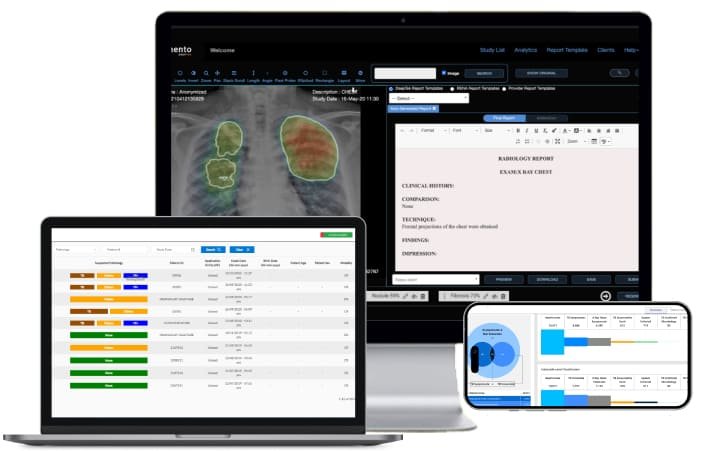 DeepTek’s Genki and Augmento platforms analysing chest X-rays. (Image: DeepTek)
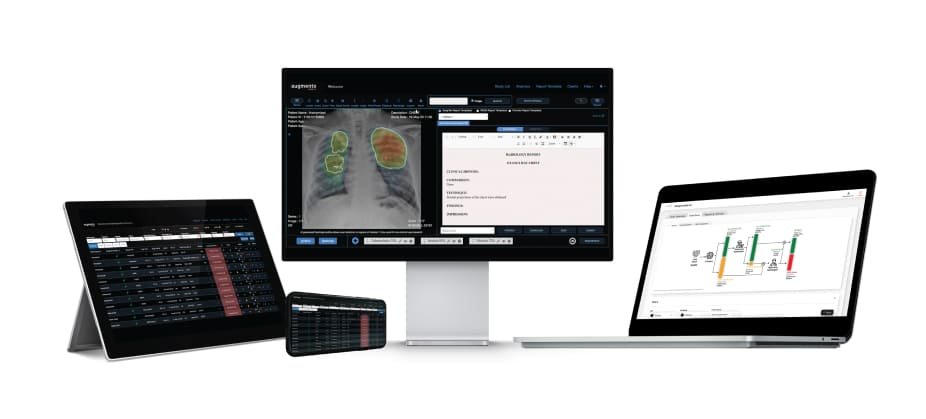 DeepTek’s Augmento platform across devices. (Image: DeepTek)
More Read

Augmento: the radiologist’s AI workbench
Alongside Genki, DeepTek built Augmento, a cloud-based picture archiving and communication system with AI woven through it. It pre-screens every scan, flags the urgent cases first, and produces structured draft reports that radiologists can review and finalise. The company says the platform processes more than 100,000 multi-modality scans a month, and its chest X-ray AI has received US FDA clearance, with approvals also in place from India’s CDSCO, Singapore’s HSA, Kenya and Thailand, plus CE certification under the European Union’s Medical Device Regulation as a Class IIb device.
From Chennai’s mobile vans to Singapore’s hospitals
Genki’s impact shows up most vividly in the field. In Chennai, the Greater Chennai Corporation deployed Genki across four mobile diagnostic units in remote areas, screening 25,598 patients with 98% sensitivity and 96.9% accuracy, according to the company — and the company says screening yield rose 25-fold there. In Thailand, Genki is installed in hospitals including Makarak, Hua-Hin, Trang and Chaiprakarn, and it is deployed across Thailand, Mongolia, the Philippines, Tunisia and Indonesia. In Singapore, the platform has been adopted by Synapxe, the national health-tech agency, for public hospitals.
The scale the company reports today is striking: more than 3 million lives touched, over 2,000 sites worldwide, 7 patents filed and more than 30 research papers. DeepTek raised $10 million in a Series A round led by Tata Capital Healthcare Fund in 2022, and its work has been validated in independent studies across countries including Thailand, Vietnam and Geneva, where the company says Genki matched expert radiologists and outperformed human readers given equal information.
Now, a third of the price for the places that need it most
On 2 November 2026, DeepTek announced Global Access Pricing for its WHO-recommended chest X-ray AI: eligible public-sector and not-for-profit healthcare providers across 138 low- and middle-income countries can now access it at approximately one-third of its previous pricing. The pricing is enabled through an access agreement with Unitaid and the Clinton Health Access Initiative, and it is designed to let national TB programmes expand high-quality AI-assisted screening within existing budgets.
That is the heart of DeepTek’s story. A chest X-ray is cheap, quick and painless — the bottleneck was never the picture, it was the reading. By putting a tireless, expert-level reader into clinics, vans and hospitals that never had one, a Pune team is helping the world’s most common scan reach the people who need it most, earlier, and at a price their health systems can afford.
Keep reading: Twelve Seconds to See Your Whole Mouth: Inside scanO’s AI Dental Kiosk · A Vaccine Made for One Person: Inside PopVax’s RNA Foundry · More Chemicals, Materials & Life Sciences stories
Like stories like this? Add Exceptional Technology as a preferred source on Google to see more of our reporting in your search results and Discover feed.