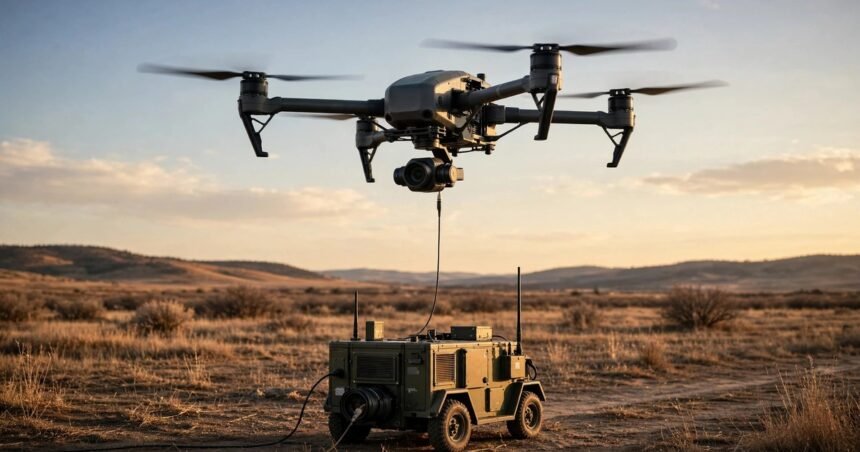
On a modern battlefield, the most dangerous things are often the ones you cannot see: a faint radio signal from a hidden transmitter, a drone slipping through a valley, an emitter that flickers on for seconds and vanishes. Ground sensors, tucked behind hills and buildings, miss them. Arka Aerospace, a Hyderabad company building indigenous unmanned aircraft, has an answer that rises above the problem — literally. Its newest platform, Cyberhound, is a tethered aerial surveillance system that watches the sky and listens to the electromagnetic spectrum at the same time, from a perch no hill can hide it behind.
Arka Aerospace was founded in 2021 by Suraj Bonagiri and incubated at IIIT Hyderabad, where it grew out of the institute’s robotics research culture. From the start, the company set itself a bold mission: to pioneer indigenous technologies and build autonomous factories that deliver airpower at speed and scale, in pursuit of what it calls absolute airspace dominance. Its early work already turned heads — Arka won the Indian Air Force’s iDEX Open Challenge 8.0 for a multi-role autonomous UAV, and its shape-changing Elasticopter, a drone that reconfigures its frame to suit different payloads and missions, showed a team that thinks in adaptable platforms rather than single-purpose aircraft.
Cyberhound: one elevated eye, two kinds of sight
Cyberhound is a persistent tethered aerial surveillance platform — a drone held aloft on a tether, drawing power from the ground so it can stay up far longer than a battery-powered aircraft, carrying a combined optical and electronic sensor payload. The company describes it as the world’s first tethered UAV to combine visual and electronic-warfare surveillance in a single node, and the idea is elegantly simple: put the sensors high enough that terrain no longer masks them, and give them two ways of seeing.
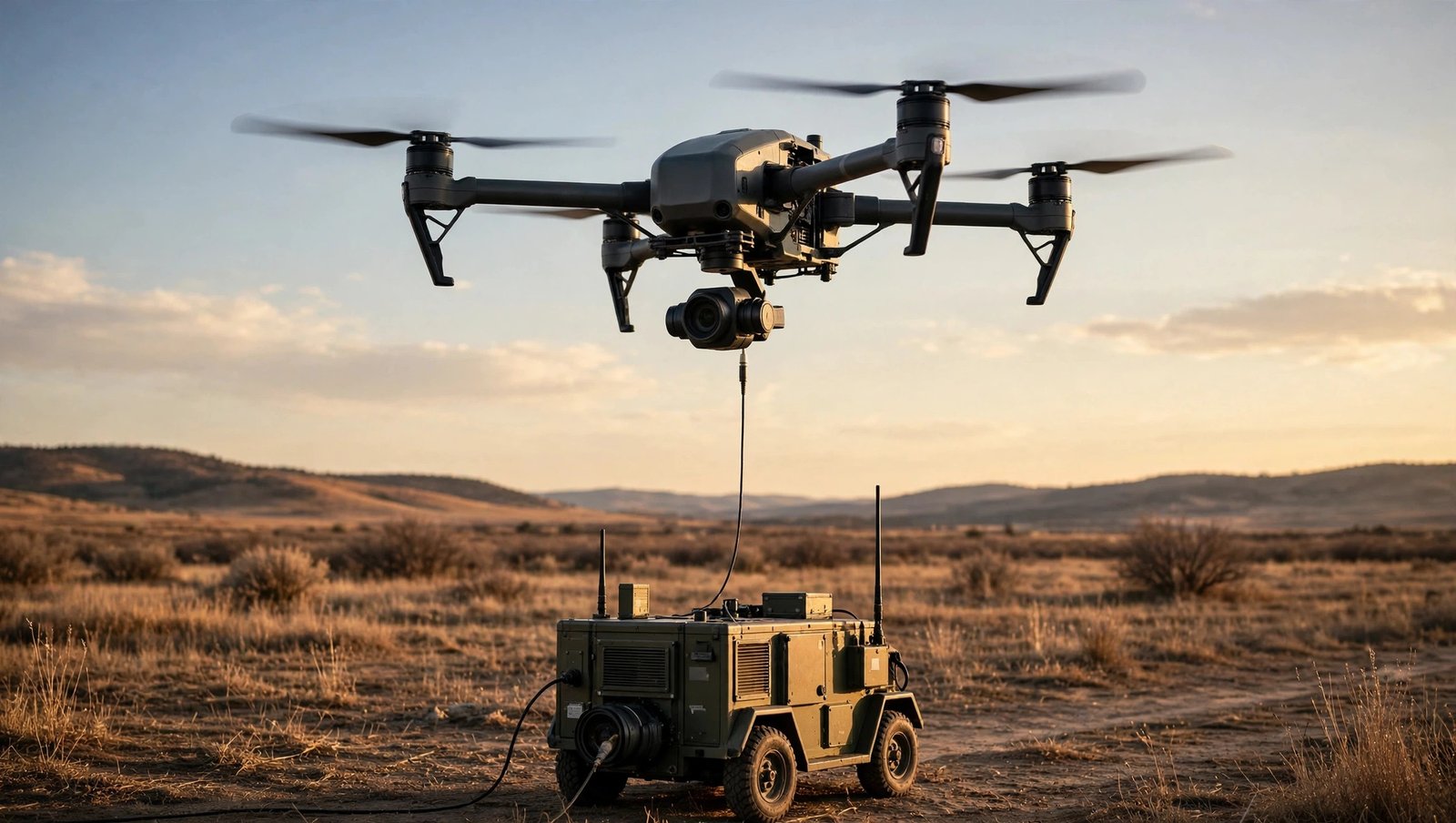 A tethered surveillance drone with an EO/IR sensor gimbal, connected to its ground station. (Illustration: Exceptional Technology)
On the visual side, Cyberhound carries high-resolution electro-optical and infrared imaging, watching day and night. On the electronic side, it carries wideband radio-frequency sensing, sweeping the electromagnetic spectrum for emissions. Fusing the two, the company says, lets the platform find targets that cameras alone would miss — emitters that are camouflaged, invisible, or simply too far away for a visual sensor to resolve. Multiple Cyberhound platforms can work together, the company says, triangulating hostile emitters to pin down their precise location and track them across a wide operational area.
AI that turns signals into decisions
What makes Cyberhound more than a flying camera is the intelligence layered on top of its sensors. Its AI-powered multi-domain software fuses optical and radio-frequency data to automatically detect, classify, prioritise and track threats, presenting operators with a single unified intelligence picture and, the company says, far less manual workload. That signal intelligence is already earning recognition: at the Telangana Startup & MSME Conclave 2026, in the Aerospace & Defence category, Arka was honoured by T-Hub and the state’s industry leadership for Cyberhound’s AI-based signal intelligence.
More Read

The platform is built to slot into the wider defence picture rather than stand apart from it. Its open, modular, software-defined architecture is designed to integrate with command-and-control, electronic-warfare, air-defence, ISR and battlefield-management systems through standard defence interfaces, and to accept new sensors, receivers and AI algorithms as threats evolve. It can fly as a single standalone node or as a network of platforms giving persistent, theatre-wide optical and electronic coverage.
A family of ideas, one direction
Cyberhound joins a fast-growing Arka family. Alongside it sits U.K.I.D., the company’s autonomous kinetic interceptor drone, designed to detect, pursue and physically neutralise hostile drones, alone or as a coordinated swarm. Earlier, Arka showed a dynamic persistent ISR UAV built to fly from fast-moving naval vessels — following a host ship at speeds of up to 30 knots so a fleet never loses its elevated eye, even while manoeuvring at sea. The thread running through all of them is the same: persistent, autonomous, Indian-built eyes in the sky, designed around the missions Indian forces actually fly.
Arka’s trophy cabinet tells the same story of steady momentum: the company lists a DRDO Dare to Dream 3.0 award among its achievements, along with hackathon honours presented by senior ministers, and service recognised during Operation Sindoor. From a IIIT Hyderabad launchpad to a tethered watcher that sees in light and in radio waves at once, Arka Aerospace is building the kind of quiet, persistent capability that lets friendly forces spot trouble first — and that is exactly the kind of engineering worth watching.
Keep reading: The Satellite That Breathes: Inside Orbitt Space’s Air-Breathing Engine for Ultra-Low Earth Orbit · Light as a Weapon: Inside Carbine Systems’ H.A.R.A., India’s First Private Laser Weapon · More Aerospace & Defense stories
Like stories like this? Add Exceptional Technology as a preferred source on Google to see more of our reporting in your search results and Discover feed.