Picture a drone flying a border patrol at 2 a.m., in smoke and haze, with no moon to help it. A normal camera sees almost nothing. A shortwave infrared camera, though, can read the faint glow of the night sky itself — and see straight through the smoke. That kind of vision exists today, but the sensors behind it are expensive, largely imported, and mostly reserved for high-end systems. Bengaluru-based Nova Spectral AI is building a chip to change that: a shortwave infrared (SWIR) image sensor made in India, from lead-free quantum dots printed onto ordinary silicon.
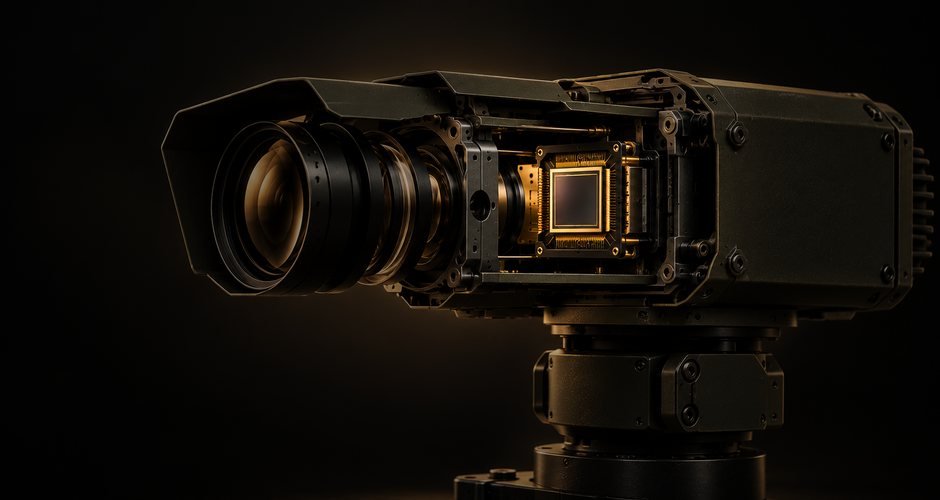 A SWIR camera carrying the company’s sensor, built for defence and surveillance imaging in darkness, smoke and haze (official company visual).
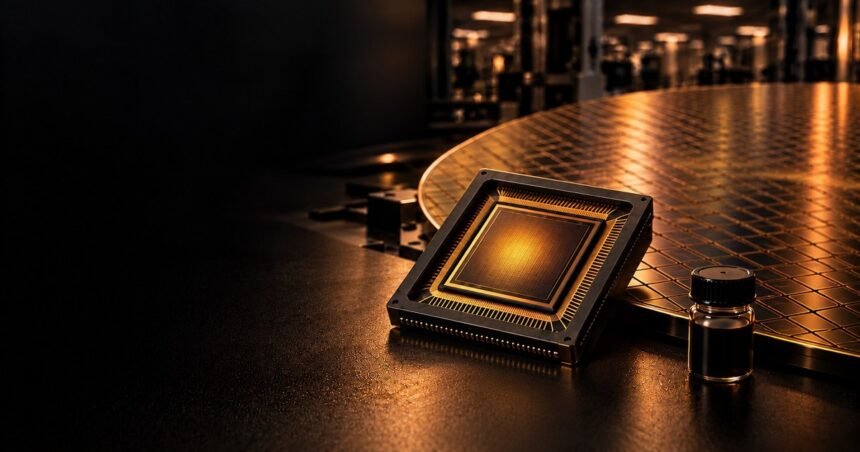
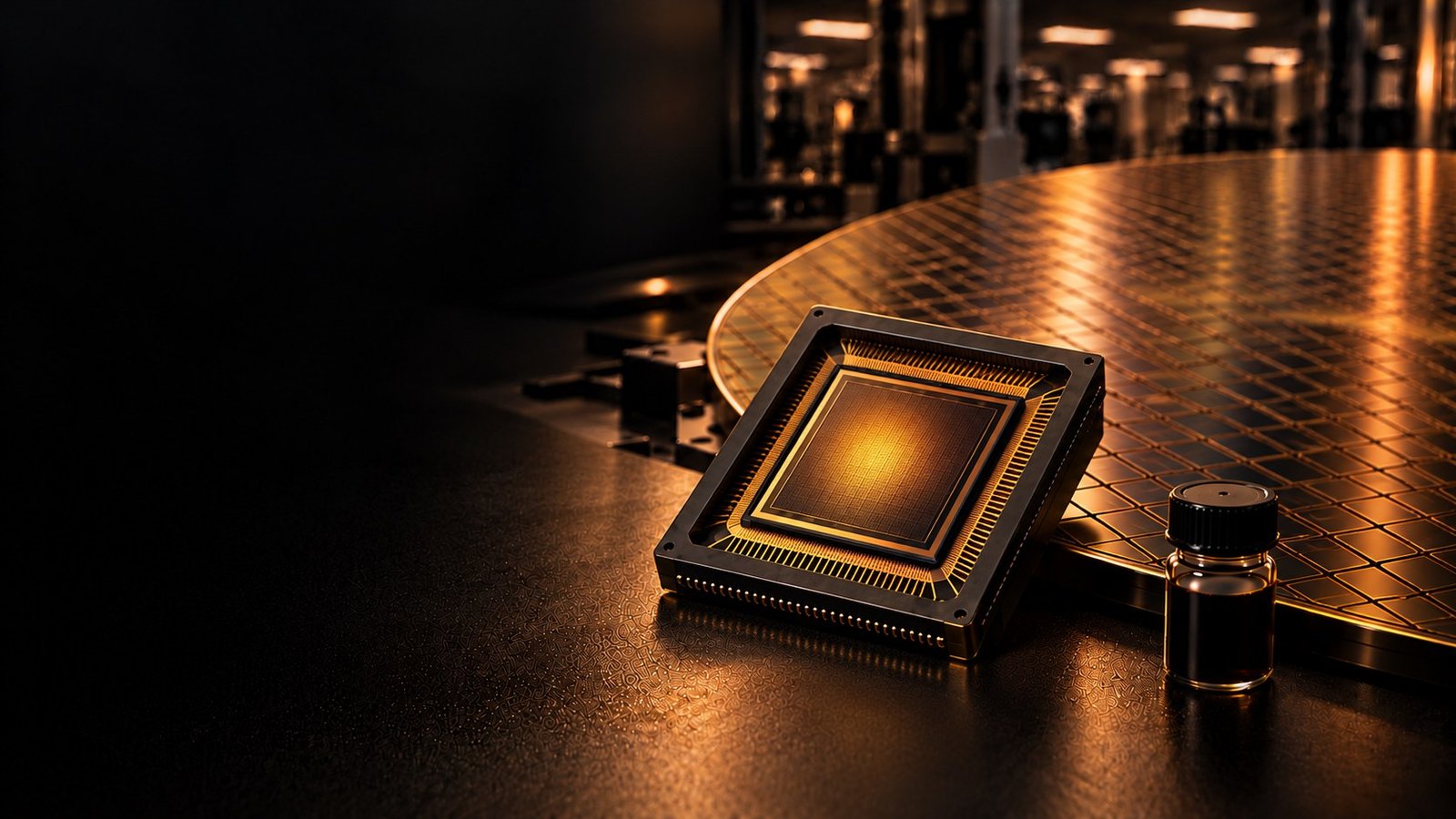 Nova Spectral AI’s SWIR sensor chip concept, with quantum-dot ink and a silicon wafer (official company visual).
The eye machines have been missing
Modern machines can plan, reason and act — but every decision they make rests on what their sensors can resolve. Conventional cameras fail exactly where autonomy is hardest: darkness, glare, smoke, haze, dust and light fog. SWIR imaging already sees through much of that. It works at night by the faint natural glow of the night sky, and it can cut through smoke, haze, dust and light fog that blind a visible-light camera. The catch has always been cost: today’s SWIR sensors are mostly built from indium gallium arsenide (InGaAs), a material that is expensive and complex to manufacture, which keeps the technology out of most machines that could use it.
Nova Spectral AI’s answer is a different material stack. The company is building its sensor from lead-free indium arsenide (InAs) colloidal quantum dots — tiny crystals tuned to absorb infrared light — deposited as a film on standard silicon CMOS, the same manufacturing base used for everyday camera sensors. Because the process is compatible with ordinary CMOS fabrication, the company says sensor costs could fall by up to 100 times compared with conventional InGaAs technology, putting SWIR vision within reach of far more platforms.
From ink to image sensor
The company’s own roadmap runs from the lab to the fab in four steps. It starts with the quantum-dot ink itself: turning InAs colloidal quantum dots into a stable, conductive ink, then coating that ink into smooth, even films across a wafer. Next come the charge-transport layers that carry the signal out of the film, and the full sensor stack built directly on standard silicon CMOS readout wafers. The roadmap then targets a field-ready sensor-array prototype in 2028, followed by a pilot fabrication line and field pilots with defence and surveillance partners in 2029.
More Read

That progression rests on hands-on experience. Co-founder and chief executive Dr Anish Priyadarshi previously built a complete colloidal quantum-dot device fabrication and research facility from the ground up, and fabricated InAs quantum-dot photodiodes for SWIR imaging across multiple wavelengths. He brings CMOS wafer-scale manufacturing experience from GlobalFoundries and Nanoco, and a PhD from NTU Singapore. Co-founder Sanjeev Kumar brings more than 20 years of commercial leadership, and both founders are IIT Kanpur alumni. The company, founded in May 2026, has an in-principle go-ahead to incubate at IISc Bengaluru, where it is building its team.
Sovereign eyes first, then the world’s devices
Defence is the first proving ground, under the company’s Mission DrishyaTech. Most infrared detectors in India’s night sights, drone payloads and surveillance systems are imported, the company says — a critical layer of the imaging chain that is often subject to export controls abroad. Its indigenous SWIR chip is aimed first at drones, intelligence, surveillance and reconnaissance platforms, and the soldier, giving them situational awareness in darkness, smoke, haze and light fog.
The longer game is much bigger. The same compact, affordable, lead-free chip could go into automotive systems that see through haze and spray and detect water and ice on the road, industrial inspection that spots moisture and defects invisible to standard cameras, and even phones and smart glasses, with under-display face authentication and eye-safe sensing. Backing that ambition, Nova Spectral AI announced a ₹21.15 crore (about US$2.25 million) seed round on 27 October 2026, led by Shastra VC with participation from Equirus InnovateX Fund and angel investors, to build its team and deliver its field-ready prototype within 18 months.
The idea at the heart of it is simple, and it is the company’s own thesis: intelligence is only as good as its eyes. Nova Spectral AI is building those eyes in India — affordable, indigenous, and ready for the machines that have to see first, whatever the dark and the weather throw at them.
Keep reading: Weeks, Not Minutes: Inside Soket AI’s LOOP, the Open-Source Harness for Agents That Never Clock Out · One Prompt, One Whole Film: Inside Eloelo’s Dolphin AI, the Studio Turning India Into a Story Exporter · More Industrial Automation & Technology stories
Like stories like this? Add Exceptional Technology as a preferred source on Google to see more of our reporting in your search results and Discover feed.