


Ask an electric-car owner what they watch most closely and the answer is almost always the same number: the kilometres left on the dashboard. Every one of those kilometres is decided long before the car reaches a showroom — inside the battery cell, in a layer of material thinner than a sheet of paper. On 4 November 2026, a Mumbai company launched a new version of that layer, and the company says it could stretch an electric vehicle’s range by up to 30 per cent without making the battery pack any bigger.
The company is Epsilon Advanced Materials, and the material is called Epsil. It is a silicon-graphite composite anode — the part of a lithium-ion cell where energy is stored when the battery charges — and it is designed to solve the one problem that has kept silicon, the most promising anode material on paper, out of most electric cars.
The bottleneck inside every battery
Nearly every lithium-ion battery on the road today stores its charge in graphite. Graphite is reliable and well understood, but it has a hard ceiling: a conventional graphite anode holds about 340–360 milliamp-hours per gram. That ceiling is one of the reasons electric cars need such large, heavy battery packs to go far — the chemistry itself can only hold so much.
Silicon can hold roughly ten times as much lithium as graphite, which is why battery engineers have chased it for years. But silicon has a stubborn flaw: it swells dramatically as it absorbs lithium during charging, then shrinks again as it discharges. Repeated swelling cracks the anode, and the battery’s capacity fades fast. Taming that expansion without giving up silicon’s capacity has been one of the battery industry’s longest-running engineering puzzles.
More capacity, same production line
Epsil is Epsilon’s answer to that puzzle. The composite blends silicon into a graphite structure engineered to hold the silicon evenly dispersed while controlling its expansion, and the company says the result keeps the cell stable through repeated charging. The numbers it reports are striking: a reversible capacity of 600–650 milliamp-hours per gram — nearly double that of a conventional graphite anode.
That extra capacity is what turns into range. Because the anode stores more energy per gram, a cell maker can either stretch a vehicle’s driving range by up to 30 per cent from the same size of pack, the company says, or shrink the pack and keep the range it already had. Epsil is also designed to support charging rates of 1C to 5C, and Epsilon has engineered it to limit lithium plating — the deposits that can degrade a battery and, in the worst case, grow into dendrites that short a cell.
More Read

Just as important for adoption, Epsil is designed as a drop-in material: it works with existing battery-cell production lines, so manufacturers can use it without rebuilding their factories.
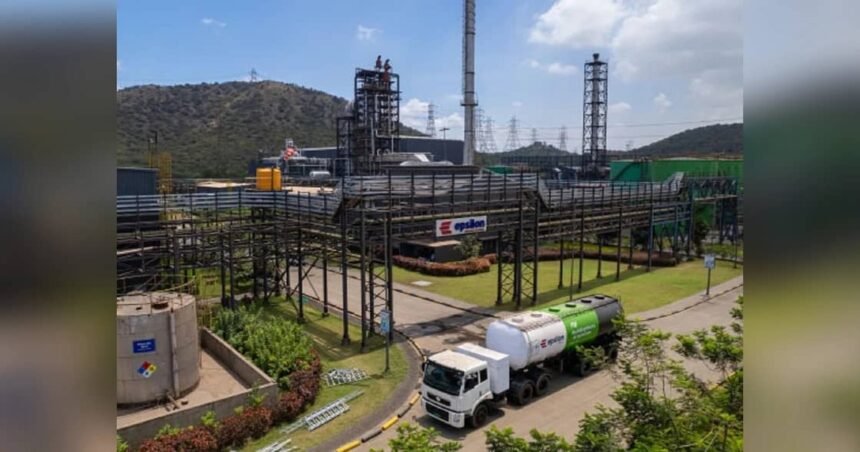
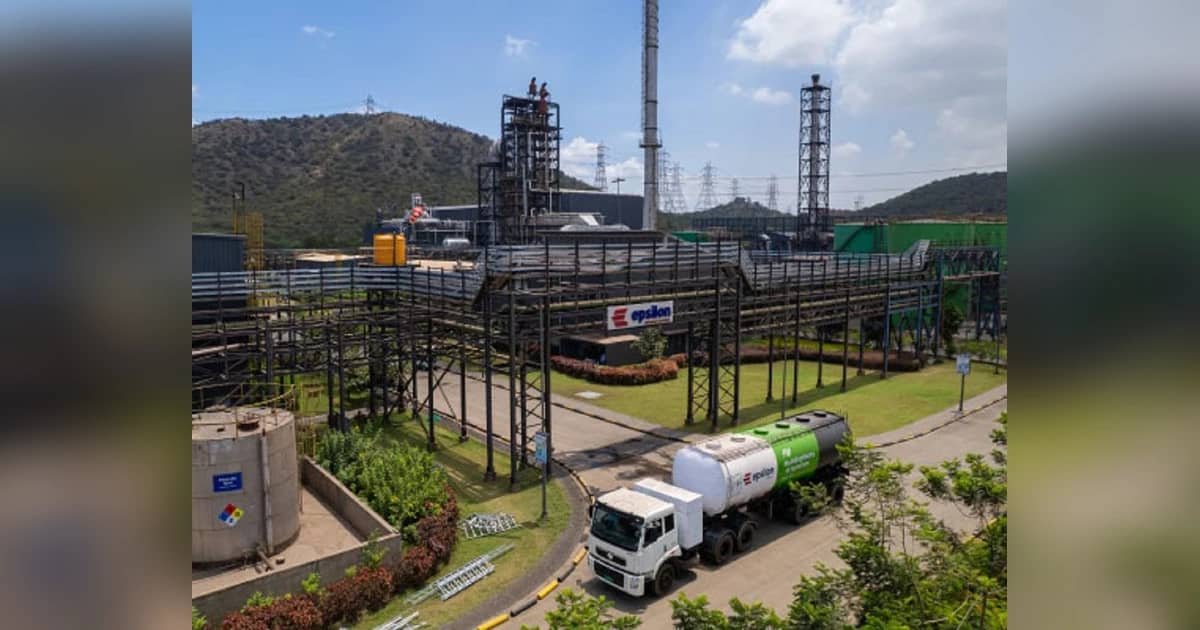 Epsilon Advanced Materials’ graphite anode plant. Image: Epsilon Advanced Materials.
Built in Vijayanagar, bound for the world
Epsilon Advanced Materials was founded in 2018 in Mumbai, and it makes both sides of the battery — anode and cathode active materials — from its base in India. Its first plant, EAM-ONE at Vijayanagar in Karnataka, is a 2,000-tonne-a-year facility that went into production in early 2024, which the company describes as India’s first graphite anode material customer qualification plant: the place where prospective customers test and qualify Epsilon’s materials for their own cells.
The scale-up from there is ambitious. Epsilon plans to grow its Indian graphite anode capacity to 30,000 tonnes a year by 2028, with a second phase taking it to 100,000 tonnes, backed by a first-phase investment of ₹4,000 crore and a memorandum of understanding with the Government of Karnataka worth about $1.1 billion. In August 2026, the Ministry of Electronics and Information Technology approved ₹145 crore of capital expenditure support for the company’s anode project under the Electronics Components Manufacturing Scheme — a government endorsement of the plan to localise a material India currently imports.
The company is building the same capability abroad. A $650 million facility in North Carolina in the United States is planned to reach 60,000 tonnes a year by 2030, enough material for about a million electric vehicles, and a plant in Vaasa, Finland, is planned at the same scale. In Germany, Epsilon acquired Johnson Matthey’s lithium iron phosphate cathode technology centre in Moosburg, giving it a research base in the heart of Europe’s battery industry.
A supply chain beyond China
That geography is the point. Graphite anodes are a supply chain China dominates, and export controls from Beijing have made carmakers and cell manufacturers anxious about where their anode material comes from. Epsilon’s managing director, Vikram Handa, says the 30,000-tonne Indian plant will be the largest non-Chinese graphite anode facility in the world — a second source for an industry that has been looking for one.
The timing is on Epsilon’s side. More than 20 million electric cars were sold worldwide in 2025, according to the International Energy Agency, and global EV battery deployment reached 1.2 terawatt-hours that year, on its way to nearly 3 terawatt-hours by 2030. Every one of those batteries needs an anode, and the industry’s appetite for materials that store more energy and charge faster is only growing.
What comes next
Epsil now enters the phase every new battery material must pass: customer validation, as cell makers test it in their own designs and charging protocols. Epsilon’s qualification plant at Vijayanagar exists precisely for that work, and the company’s broader portfolio — including a hard-carbon anode for sodium-ion batteries and a new generation of LFP cathode material — gives it more than one route into the world’s cell factories.
From a grey powder made in Karnataka to a longer drive on a single charge, Epsil is a reminder of where the electric-vehicle race is really won: not in the showroom, but in the chemistry. A battery that holds nearly twice as much in the same space does not just add kilometres — it makes the electric car itself lighter, cheaper to build and easier to sell. And this one, the company is proud to say, is made in India.
Keep reading: Not a Drop of Water: Inside Solavio’s Robots Cleaning India’s Solar Farms · Salt, Not Lithium: Inside VoltAsun Technologies’ Sodium-Ion Battery Mission · More Energy & Power stories
Like stories like this? Add Exceptional Technology as a preferred source on Google to see more of our reporting in your search results and Discover feed.







