


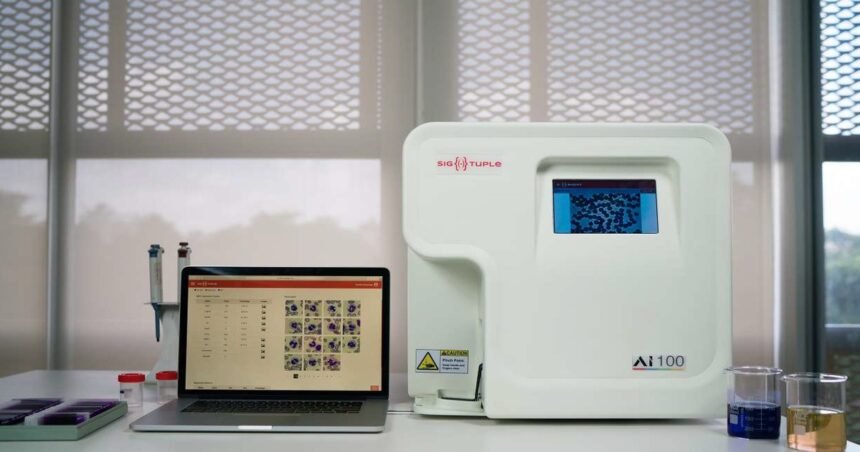
In a small clinic in Parbhani, Maharashtra, a boy’s blood smear had already been looked at once — and cleared. Then the sample went through a machine sitting in the corner of the lab, and the machine disagreed. Its AI flagged the unmistakable signs of acute leukaemia. The boy was referred to a government hospital more than 200 kilometres away, where a pathologist confirmed what the machine had seen. A manual review had missed it; the machine had not.
The machine was SigTuple’s AI100, and the story captures exactly what the Bengaluru company set out to do. India has roughly one pathologist for every 65,000 people, and of the country’s estimated one lakh laboratories, only about 20,000 do microscopy at all. The World Health Organization reckons a pathologist should spend around 20 minutes examining a single blood smear under a microscope. In a country with that kind of shortage, the queue is the diagnosis — and SigTuple decided to automate the microscope itself.
Born from a misdiagnosis
SigTuple began with a loss. Founder and CEO Dr Tathagato Rai Dastidar lost his father almost two decades ago to a misdiagnosis of acute myeloid leukaemia, and the experience stayed with him through a career in big data — he is an IIT Kharagpur alumnus who worked at American Express’s big-data lab in Bengaluru. In 2015, he founded SigTuple with former colleagues Rohit Kumar Pandey and Apurv Anand, with one ambition: to automate the manual review of visual medical data, starting with images of blood and urine.
The bet was that the microscope, a tool essentially unchanged since the 17th century, was ready to become a robot. SigTuple combined AI, robotics, microfluidics and high-resolution microscopy into a single bench-top device, and spent more than a decade refining it — the company counts 10-plus years of R&D, 27 patents and more than 30 published research papers behind the platform.
How the AI100 works
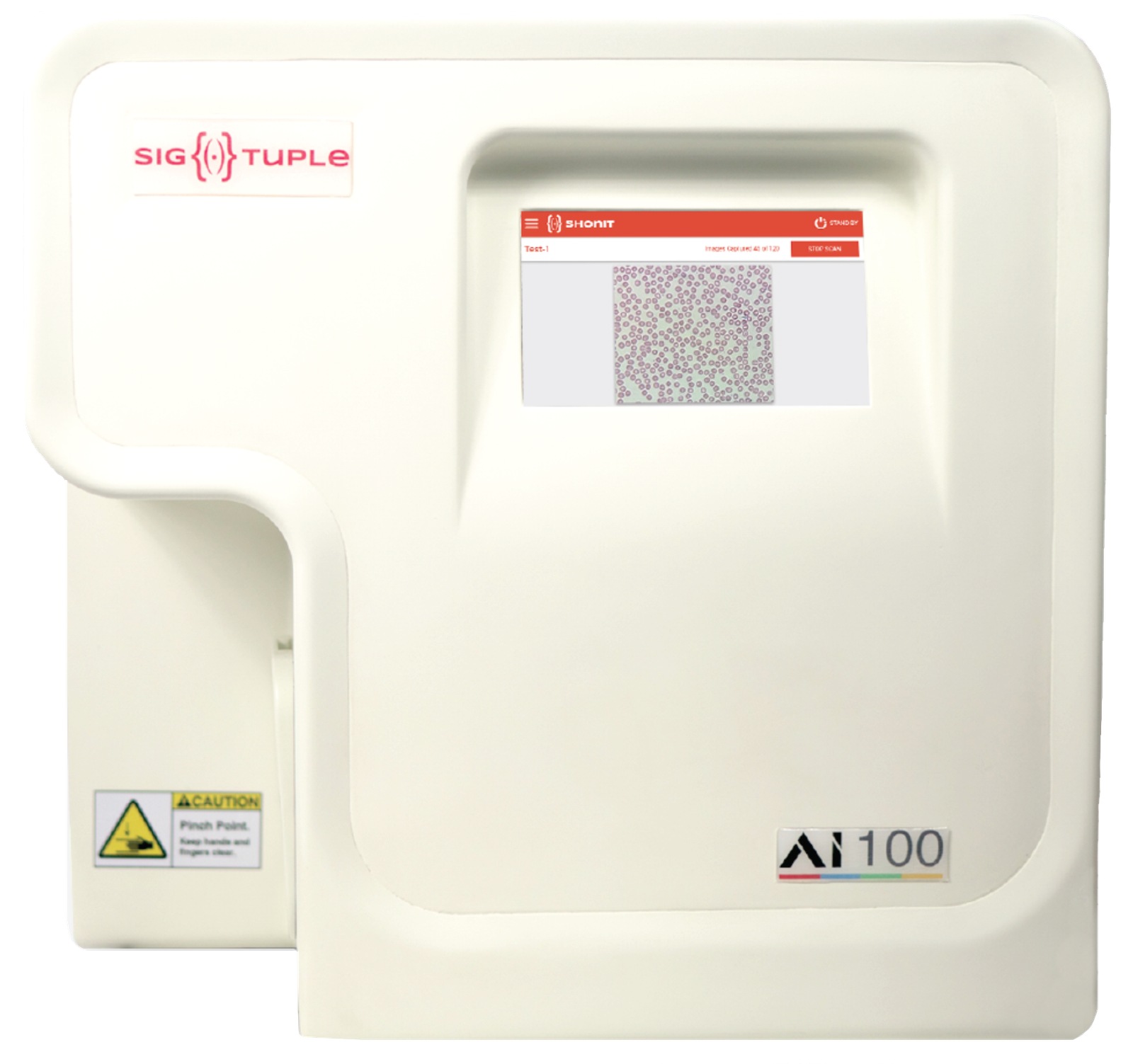
The AI100 is an automated digital microscope with a built-in AI platform. A prepared slide goes in; an optical column with a microscopic lens, LED illumination and a CMOS camera digitises the sample, and the company’s Shonit application extracts each cell and classifies it into more than 30 different cell types. The AI platform, called Manthana, analyses the digital images and prepares a report for a pathologist to review — from anywhere, through a browser.
The effect on speed is dramatic. A sample review that used to take a pathologist five to ten minutes now takes about 30 seconds, and a report is generated in under ten minutes. And the AI100 does something no other automated analyser does, the company says: it handles both of the two most common microscopic tests in a laboratory — peripheral blood smear and urine sediment — on the same machine, at 40X image resolution, with AI-aided remote review and unlimited scan storage on the cloud.
More Read

Cleared by the FDA
In September 2023, the AI100 with Shonit received 510(k) clearance from the US Food and Drug Administration — the first integrated hardware-and-AI medical device, and the first product in AI-assisted digital microscopy from India, to win the clearance. The device is CE-cleared too. “This is a watershed moment for us — to have the quality and efficacy of our product validated and approved by one of the most stringent medical regulatory authorities in the world,” Dastidar said at the time.
The clearance opened the door to the world’s most demanding healthcare market, and SigTuple has kept walking through it: the company has expanded across Southeast Asia, the Middle East and North Africa, and counts 350-plus deployments across seven countries. Its customers read like a roll call of Indian diagnostics — HCG, Manipal Hospitals, SRL, Thyrocare, Krsnaa Diagnostics, Dr Lal PathLabs, Agilus Diagnostics, Vijaya Diagnostic Centre and Apollo Hospitals — and global diagnostics leader HORIBA has partnered with SigTuple to distribute the AI100 across the Indian subcontinent.
Reaching the last mile
The deployments that matter most are the ones furthest from a big-city lab. At a 30-year-old tribal hospital in Gudalur, Tamil Nadu, which had never had a pathologist, an AI100 now serves some 300 surrounding hamlets: samples are prepared and scanned at the centre itself, and doctors in Bengaluru review them remotely. Krsnaa Diagnostics uses the same technology to carry standardised, reproducible diagnostics deep into rural India, replacing inconsistent manual review with automated analysis at scale.
It is a model built for a country where the specialist is almost always somewhere else — the machine does the looking, the AI does the sorting, and the pathologist, wherever they are, makes the call. SigTuple has raised about $50 million from investors including Accel, Chiratae Ventures, Endiya Partners and SIDBI Venture Capital, won the Top Innovator award at the ET Startup Awards 2018, and took the Judges’ Choice award at Google’s first Demo Day Asia.
What comes next
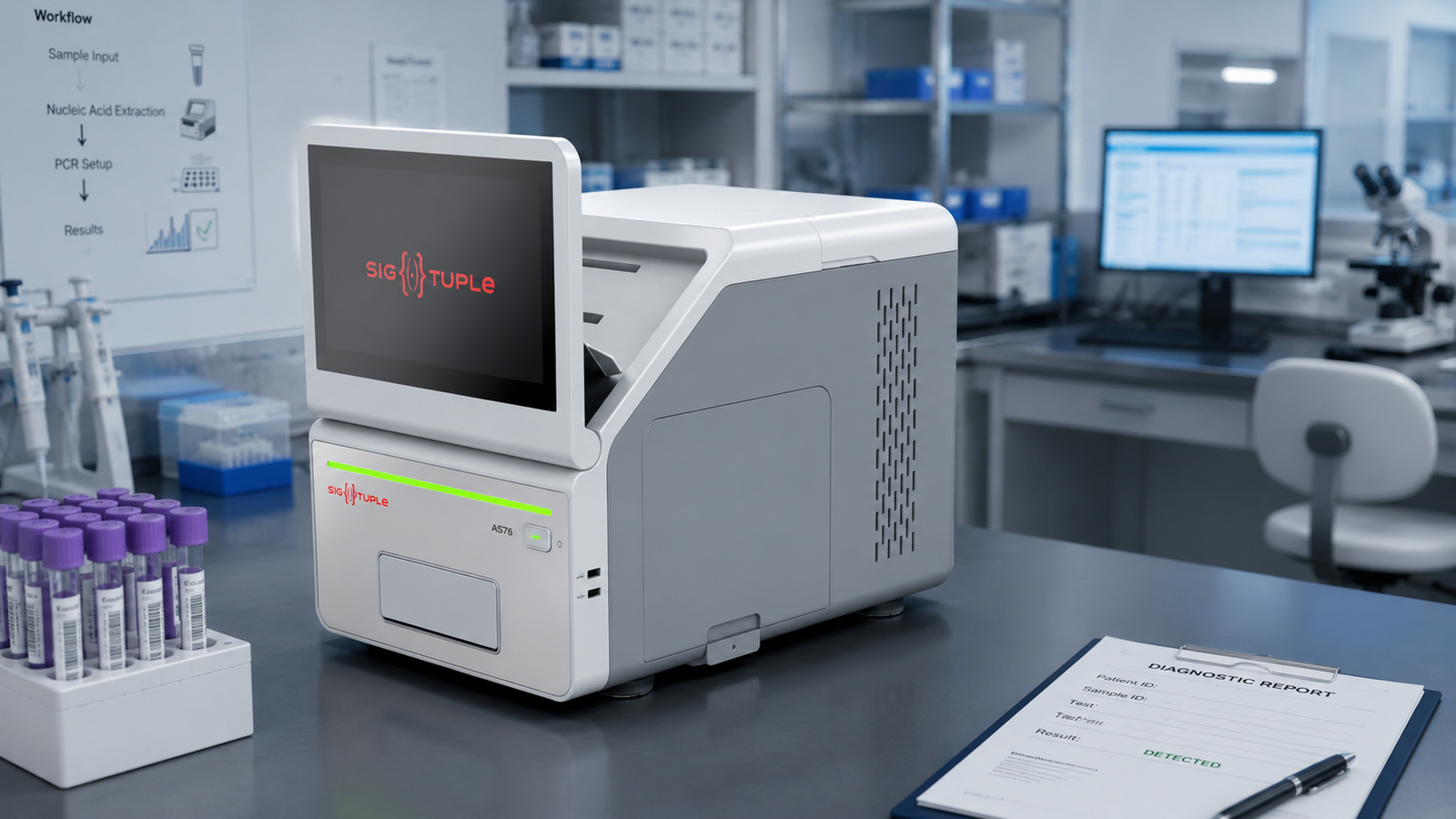
SigTuple is already building the next generation. The AS76 is a next-generation automated AI-powered digital cell morphology analyser for peripheral blood smears, with true 100X oil immersion resolution, six slides scanned simultaneously and a 200-cell leukocyte differential — and all its AI models run on the device itself, with no cloud dependency. It is CE-IVDR compliant and aimed at medium and large laboratories. Alongside it, SigVet takes the same AI-powered microscopy to veterinary clinics, bringing laboratory-grade analysis to the point of care for animals.
From a misdiagnosis that cost a father his life to a machine that catches leukaemia a tired human eye missed, SigTuple’s story is a reminder of what Indian engineering does at its best: it takes a shortage the rest of the world accepts as permanent, and builds a machine that simply refuses to accept it. A blood smear reviewed in thirty seconds, a diagnosis that reaches a village that never had a pathologist, a device cleared by the FDA — that is a microscope doing far more than magnifying. It is making sure nobody is lost to a missed slide again.
Keep reading: From Burnt Stubble to Sunscreen: Inside altM, the Bengaluru Startup Turning Farm Waste Into Chemicals · Water From Thin Air: Inside Aeronero, the Chennai Startup Pulling Drinking Water Out of the Sky · More Chemicals, Materials & Life Sciences stories
Like stories like this? Add Exceptional Technology as a preferred source on Google to see more of our reporting in your search results and Discover feed.







