


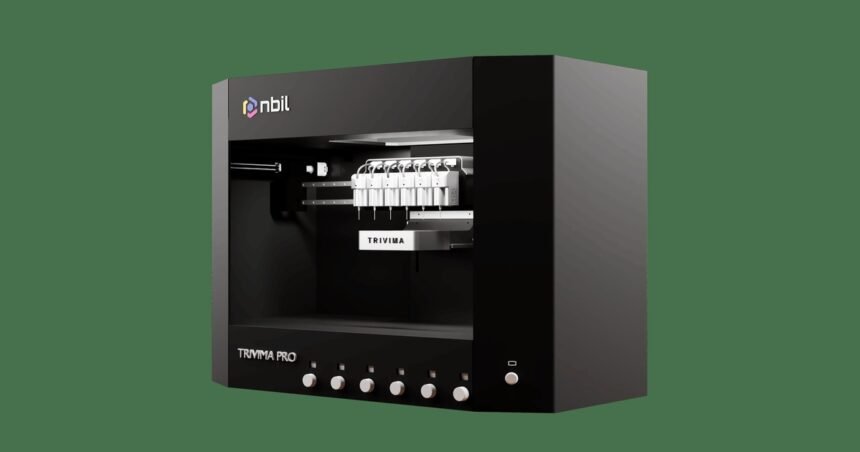
Every year, thousands of Indians wait for an organ that may never arrive, and every new medicine takes a decade and billions of dollars to reach a pharmacy shelf — much of it tested on flat layers of cells in a plastic dish that behave nothing like a living body. In Bengaluru, a small team of engineers and biomedical scientists decided the answer was to stop testing drugs on approximations and start printing the real thing. Next Big Innovation Labs builds machines that print living human tissue, layer by layer, with living cells as the ink.
Founded in 2016 by Piyush Padmanabhan, Alok Medikepura Anil and Pooja Venkatesh, NBIL — as the company is known — set out to make sophisticated bioprinting technology that Indian researchers could actually afford and use. The result is Trivima, a family of 3D bioprinters the company says was India’s first customisable bioprinter, designed and built entirely in-house. The machines now run in some of India’s best-known research labs, and in 2023 the World Economic Forum named NBIL a Technology Pioneer.
A printer that prints with living cells
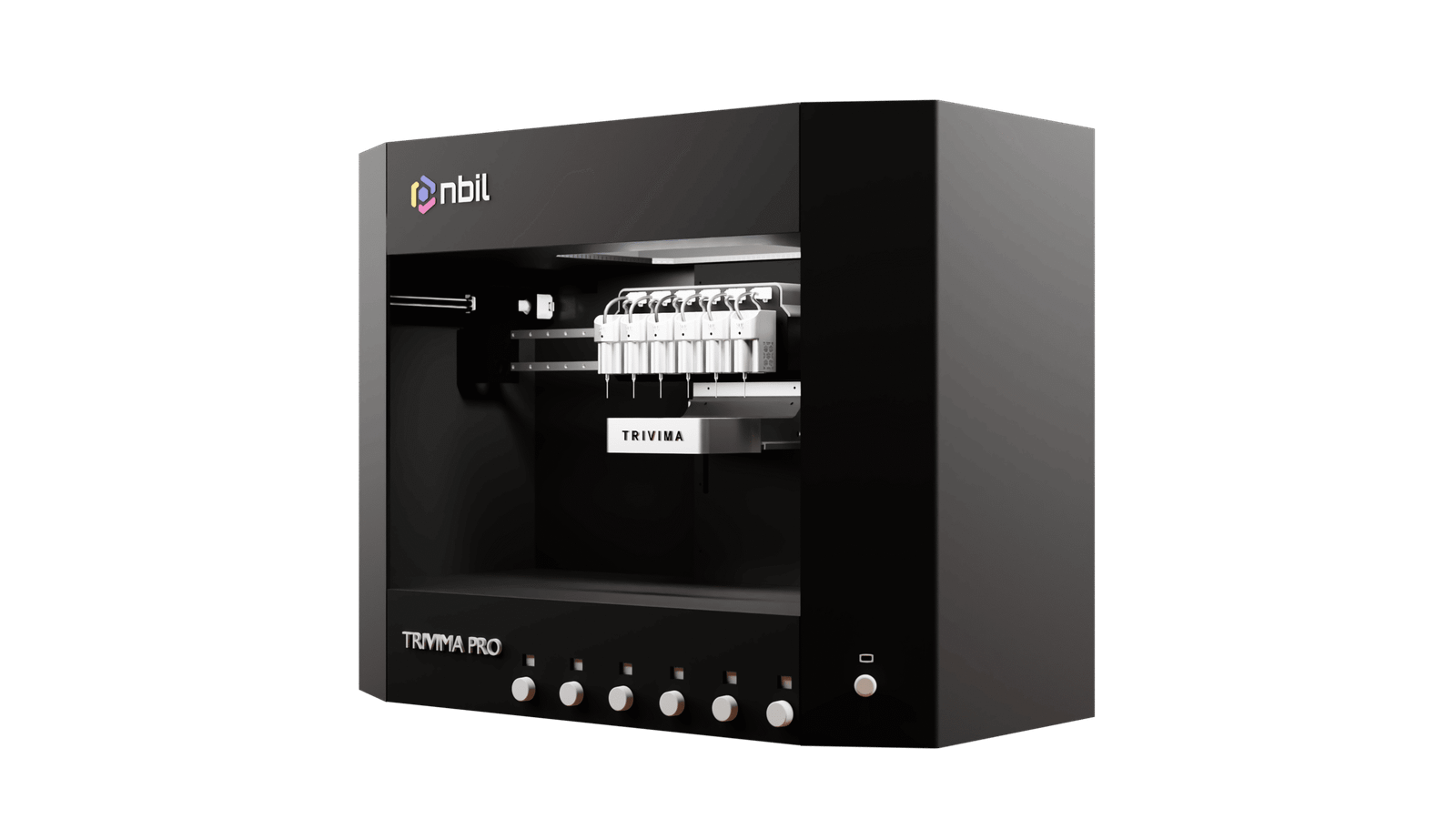
Bioprinting takes the idea of 3D printing and swaps plastic filament for bioink — living cells suspended in a gel that supports them as they grow. The printer lays the ink down in precise patterns, building scaffolds and tissue structures that mimic the real architecture of skin, bone or an organ. The company says Trivima’s print heads can work with multiple cell types in a single build, so one printed construct can carry the different cells a real tissue needs, side by side.
That matters most in the earliest, most expensive stage of medicine: finding out whether a new drug works, and whether it is safe. A three-dimensional printed tissue behaves far more like the real thing than the flat layer of cells in a dish that drug researchers have relied on for decades — so the right molecules can be spotted sooner, and the wrong ones dropped before they consume years and fortunes. NBIL says its printers are already being used for tissue disease models, 3D printed scaffolds, stem cell research, wound healing, cancer studies, patient-specific bone implants and personalised medications.
One family, three ways to print
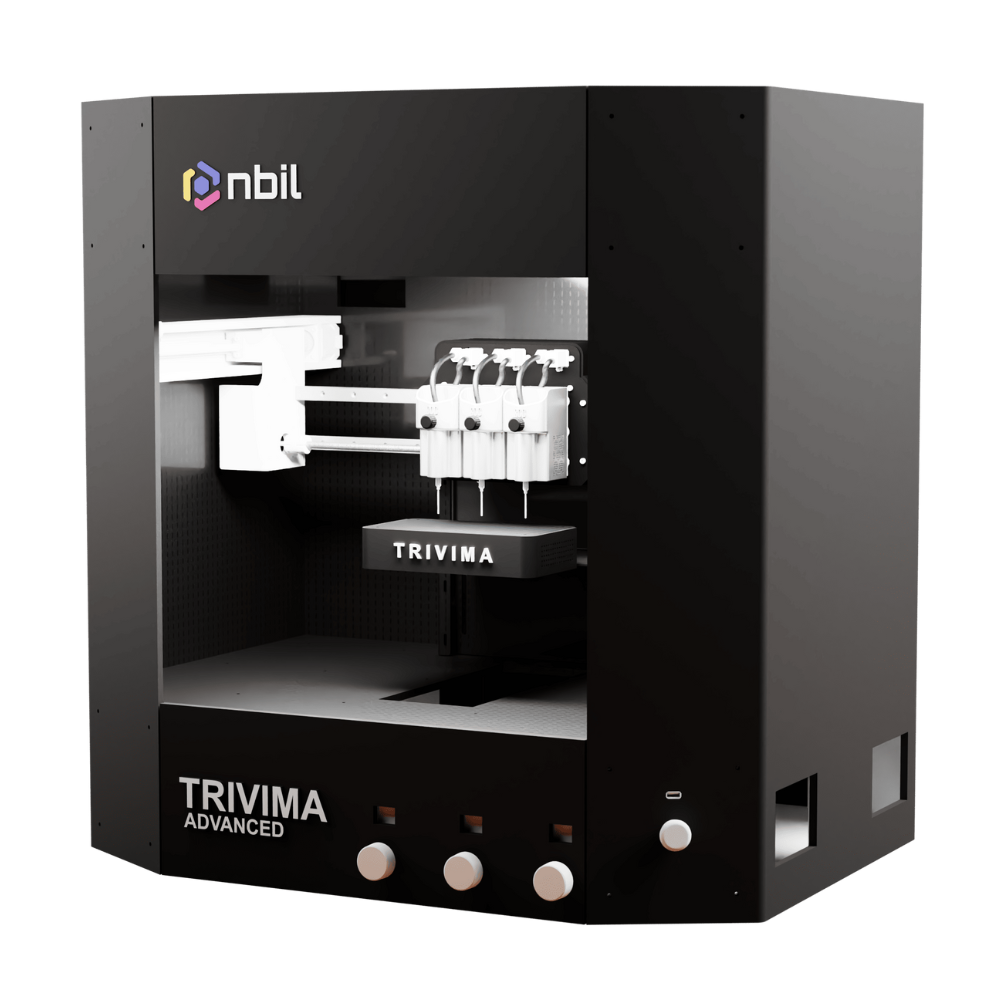
Trivima — three-dimensional, in Sanskrit — comes in three grades, so a lab can start small and grow. Trivima Basic, with two extruders and pneumatic printing, is built for researchers taking their first steps in bioprinting. Trivima Advanced adds a third extruder, combining pneumatic and coaxial bioprinting with well-plate printing for more precise, controlled experiments. And Trivima Pro, the flagship, runs six extruders across pneumatic, inkjet and pellet extrusion, handling well-plate, insert, triaxial and quadaxial printing for the most complex projects. All three run on Niyantranam, the company’s in-house bioprinter control software.
The newest member of the family prints with light instead of nozzles. Trivima AURA, which the company calls India’s first light-based bioprinter, shapes structures with light at a resolution below 30 microns, opening up microfluidics, tissue engineering and disease modelling at a fineness extrusion printing cannot reach. The company says years of research and development went into bringing homegrown light-based bioprinting to India’s research community.
More Read
From the printer to the patient
NBIL is not only selling printers — it is printing tissue itself. Its Innoskin is 3D-bioprinted human skin, built as an alternative to animal testing in cosmetic, clinical and pharmaceutical research. Its organs-on-a-chip — microfluidic chips that grow human cells and tissues to mimic how an organ behaves — are in development for hospitals and research labs testing personalised treatments, with the company working alongside Microsoft to bring AI into the bioprinting process.
The lab work keeps pushing into new territory. Using decellularised extracellular matrix hydrogels drawn from tracheal cartilage, muscle and lung tissue, the company’s printers have produced multilayered tracheal rings, a trifurcated bronchial tree, and free-form organ-shaped constructs — cornea, kidney, liver and skin — holding their shape without collapse. Trivima printers are now installed at IIT Hyderabad, King George’s Medical University in Lucknow, AIIMS New Delhi, the Central Leather Research Institute, the University of Agricultural Sciences in Raichur, and the Manipal School of Life Sciences, where Dr Manash K. Paul’s lab is using one to explore lung and tracheal tissue engineering.
The journey there was built step by step. NBIL was incubated at the Bangalore Bioinnovation Centre in 2017, backed by Karnataka government and BIRAC grants, secured two patents for its bioprinting technology in 2019, and began its first international project with Merck KGaA the same year. A partnership with HiMedia Laboratories followed in 2022, an office in Germany opened in 2018, and in 2023 the company signed an MoU with the Government of Karnataka for research and development in bioprinting.
The long game: organs on demand
“As a tool, 3D bioprinting helps lower the time-to-market for medicines and drugs,” says Alok Medikepura Anil, NBIL’s co-founder. “Otherwise, drugs are developed over 10 years.” That is the near-term prize — faster, cheaper, more human drug development. The long-term dream is bigger still: a world where the wait for a donor organ ends because the organ itself can be printed, layer by living layer, from a patient’s own cells.
It is a long road from a printed tracheal ring to a printed organ, and NBIL knows it. But every printer it installs in an Indian lab, every tissue model its machines help a researcher build, and every micron of resolution its light-based printing gains brings that future a little closer. A decade ago, an Indian bioprinter was a thing no one had built. Today, Bengaluru builds them — and the world’s labs are printing with them.
Keep reading: Liquid Trees in the Waiting Room: Inside Zaara Biotech’s Algae Machines Cleaning Delhi’s Hospital Air · An Eye Clinic That Fits in a Suitcase: Inside Forus Health’s FH eyepal, the Portable Digital Eye Clinic From Bengaluru · More Chemicals, Materials & Life Sciences stories
Like stories like this? Add Exceptional Technology as a preferred source on Google to see more of our reporting in your search results and Discover feed.







