


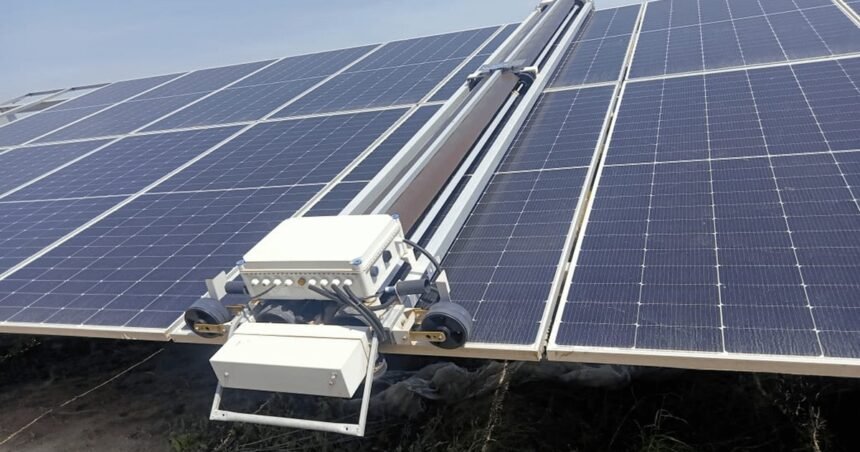
India now has more than 168 gigawatts of solar power plugged into its grid, much of it spread across the sun-baked deserts of Rajasthan and Gujarat. But the same sun that fills those panels with light also coats them in dust, and a dusty panel is a lazy panel. Washing the country’s solar fleet the old way takes an astonishing amount of water — by one estimate, up to 24,000 litres per megawatt for a single wash, or more than 4 billion litres for one nationwide cleaning cycle. In Ghaziabad, a startup called Solabot looked at that trade-off — clean energy that drinks water to stay clean — and built a robot that does the job without a single drop.
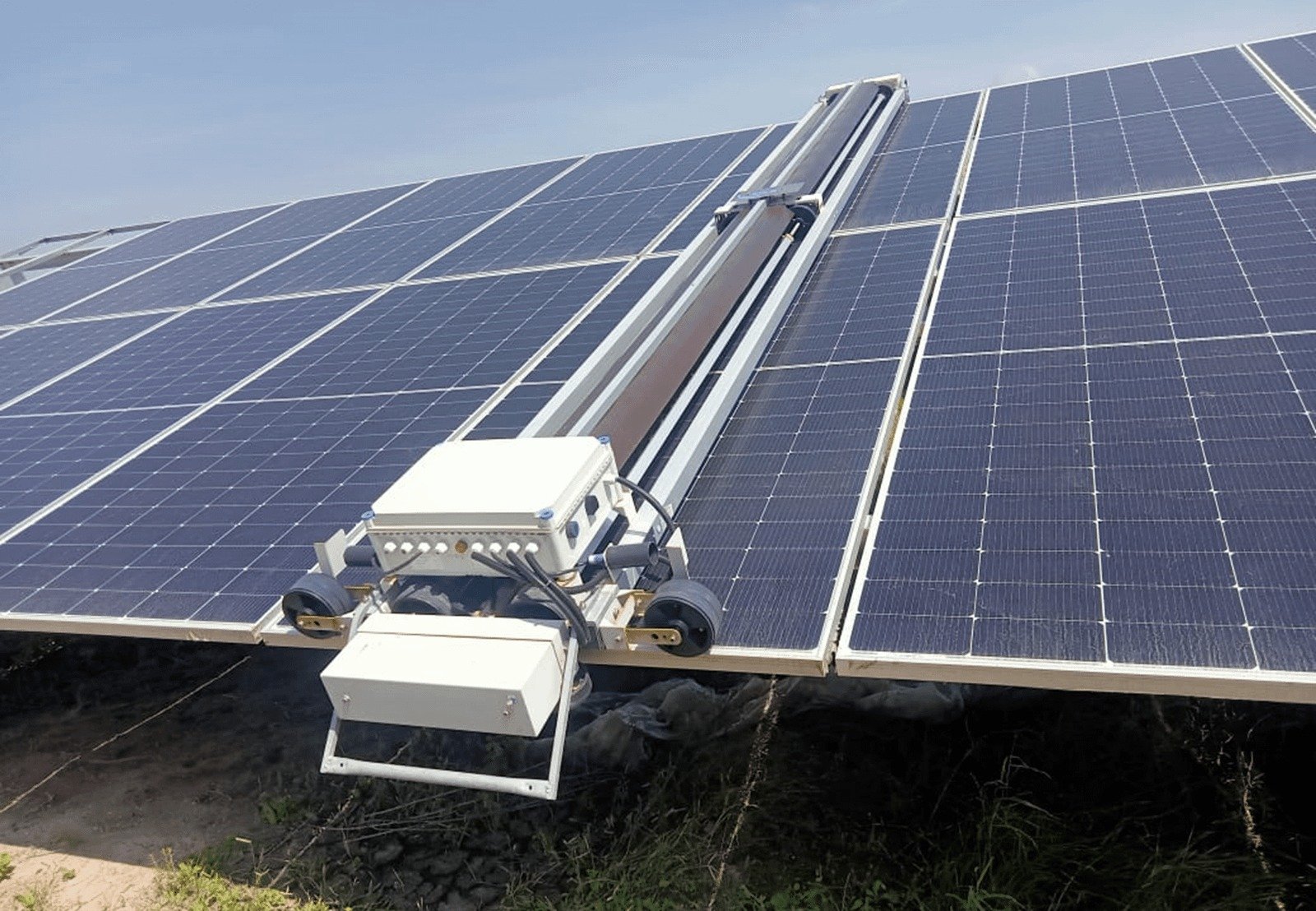
A Solabot dry-cleaning robot at work on a row of solar panels. (Image: Solabot Technologies)
Solabot Technologies was founded in 2016 by Amit Aggarwal, and it began, fittingly, on a rooftop. Aggarwal owned a small solar plant of his own and watched its output sag as dust settled on the panels — even after cleaning, the numbers never quite came back. Two years of research and development later, his team had a fully automatic machine that sweeps panels clean every day using nothing but a soft brush, sensors and the sun itself. The robot charges itself from the very panels it cleans, runs without an operator, and never asks for water.
The problem: dust is a tax on every panel
Solar plants live where the sun is strongest, and that usually means where dust is thickest and water is scarcest. A thin film of grime quietly eats into generation, and the traditional fix — crews with hoses and tankers — is slow, expensive and thirsty. In the desert districts that host India’s biggest plants, water is often trucked in at real cost. Solabot’s answer is to take water out of the equation entirely: its robots use ultra-soft PBT brushes and cleaning algorithms that lift dust without scratching the glass, guided by sensors that read the panel’s angle and obstacles, and scheduled by weather data so every row is swept daily.
More Read

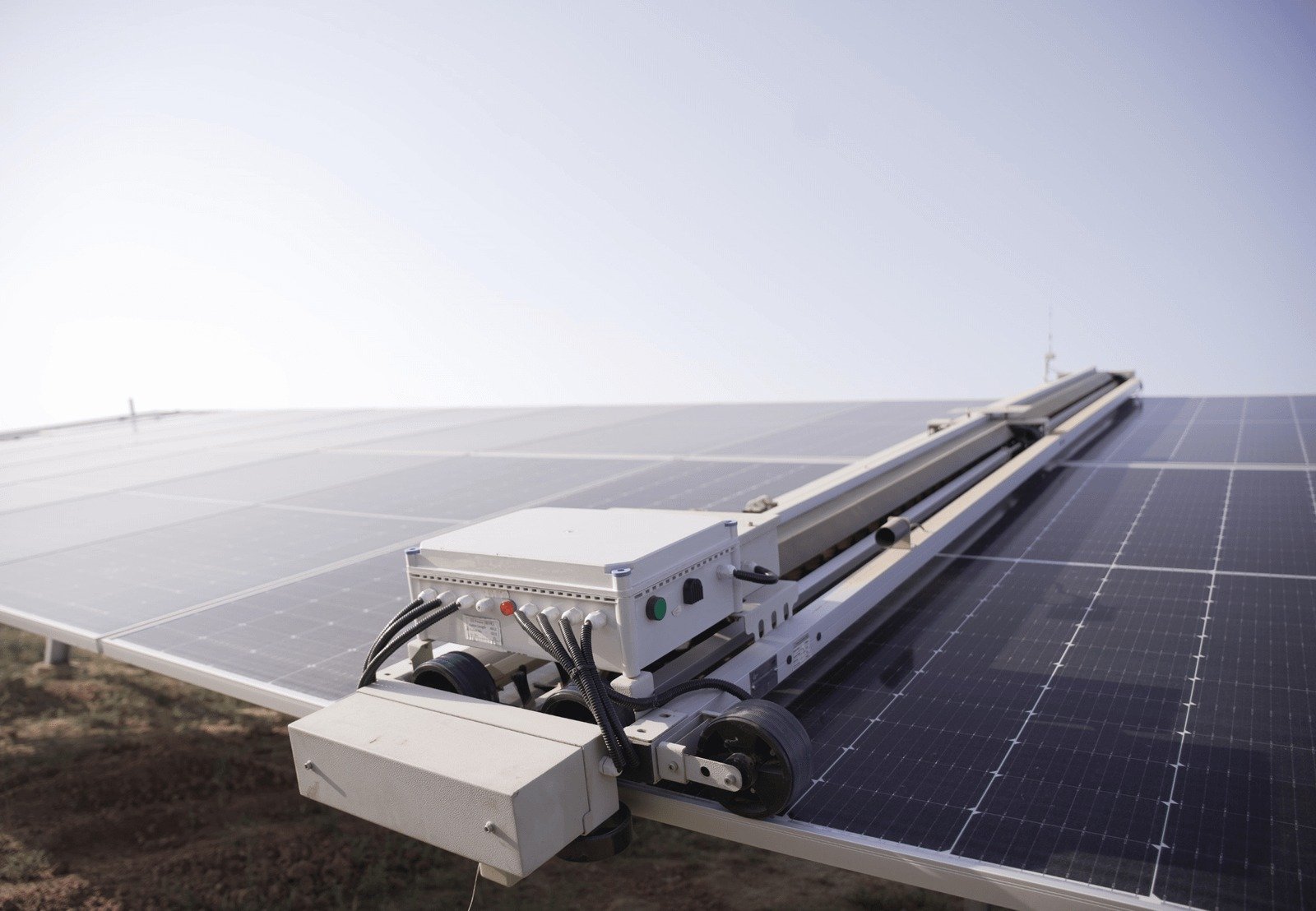
A Solabot robot sweeping a long row of panels at a utility-scale plant. (Image: Solabot Technologies)
A robot that charges itself from the sun it cleans
The flagship SB-01 is a fully automatic dry-cleaning robot: self-charging, manpower-free, and monitored and controlled through SCADA, so an operator can watch a whole fleet from a control room. Its datasheet lists a cleaning speed of 545 metres per hour, with a lithium-iron-phosphate battery topped up by its own onboard solar modules. Around it, Solabot has built a family of five machines for different sites: the semi-automatic SB-03, the SB-04T built for tracker-mounted plants, a mobile docking station that moves robots between rows, and the SB-RT for rooftops. Every one of them cleans dry, with no chemicals and no water.
Proof in the numbers
The fleet has grown fast. Solabot’s own count now stands at more than 12,400 robots installed across 152 projects in 14 states, serving more than 40 customers — and a December 2025 industry report put its robots at work on more than 12 gigawatts of solar assets. Its project list reads like a map of Indian solar: Avaada’s giant plants at Bikaner in Rajasthan, Surendra Nagar in Gujarat and Bhadla, and O2 Power’s Pokhran site. The company says its cleaning can lift a plant’s power production by up to 5%, and it is the only Indian robotic company to hold compatibility certificates from 16 Tier-1 module manufacturers. The work is backed by a 38,000-square-foot integrated manufacturing facility and service engineers posted across eight states. In December 2025, the industry noticed: Solabot was named Company of the Year for Robotics & Automation at the RE Assets awards.
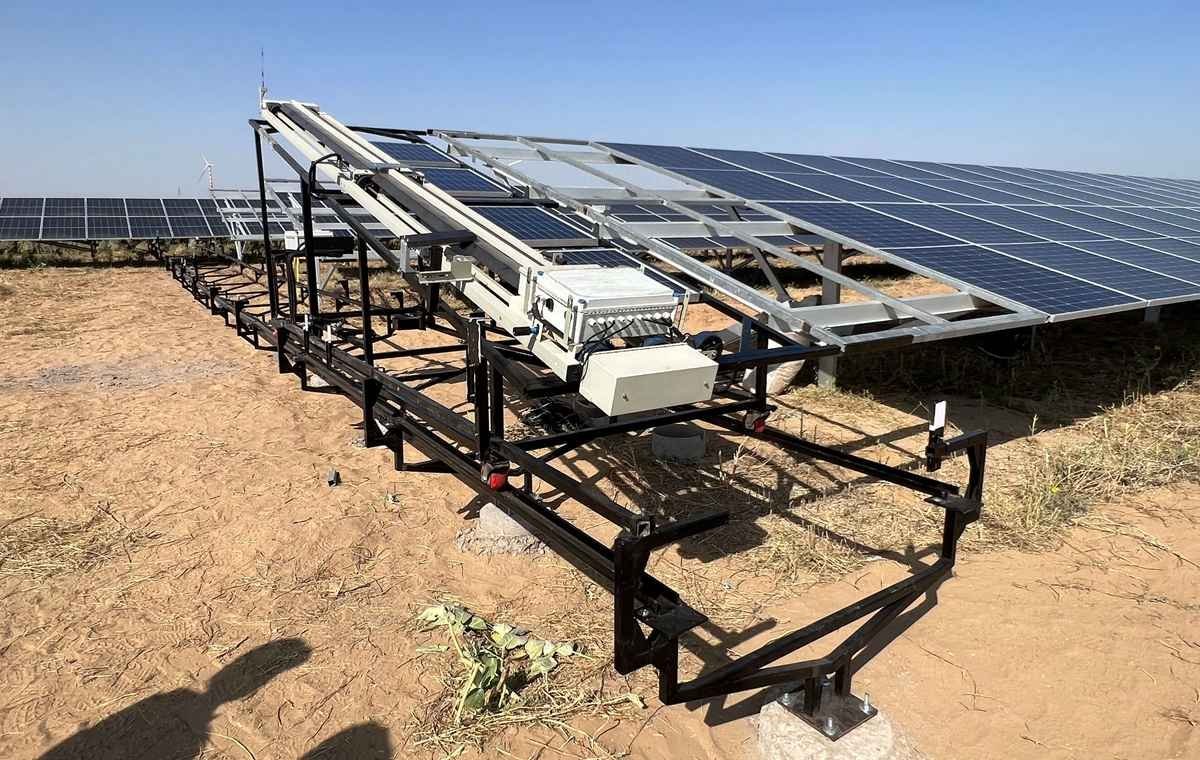
A Solabot tracker cleaning robot on a solar farm. (Image: Solabot Technologies)
Built by people who know the field
Solabot is, at its core, an engineering company that grew out of a founder’s own frustration. Aggarwal spent two years with his team turning a rooftop annoyance into a machine, and the company has kept that field-first approach: a dedicated in-house R&D team, its own manufacturing, and service engineers on the ground in the states where its robots work, with in-house customer care for instant troubleshooting. It is the unglamorous, essential layer of India’s energy transition — the machines that keep the machines clean.
India’s solar boom will only get bigger, and every new gigawatt adds more glass to keep clean in places where water is precious. Solabot’s bet is that the panels of the future will be swept by robots that ask for nothing but sunlight — and that the cleanest energy is the kind that doesn’t drink to stay clean.
Keep reading: A Coating Thinner Than a Hair: Inside TriNANO, the Mumbai Startup Making Solar Panels Work Harder · The Silver Lines Inside Every Solar Panel: Inside AnyD Materials, the IIT Bombay Startup Ending India’s Paste Imports · More Energy & Power stories
Like stories like this? Add Exceptional Technology as a preferred source on Google to see more of our reporting in your search results and Discover feed.







