Picture a black Mahindra Thar rolling down a rough dirt track outside Bhopal — no driver, no passenger, nobody inside at all. A bike rider cuts in from the left. The company’s older Bolero test vehicle pulls out and stops dead in front of it. The Thar slows, steers around the obstacle and keeps going, dodging every blocker the team throws at it. That is the scene Swaayatt Robots filmed in January 2026, and the company describes it as the first driverless autonomous dodging test of its kind.
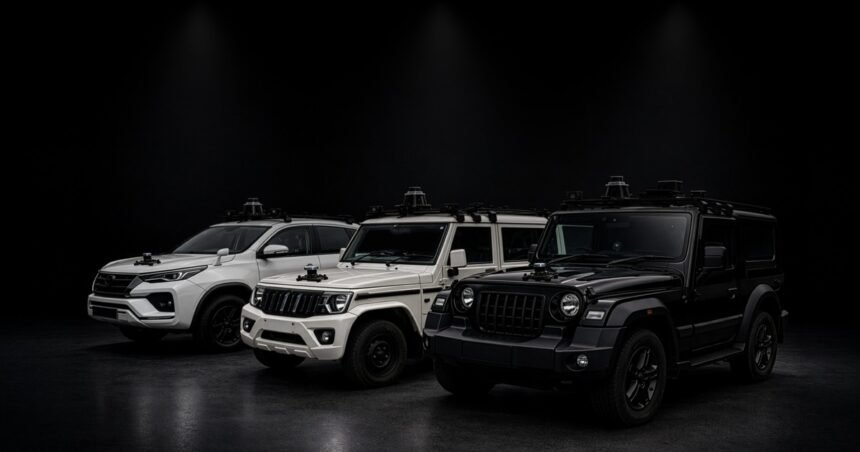
Swaayatt Robots was founded in 2015 in Bhopal by Sanjeev Sharma, and it has spent a decade building one thing: a universal autonomous navigation system that can be fitted to any vehicle. The company’s test fleet — a Fortuner, a Bolero and the black Thar it calls Deep Xplorer — all run the same stack, and the team behind it has grown to more than 100 people. The work has drawn a $3 million seed round in 2021, a $4 million post-seed round in 2024, and a grant from the Ministry of Electronics and Information Technology, with NVIDIA support along the way.
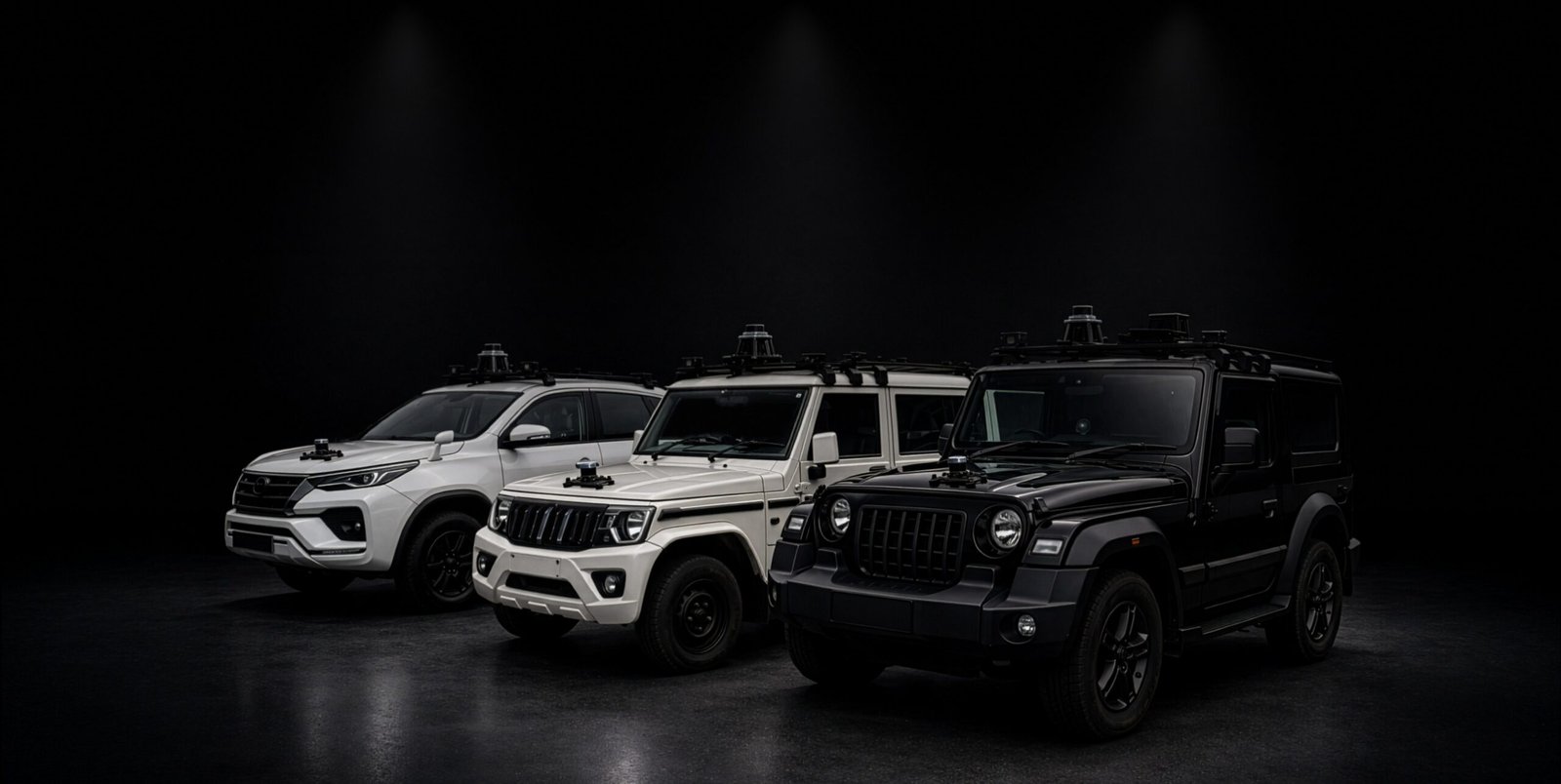
Swaayatt’s test fleet — a Fortuner, a Bolero and the black Thar “Deep Xplorer”, each fitted with the company’s sensor arrays. (Image: Swaayatt Robots)
Dodging without a driver
The January 2026 demonstration is the one that put the Bhopal startup on the map. On an off-road trail built to simulate a village road, the three-door Thar drove itself at around 30 kmph with no safety driver and no occupants at all. Bikes crossed its path, the Bolero “Xplorer” overtook it and stopped in front of it, and a Fortuner came at it from the wrong side — and the Thar slowed, steered around each obstacle and carried on. The company says its core planning software runs at over 200 Hz, and that the system handles steering, brake, accelerator and clutch on the manual-transmission vehicle entirely on its own. Underneath the driving is what the company calls a Multi-Agent Intent Analysis and Negotiation Framework — software that reads what every other vehicle on the road is about to do, and decides its own move in response.
Ninety on the ghats — and a reverse gear of its own
The dodging test was only the start. In September 2026 the same Thar was filmed running driverless on narrow mountain roads at more than 90 kmph, with the company fine-tuning the system so the vehicle holds its line through fast turns without skidding, drifting or rolling. Then, in October 2026, came the trickiest manoeuvre of all: on a single-lane road, the Thar met a truck coming the other way and reversed — entirely on its own — to let it pass, repeating the move for a Fortuner, a Bolero and a tanker. The company even built a robotic manipulator that shifts the gear selector between Drive and Reverse, just as a human driver would. The company says it is achieving all of this through its motion-planning algorithms and decision-making policies, comparing a conventional planner with a policy learned through deep reinforcement learning.
More Read

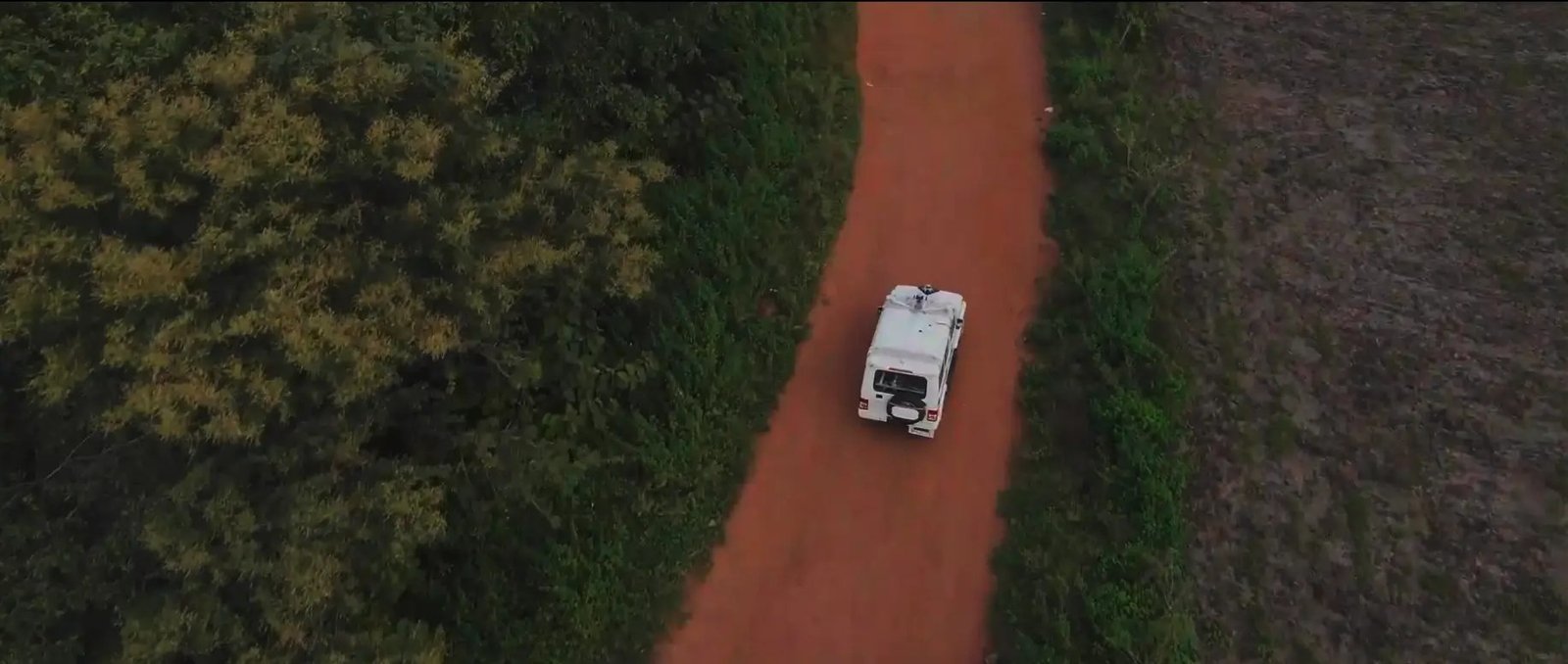
The company’s Bolero test vehicle on a dirt road during trials. (Image: Swaayatt Robots)
Built for the hardest roads first
What makes the Bhopal approach different is the problem it chose first. Rather than the tidy highways and predictable traffic of the West, Swaayatt set out to drive on Indian roads — where a cow, a tractor and a wrong-side Fortuner can all appear in the same minute. Its system is built on reinforcement learning, unsupervised learning and inverse reinforcement learning, with teams working on perception, mapping and localisation to build a live picture of everything around the vehicle. Founder Sanjeev Sharma puts it simply: a vehicle that can drive safely on Indian roads can drive safely anywhere in the world. The company’s stated roadmap now runs to autonomous driving at 100 kmph on mountainous terrain, and an energy-efficient chip of its own with retrofit capability, so the system can be fitted to vehicles already on the road.
Swaayatt Robots’ Deep Xplorer driving itself off-road, with no safety driver. (Video: Swaayatt Robots)
What makes the Bhopal story stand out is how much of it happened far from India’s usual startup map: a decade of work, a team of more than 100 people, and a vehicle that now reverses, dodges and climbs mountain roads with nobody at the wheel. The Thar that drives itself is only the demonstration — the ambition is a retrofit kit that can turn any vehicle driverless, starting with the hardest roads in the world.
Keep reading: Ten Years in the Making: Inside Motormind’s Hyperion-1, India’s First Homegrown Roadster · Ninety Tonnes, No Diesel: Inside Propel Industries, the Coimbatore Company Electrifying India’s Mines · More Automotive & Mobility stories
Like stories like this? Add Exceptional Technology as a preferred source on Google to see more of our reporting in your search results and Discover feed.