



Picture a solar farm in Rajasthan at noon. The sun is doing exactly what it is supposed to do, but the panels are not: a fine film of dust has settled on the glass, the cells underneath are running hot, and every week a tanker of water arrives to wash it all off. Across India, the same quiet loss repeats on rooftops and in solar parks — panels that were rated at 20 to 24 per cent efficiency in a laboratory deliver closer to 16 to 18 per cent in the real world. A Mumbai startup called TriNANO Technologies decided the fix should not be a bigger panel or a better washer. It should be a coating thinner than a human hair.
TriNANO was registered in January 2022 and incubated at SINE, IIT Bombay, after its founders had spent years working on the problem. The company is led by Dr Harsh Sethi, a materials engineer with more than two decades in energy and engineering, alongside co-founders Dr Anshu Dandia and Dr Tanujjal Bora. The research behind the coating began in 2018–19, and the company says it is now the world’s first solid-state nano-coating to combine light-trapping, self-cleaning and anti-reflection in a single layer.
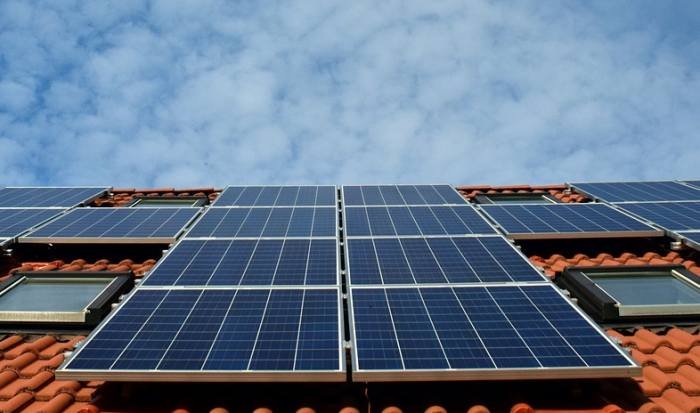
Rooftop solar panels — the surface TriNANO’s nano-coating protects. (Image: TriNANO Technologies)
One coating, four jobs
The coating itself is a solid-state layer of inorganic, ceramic and oxide materials, just 0.4 microns thick — about 400 nanometres — deposited on the top glass of a solar panel through an electro-deposition process. TriNANO calls the technology 3D Quantum Cladding, and it does four things at once. It traps more light, it cuts reflections, it sheds dust and water, and it reflects the infrared wavelengths that heat panels up, so coated panels run up to 3°C cooler. The science borrows from nature: light-trapping inspired by super-black feathers, anti-reflection inspired by moth eyes, and self-cleaning inspired by the lotus leaf. Because the layer bonds directly with the glass at the nanoscale, the company says it works on any panel — any brand, any age — with no new hardware at all. A portable coating machine applies it on site, even on panels already in service, without taking them down.
Proven in the lab, proven in the field
The numbers behind the coating have been checked outside the company. India’s National Centre for Photovoltaic Research and Education (NCPRE) at IIT Bombay put it through accelerated UV exposure, thermal cycling from 40°C to 185°C, damp-heat testing at 85 per cent humidity, and months of outdoor soiling trials against uncoated control panels — and confirmed the output gain of up to 4 per cent. The National Institute of Solar Energy in Gurugram recorded similar findings. Pilots followed at a Toyota rooftop project in Mumbai, a Tata Power pilot in Bengaluru and a residential rooftop in Navi Mumbai, and the company has since run pilots across nine states, from Punjab and Haryana to Karnataka and Andhra Pradesh.
More Read

The field results tell the same story. Renkube tested the coating against an uncoated panel for five months in Bengaluru and recorded 6 per cent higher energy output from the coated side. SolarSquare ran a five-month trial on a 3.24 kWp plant in Pune and measured 5.9 per cent more energy from coated panels. Chemitech, which used the coating across several EPC projects between 2023 and 2025, reported more than 4 per cent extra output and less frequent cleaning. In all, the company says the coating has now been tested in 22 commercial projects, and its customer list includes Tata Power, Adani Green, Waaree, Ayaana, Avaada, Blupine Energy, Solar Square and Chemitech.

TriNANO CEO Harsh Sethi shows the Best Deeptech Startup Award certificate to Prime Minister Narendra Modi at National Startup Day 2026. (Image: TriNANO Technologies)
The economics of a cleaner panel
For a solar plant owner, the coating is priced at 95 paise per watt-peak, and the company says the investment pays for itself in 26 to 30 months at utility scale — faster, under a year, on a rooftop. The maintenance maths is just as striking: the company says annual upkeep falls from Rs 25–30 lakh to under Rs 1 lakh per megawatt, because cleaning cycles drop by 40 to 56 per cent and water use for cleaning falls by up to 55 per cent — saving more than a million litres of water per megawatt every year. The coating is built to last more than 10 years, where conventional coatings typically last around three months, and the company says it extends a panel’s life by two to three years. The coating is listed at around Rs 750 per 540 Wp panel.
From Mumbai to the world’s sunniest places
The work has drawn national recognition. On 16 January 2026, at National Startup Day in New Delhi, TriNANO won the Best Deeptech Startup Award at the National Startup Awards 5.0, and its founders met Prime Minister Narendra Modi at the company’s booth. The Ministry of New and Renewable Energy has featured the technology on its website as a Made-in-India innovation for improving solar output, IIT Bombay signed an R&D collaboration with the company in December 2024, and the startup has been named to Forbes India’s Top 100 startups for climate tech and won the Maharathi Award at Startup Mahakumbh 2025. The company holds an Indian patent, with international filings in progress, and has raised close to $700,000 — roughly Rs 6 crore — across a grant round and a seed round, including a Rs 3.1 crore seed round led by Spectrum Impact. The next step is scale: the company plans to raise Rs 5.5 crore to lift its annual coating capacity from 7 MW to 330 MW by FY 2026–27, with automated robotic coating machines, and then to take the coating to sun-rich markets in the Middle East, the Americas, Europe and Australia.
India now has some of the cheapest solar power in the world — and some of the dustiest sunlight. TriNANO’s bet is that the cheapest way to get more from the panels India already owns is not to build more of them, but to keep the ones it has clean, cool and catching every ray. A layer 400 nanometres thick is doing exactly that, one rooftop and one solar park at a time.
Keep reading: The Silver Lines Inside Every Solar Panel: Inside AnyD Materials, the IIT Bombay Startup Ending India’s Paste Imports · The Battery That Grows on a Plant: Inside Aloe E-Cell’s Aloe Vera Revolution · More Energy & Power stories
Like stories like this? Add Exceptional Technology as a preferred source on Google to see more of our reporting in your search results and Discover feed.







