
Right now, most sensors are couriers, not thinkers. A cardiac patch records a heartbeat, a factory sensor feels a vibration, a camera grabs a frame — and all of that raw data travels somewhere else to be understood. Sensesemi, a Bengaluru fabless semiconductor company founded in 2014, is building chips that flip that journey around. Its flagship system-on-a-chip, SenseSoC, puts the intelligence on the sensor itself, so the device can decide what matters before a single byte leaves it.
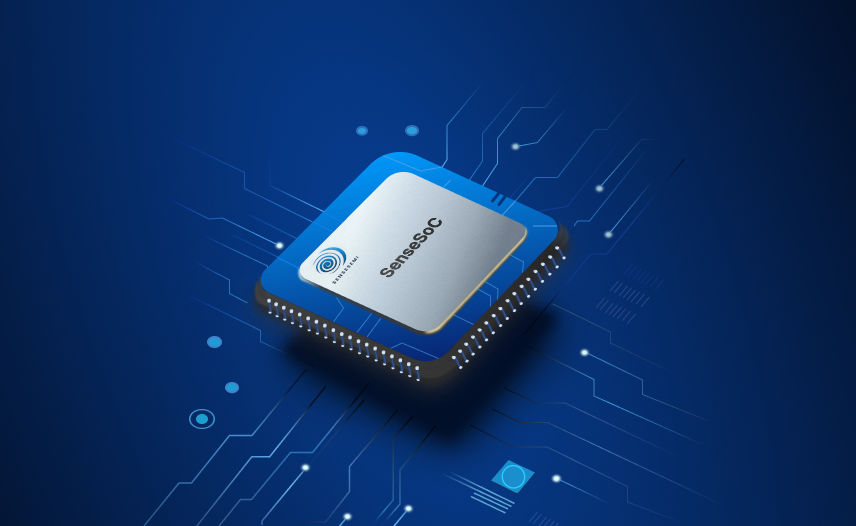
The SenseSoC chip — Sensesemi’s edge-AI system-on-a-chip. (Official image: Sensesemi)
Three jobs, one chip
SenseSoC is Sensesemi’s answer to a problem the company’s founder and chief executive, Vijay Muktamath, sums up in one line: “There are a lot of sensors in the world today, but there is no intelligence at the sensor node itself. That is where we come in.” Conventional edge-AI designs split the work across several components — one chip to sense, another to compute, another to connect. Sensesemi integrates all three onto a single piece of silicon: AI inferencing, wireless mesh connectivity, and precision analogue signal processing. The result, the company says, is a chip that runs real-time, on-device intelligence at ultra-low power — the kind of power budget that lets battery-operated devices keep working for years rather than days.
Analogue AI: the power breakthrough
In parallel, Sensesemi is building an analogue AI inference processor — a bet that doing the maths in the analogue domain, rather than converting every signal to digital first, can cut power consumption dramatically. The company’s co-founder and head of engineering, Namit Varma, says the approach is aimed squarely at devices that live under severe constraints on power, size and cost: medical implants, industrial sensors, and the wearables that monitor hearts around the clock. The company says analogue-domain inferencing can deliver multi-year battery life without giving up performance or reliability — and the applications it names show the range: cardiac monitoring, neurostimulation and smart drug delivery in medical devices; predictive maintenance and vision-based quality inspection in factories; multi-sensor driver assistance and driver monitoring in cars.
A founder’s second attempt — and an ecosystem that caught up
This is Muktamath’s second attempt at building a fabless chip company in India. More than a decade ago, he tried to build a Wi-Fi chipset startup — and watched it stall on infrastructure that simply did not exist in India then: no OSAT facilities, no commercial testing infrastructure, not even basic probe stations. Packaging had to be done in Japan, and, as he told The Economic Times, “the logistics completely consumed us.” The contrast today is the story of India’s semiconductor ecosystem in miniature. “Today, I can call an OSAT and say the chip will arrive in 15 days, and they are ready,” he said. Sensesemi plans to fabricate its first-generation chips with TSMC, while testing and packaging will happen with domestic OSAT players — the company is also exploring a partnership with Kaynes Technologies. The company is approved under the government’s Design Linked Incentive (DLI) scheme, and under it is developing its SoC for IoT and medical devices, with an MCU and wireless IP integrated with an ultra-low-power analogue front end and AI inferencing IP.
More Read

From tape-out to production
The work is now funded to move fast. In January 2026, Sensesemi raised Rs 25 crore (about $2.75 million) in a seed round led by Piper Serica, with LetsVenture Angel Fund, Sun Icon Ventures, MyAsiaVC, Whitepine Investments and Jain Oncor participating, alongside the REAN Foundation and angel investors Niraj Shah and Deepak Khanna. The company says the capital will tape out and validate its first two test chips in 2026, put them through field testing so customers can run real-world applications on the silicon, and build the production-grade version through 2027, with commercial production targeted for the first quarter of 2027. The prize is large: industry estimates put global edge-AI chip shipments at 5–7 billion units a year by 2030, in a world the company’s founder expects to hold close to 30 billion connected devices — of which only 8–10 billion have intelligence built in today.
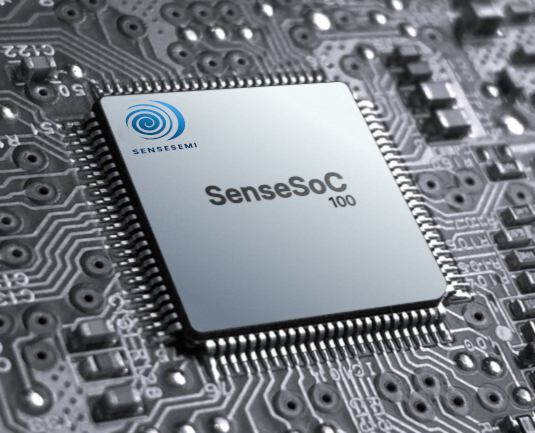
The SenseSoC 100, up close on a circuit board. (Official image: Sensesemi)
What comes next
Sensesemi is already extending the same philosophy beyond sensing into vision. The company is applying its mixed-signal architectures and analogue in-memory compute to cameras and surveillance systems, fusing non-visual signals — audio, vibration, thermal data — with video, and filtering aggressively on the device so that only meaningful events ever need to be transmitted. In power- and bandwidth-constrained places, the company says, that on-device filtering is the only practical approach — and it keeps sensitive data local, inside the camera or sensor, rather than streaming it to a server. It is the same idea that runs through everything Sensesemi builds: the smartest place for intelligence is where the data is born.
Keep reading: The AI Workforce Behind India’s Supply Chains: Inside Enmovil’s CADDIE · Seeing Inside the Metal: Inside AugurAI, the Trichy Startup Teaching Factory Cameras to Spot the Invisible · More Industrial Automation & Technology stories
Like stories like this? Add Exceptional Technology as a preferred source on Google to see more of our reporting in your search results and Discover feed.