


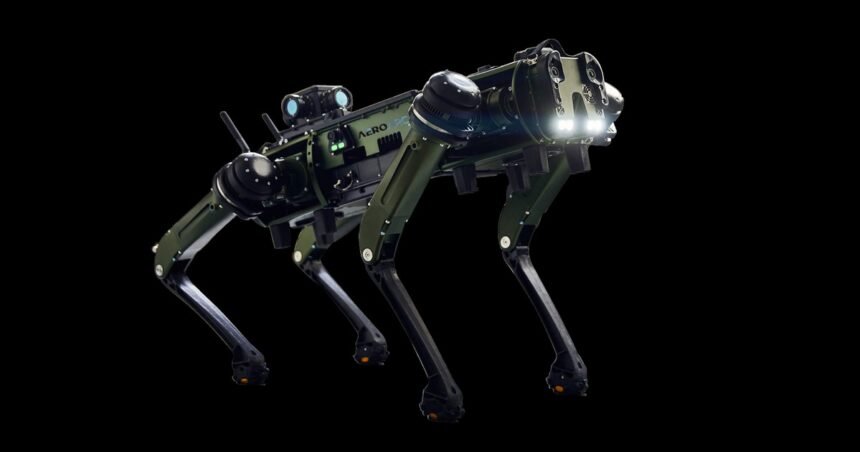
For more than 75 years, the Indian Army’s mules have carried loads up Himalayan trails no vehicle could reach. Now a machine built for the same job — and carrying the same name — is marching beside the soldiers. The MULE, short for Multi-Utility Legged Equipment, is a four-legged robot built by AeroArc, a New Delhi defence-technology company. One hundred of them already serve with the Army, and they have gone from the parade ground to patrolling the Line of Control.
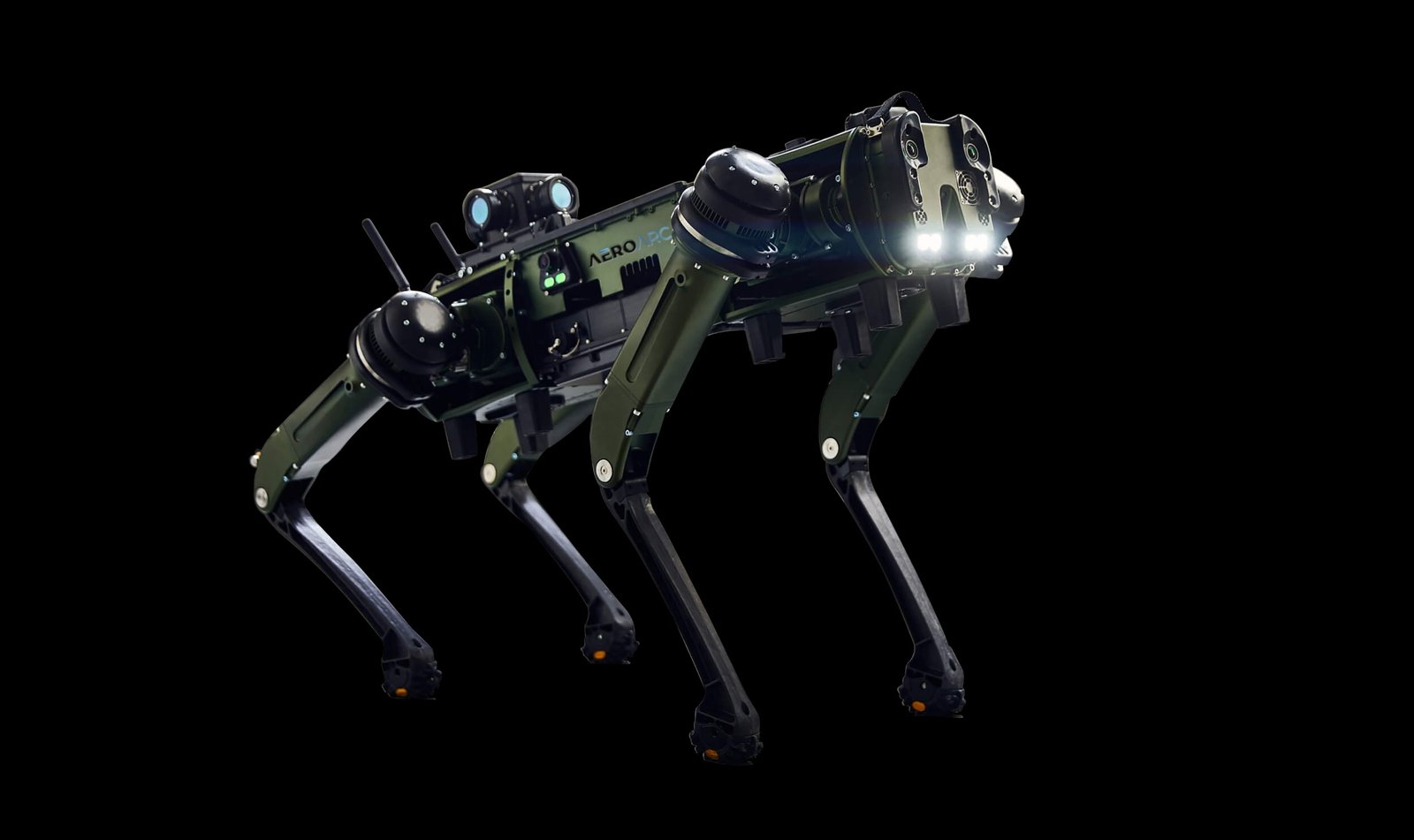
The ARCV MULE — AeroArc’s four-legged robot for the Indian Army. (Official image: AeroArc)
A robot built for the hardest ground in India
The MULE is a quadrupedal unmanned ground vehicle — a Q-UGV — designed to go where wheels and tracks cannot. It weighs 51 kilograms, climbs stairs and steep slopes, scrambles over debris and crosses water obstacles, and it keeps working in temperatures from -40°C to +55°C. Its IP67 rating makes it dustproof and water-resistant, and the whole machine sets up in 15 minutes. An NVIDIA Xavier processor runs its autonomy, and it can work for three hours on the move or stand by for around 20 hours, operating up to 10 kilometres from its handler over Wi-Fi and LTE.
The machine is built from five parts working together: a compute box that acts as its brain, a battery, a front sensor head and a rear sensor head that read the world around it, and the four legs that carry it across it. It can be driven remotely or left to operate on its own, and it carries up to 12 kilograms of mission equipment on its back.
From the parade ground to the Line of Control
The Army ordered 100 MULEs under the fourth tranche of its emergency procurements in September 2023, and took delivery of them in June 2024. Eight of the robots marched in the Army Day Parade in Pune on 15 January 2025, and they appeared again at the Republic Day parade in Kolkata days later — the first time robotic mules had marched in an Indian parade.
More Read

Since then the MULE has gone to work. The Army has deployed the robots for patrolling along the Line of Control in Akhnoor, Jammu and Kashmir, where their cameras and sensors help soldiers spot danger early, and an Army official told ANI the robots were also used during Operation Sindoor. It is the kind of deployment that turns a demonstration into a tool soldiers rely on.
One machine, many missions
What makes the MULE remarkable is how much it can be asked to do. The platform is modular, so the same robot can carry small arms, electro-optical and thermal vision systems, loitering munitions, a robotic manipulation arm, or chemical and radioactive detection sensors. Through a single ground control station, one operator can drive the robot into a remote or contested spot, watch the live picture it sends back, and identify, track and lock targets with precision. The company says the MULE can even carry a remotely controlled weapon station.
The mission list the Army has for it runs long: perimeter security, asset protection, handling hazardous chemical, biological, radiological, nuclear and explosive material, bomb disposal, and intelligence gathering. Every one of those is a job that would otherwise put a soldier in harm’s way.
The bigger brother: VIRA
AeroArc’s ground robots do not stop at four legs. Its VIRA platform is a tracked, fully electric logistics vehicle built to carry up to 500 kilograms of stores, ammunition and equipment to frontline units across rough terrain. It runs on exchangeable rechargeable batteries, tops out at 13.4 kilometres an hour, and can navigate manually, follow pre-fed waypoint routes, or simply follow its leader. The company says VIRA can also be customised for medical evacuation and human transport — a tracked ambulance for ground no wheeled vehicle can reach.
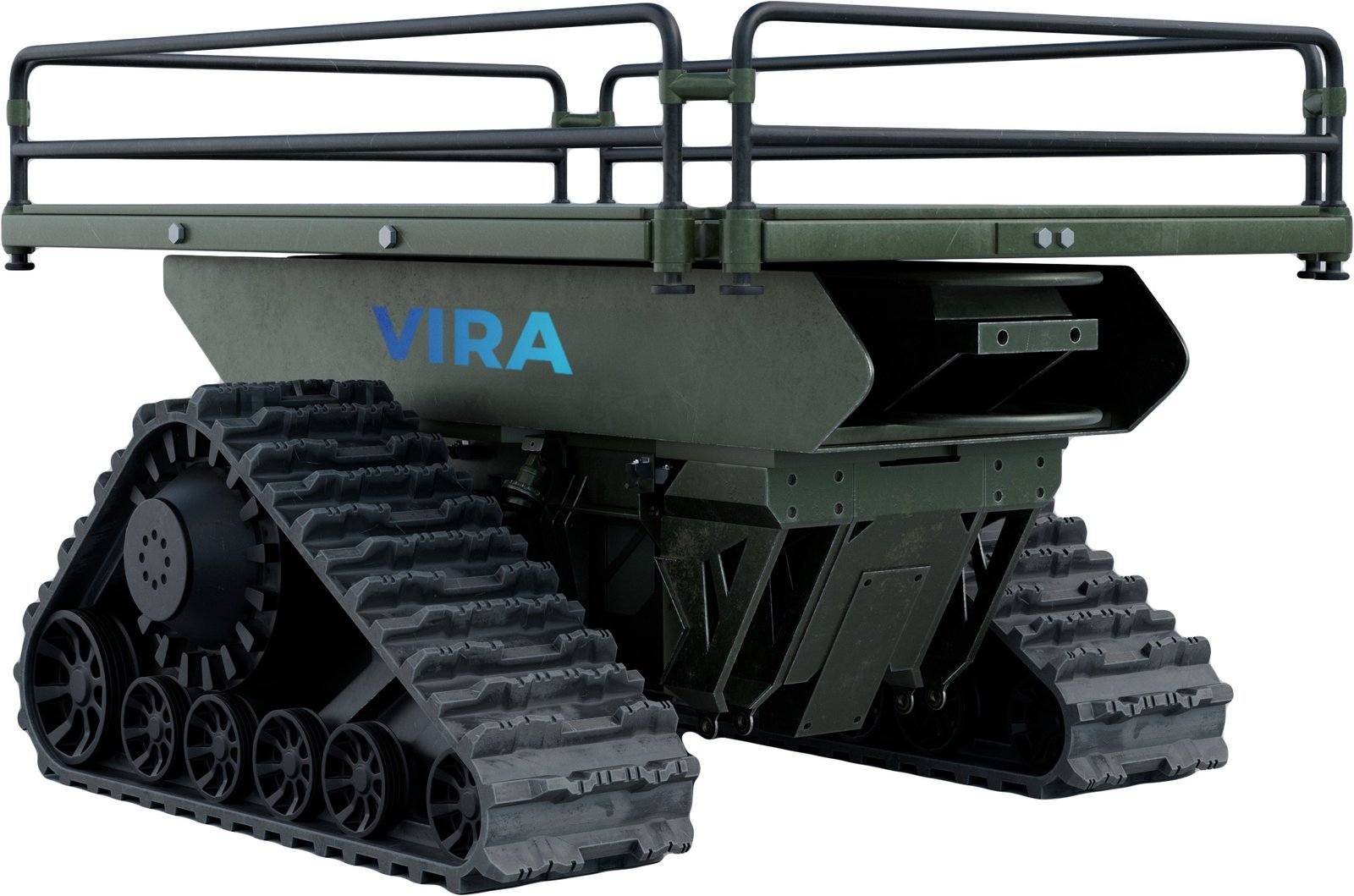
VIRA, AeroArc’s tracked logistics platform, carries up to 500 kg across rough terrain. (Official image: AeroArc)
A company built around unmanned systems
AeroArc was founded in New Delhi in 2018, led by managing director Arjun Aggarwal, and it is a subsidiary of Arc Ventures. Work on the MULE began in 2017, and the company raised a Series A round in December 2023 to scale it. AeroArc builds aerial systems too — the company says it has deployed more than 1,000 drones, logged over 250,000 flight hours, and holds 19 patents across its portfolio.
The MULE’s story is really the story of that patience paying off: nine years from first research to robots on the Line of Control, built by a Delhi company that manufactures and integrates the system entirely in India. The Army’s mules served for 75 years. Their robotic namesake has only just begun.
Keep reading: The 6.5-kg Falcon: Inside Pixiu Systems’ SYENA ASTRA-1, the Backpack Loitering Munition for India’s Small Units · Light-Speed Defence: Inside Paras Defence’s RayStrike-9, the Laser Weapon Hunting India’s Drones · More Aerospace & Defense stories
Like stories like this? Add Exceptional Technology as a preferred source on Google to see more of our reporting in your search results and Discover feed.







