Between 20 and 24 November 2026, on the firing ranges at Pokhran, a Nagpur-built machine spent five days doing something no Indian system had done before. Rockets and guided micro-missiles rose from a vehicle-mounted launcher and struck real drone targets flying in formation — a swarm, met in the air and broken apart before it could reach anything worth protecting. Solar Defence and Aerospace Limited (SDAL) calls the system Bhargavastra, and the company says the trials mark the moment India’s answer to the drone swarm moved from drawing board to deliverable hardware.

Two layers, one answer
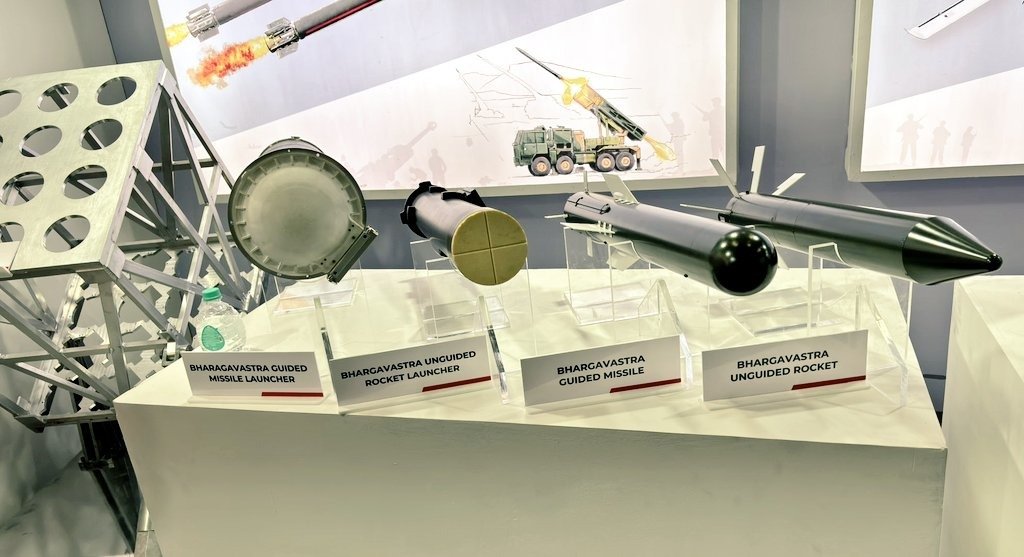
Bhargavastra is, the company says, India’s first indigenously designed and developed two-layer, vehicle-mounted counter-swarm drone system. The two layers are the heart of the idea. The first is a 64-tube launcher firing unguided air-defence rockets, built to break up a swarm across a wide area — the company says a single salvo can destroy drones within a 20-metre radius, at ranges up to 2.5 kilometres. The second layer is a 64-missile launcher firing guided micro-missiles, each with autonomous guidance and an infrared seeker, for the targets that need precision: the fast, the evasive, the high-value ones. The micro-missiles lock on after launch and home in on their own, and the company says the whole sequence, from detecting a target to intercepting it, takes under 16 seconds.
A single launcher carries 64 rockets or missiles in 8×8 cassettes and can loose them in salvo mode, several launches within 10 seconds, with 360-degree coverage. The two layers work as one system: the rockets thin the swarm, the missiles finish what is left. And because the threat is not always a swarm — sometimes it is a single loitering munition slipping in quietly — the same launcher can answer that too.
Seeing the swarm before it arrives
A counter-drone system is only as good as its eyes. Bhargavastra watches the sky with surveillance radar, passive radio-frequency detectors and electro-optical and infrared sensors, fused through an AI-enabled command-and-control system that builds a live air picture and assigns targets to the launcher. The company says the radar can pick up medium and large unmanned aircraft at 10 kilometres, and small drones at 6 kilometres — even ones with a radar cross-section as small as 0.01 square metres — while the electro-optical system keeps tracking through day and night.
The system also plugs into the wider air-defence network: it can integrate with Akashteer and the Integrated Air Command and Control System, so a Bhargavastra vehicle is not fighting alone but as one node in a layered shield. The architecture is open, so sensors and effectors can be configured to the mission, and the company says a soft-kill layer of jamming and spoofing can be added for a complete system.
From Gopalpur to Pokhran
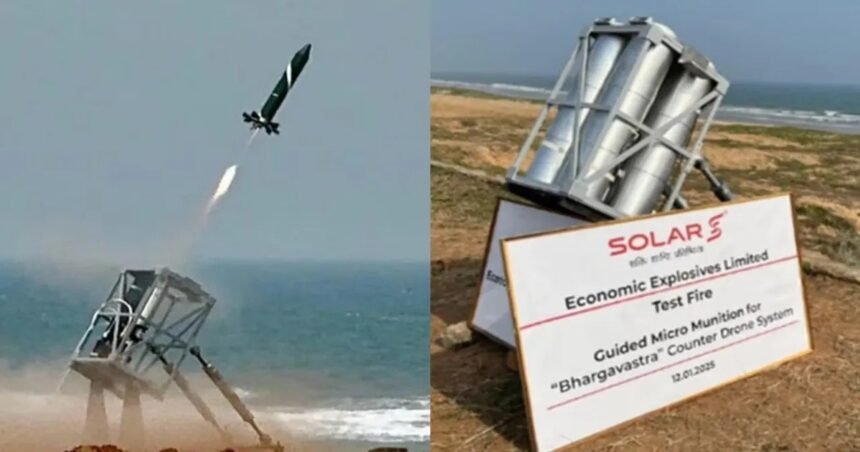
Bhargavastra’s road to Pokhran has been a steady climb. The system fired for the first time on 12 January 2025, hitting a stationary target in the air at 2.5 kilometres from the Seaward Firing Range at Gopalpur in Odisha; the next day it scored a clean hit on a moving electronic target. On 13 May 2025, before senior officers of the Corps of Army Air Defence, it fired three test rounds — two single rockets and a two-rocket salvo loosed within two seconds.
More Read

In July 2026 the company demonstrated the complete system to all three services at its Nagpur facility, detecting and tracking a simulated drone swarm, building a real-time air picture and assigning targets to the launcher. The November trials at Pokhran were the next step: the full integrated system, rockets and micro-missiles, fired against actual swarm drone targets, with the company reporting that the warheads struck their designated points and the micro-missiles proved their guidance and terminal homing. Bhargavastra is now ready for prototype demonstration in its deliverable configuration, the company says.
Built on its own initiative
What makes Bhargavastra unusual is how it began. Solar Group developed it on its own initiative — no formal request for proposals from the armed forces — after studying the drone wars in Ukraine and Nagorno-Karabakh, where cheap unmanned aircraft rewrote the economics of the battlefield. The formal programme followed: a Project Sanction Order from the Ministry of Defence in July 2024 under the Make-II (Buy Indian-IDDM) category, with a project completion date of March 2027 and plans for one prototype set and 12 deliverable sets. The Army asked for a rocket-based system; SDAL went further and built the guided micro-missile layer itself.
Everything in the system — hardware, software and intellectual property — is Indian, the company says, with the micro-rocket and micro-missile munitions developed by group company Economic Explosives Limited. The launcher rides on a 7.5-tonne-class all-terrain vehicle, and the complete system is spread across three vehicles carrying the launchers and the integrated sensor, command and control systems. It is built to work in deserts, on plains and at high altitude, up to 5,000 metres.
The Solar Group behind it
SDAL is the defence arm of Solar Industries India, the Nagpur-headquartered listed company that built its name on industrial explosives and has spent the last few years turning itself into a defence manufacturer. The same team delivered 450 Nagastra-1R loitering munitions to the Indian Army in October 2026 under a Rs 158-crore emergency-procurement contract, and began delivering the anti-tank Nagastra-2 the same month. Its Rudrastra hybrid VTOL drone was tested at Pokhran in June 2025, and it is developing a 150-kg-class loitering munition with CSIR-NAL. Bhargavastra is the third leg of that portfolio: Nagastra strikes, Rudrastra watches and loiters, Bhargavastra defends.
Why now
The drone swarm is the newest problem in warfare, and the hardest to answer cheaply. A swarm is designed to overwhelm: dozens of small, fast, expendable aircraft arriving together, too many and too cheap for conventional air defence, and increasingly autonomous — which means jamming and spoofing, the soft answers, do not always work. Bhargavastra’s answer is deliberately hard and deliberately cheap: small rockets and missiles, built in India, fired in salvos, at a fraction of the cost of the surface-to-air missiles they replace. It is a system designed for the war the world is already fighting, built by a company that decided not to wait to be asked.
That is what makes Bhargavastra worth watching. It began as a private bet on a threat most people had not yet taken seriously, and it has arrived at the point where the Indian Army can take delivery of a finished, vehicle-mounted system. The swarm has met its match — and the match was made in Nagpur.
Keep reading: The Flytrap in Orbit: Inside Cosmoserve Space, the Hyderabad Startup Catching Dead Satellites · The Brains of the Arsenal: Inside Ammunic Systems, the Bengaluru Startup Building India’s Electronic Fuzes and Warheads · More Aerospace & Defense stories
Like stories like this? Add Exceptional Technology as a preferred source on Google to see more of our reporting in your search results and Discover feed.