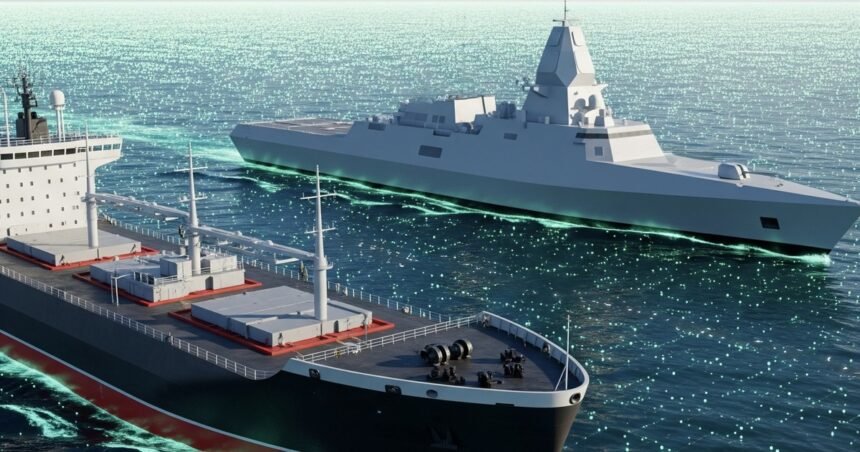
Some of the hardest engineering in Indian shipbuilding is not the steel of the hull — it is everything that has to work together inside it. That is the world a 15-person Chennai startup has just stepped into at the highest level: AstraYAN, incubated at IIT Madras, has emerged as the lowest bidder to integrate the propulsion systems of five of the Indian Navy’s next-generation warships.
Outbidding the world’s shipbuilding giants
The contest for the Propulsion System Integration (PSI) contract ran for more than a year, and it began with five prominent global players in the fray — among them Fincantieri of Italy, Navantia of Spain and RENK of Germany, names that have powered navies around the world for decades. The technical evaluation was carried out by the Indian Navy, the Naval Science & Technological Laboratory (NSTL) of the DRDO, and the shipyards themselves. After technical and commercial evaluation, three companies qualified — Fincantieri, RENK and AstraYAN — and the Chennai startup emerged L1, the lowest bidder, for the tender.
For AstraYAN’s chief operating officer, Lt Cdr Raghuveeraje Urs (Retd), a naval architect who served in the Indian Navy, the result carries a special weight: the company says it is the first Indian company to achieve this complex technological feat — and it did so with a team of just 15 people.
The heart of the ship: CODAG-CC propulsion
Propulsion system integration is the discipline of making a warship’s powerplant behave as one machine. For the Next Generation Corvettes, that means the advanced Combined Diesel and Gas Turbine–Cross-Connect (CODAG-CC) arrangement — diesel engines and gas turbines combined in a cross-connect layout, so power can be shared and shifted across shafts to match whatever the mission demands, from a high-speed sprint to a long, quiet patrol.
Getting that integration right decides whether a warship delivers its designed speed, range and manoeuvrability on every deployment. It is exacting, systems-level engineering — and it is precisely the ground AstraYAN has chosen as its own.
Fifteen people and a digital-first playbook
AstraYAN was founded in 2025 with a single conviction: that the future of shipbuilding belongs to intelligent digital platform systems — what the company calls the “brain and heartbeat” of today’s smart vessels and tomorrow’s unmanned ones. Its platform, ARKionics, is designed for modern smart and unmanned ships, grounded in avionics principles and built for seamless integration of control and machinery systems.
More Read

Underneath it sits VyomARK, the company’s in-house development framework, engineered for high data throughput, robust security and a modular, scalable architecture. The company’s designs integrate AI at their core for real-time decision-making and adaptive operations, and they are developed with Model-Based Systems Engineering to manage the complexity of bringing many systems together as one.
That thinking runs through its product family: SmartARK for digital platform and simulation systems on conventional and smart ships, RemoteARK for unmanned remote-controlled ships, AutonomARK for unmanned autonomous ships, and IntegARK — its baseline product — for system design and integration from conventional to unmanned, commercial to naval ships, specialising in complex propulsion systems for naval and special applications. Even the name carries the ambition: AstraYAN fuses Sanskrit and Latin words to mean a vessel of advanced intelligence and powerful tools.
The ships at the heart of it
The corvettes themselves are among the most significant warships India is building. On 2 November 2026, the Ministry of Defence signed contracts worth ₹53,866.50 crore with Garden Reach Shipbuilders & Engineers (GRSE) and Goa Shipyard Limited (GSL) for eight Next Generation Corvettes — five to be built by GRSE under a ₹32,000 crore programme, and three by GSL. The ships will measure 127 metres in length with a 17.6-metre beam and a deadweight tonnage of 4,950 tonnes, with an endurance of 14 days at sea and a maximum speed of 26 knots.
Designed for a wide spectrum of maritime missions, they will undertake offensive ship-to-ship and ship-to-surface missile attacks, anti-missile defence, anti-submarine warfare, escort duties, maritime interdiction operations including Visit, Board, Search and Seizure, and local naval defence. The bid now moves into the price negotiation stage, which the company says will take about a month before the deal closes with GRSE — and AstraYAN plans to pitch for the propulsion integration of GSL’s three corvettes as well.
For a startup founded in 2025, the arc is extraordinary: a 15-person team from Chennai, incubated at IIT Madras, now stands between the drawing board and the engine rooms of the Navy’s next frontline warships — proof that in Indian shipbuilding, the smartest systems can come from the smallest rooms.
Keep reading: Designed by the Navy, Built in Kolkata: Inside GRSE’s Five Next-Generation Corvettes · From Kerala’s Backwaters to the Open Sea: Inside MKEL Marine’s Five Indigenous Watercraft Lines · More Shipbuilding & Maritime stories
Like stories like this? Add Exceptional Technology as a preferred source on Google to see more of our reporting in your search results and Discover feed.