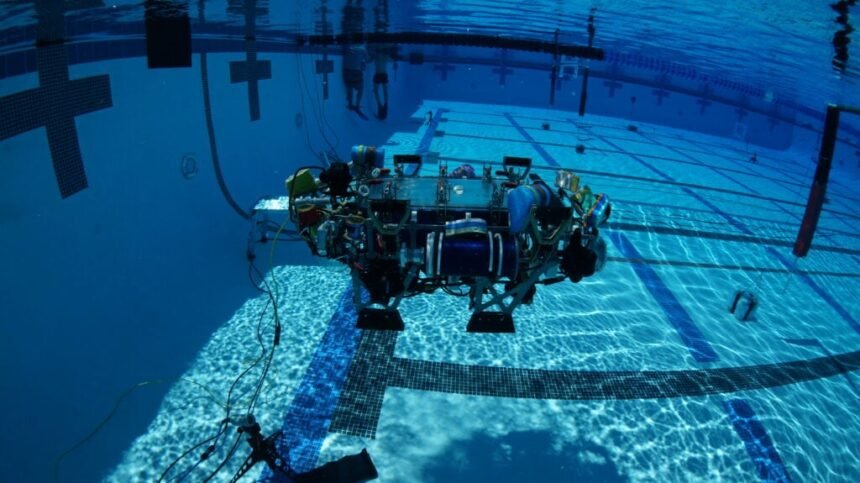
GPS doesn’t work underwater. Radio dies within metres. So an autonomous underwater vehicle is on its own the moment it submerges — no operator, no tether, no second chances. Every July, student teams from around the world gather in California to prove their robots can think alone in the deep end of a swimming pool. In 2026, IIT Bombay’s AUV-IITB team came home with two first-place finishes — and a story worth telling precisely, because the headlines got it slightly wrong.
What RoboSub 2026 actually was
RoboSub 2026 ran from 11 to 16 July at the Woollett Aquatics Center in Irvine, California — the 29th edition of the competition, with 58 teams from 9 countries, according to YourStory’s coverage. The robots must complete fully autonomous missions: navigation, object detection, pipeline tracking, underwater manipulation. No human control during runs.
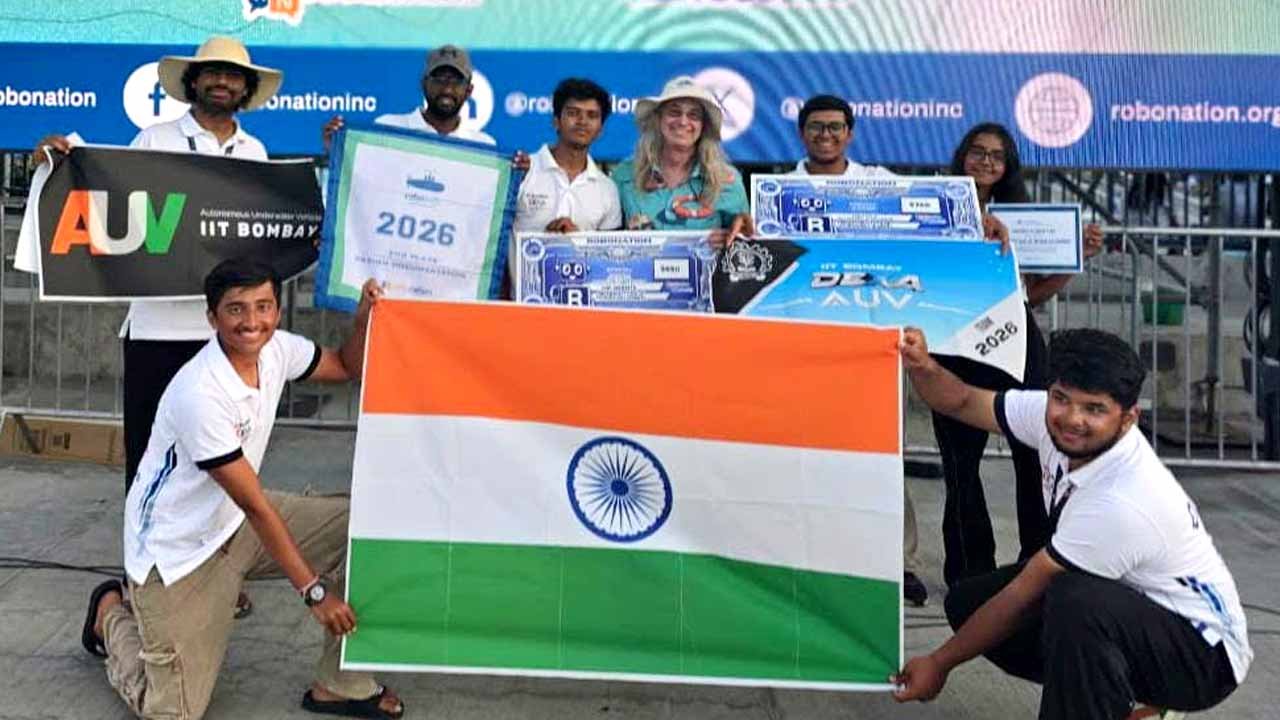
Here is the honest framing, because it matters. AUV-IITB did not win the overall competition — NUS Bumblebee took first overall, followed by Istanbul Technical University and NTU, per industrywired’s results roundup. What the IIT Bombay team won: first place in the Overall Wildcard Challenge and first place in Overall Website Evaluation, plus fifth in the Global Autonomy Challenge, second in the MathWorks Simulation Challenge, and third in the Technical Design Report. Those are real achievements against a world-class field. They are not the overall championship, and this post won’t call them that.
The machines: Matsya 7 and Mini Matsya
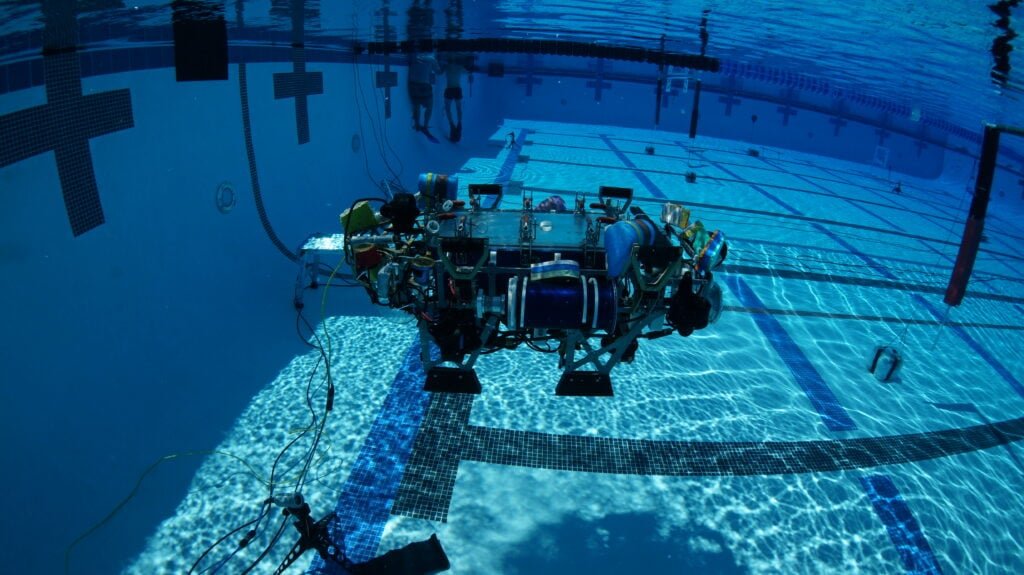
The campaign’s highlight was dual-vehicle operation. The flagship Matsya 7 was built from scratch in roughly six months and carries eight thrusters. Alongside it swam the new Mini Matsya — built in under five months at roughly one-fifth the cost, according to the team’s own account via the team. Running two vehicles in tandem, each handling parts of the mission in parallel, was the technical statement of AUV-IITB’s 2026 run.
AUV-IITB is a multidisciplinary student team — mechanical, electrical, software and aerospace students working with faculty advisors. It is not a company. There is no product, no funding round, no commercial deployment here. The story is engineering talent and technical novelty, not a business — and that distinction is the whole point.
The tech that actually matters
Two 2026 additions deserve attention. First, navigation: since GPS is useless underwater, Matsya 7 uses a Doppler Velocity Log — it bounces sound waves off the seabed and derives speed and direction from the return signal. Second, manipulation: new fin-ray grippers, fingers made of TPU (a rubber-like plastic) that bend and wrap around objects of different shapes and sizes, replacing the team’s earlier rigid fingers. Both details come from the team’s description of the campaign.
The robots must think alone in the deep end — no operator, no tether, no second chances.
Why a student team matters more than a startup story
It would be easy to dress this up as another “Indian startup conquers the world” narrative. That would be dishonest, and it would miss the real story. Student engineering teams like AUV-IITB are where India’s deep-tech talent pipeline gets built — the same pipeline that feeds ISRO, private spacetech, and robotics startups. The ability to design, build, and field-test an autonomous system in months, on a student budget, against teams from nine countries, is the capability that matters. Companies can be founded later; the engineering judgment is being formed now.
The results also show where Indian student robotics stands globally: competitive in autonomy and simulation, winning in secondary brackets, still chasing the overall title that NUS Bumblebee took. That is an honest scoreboard — and a more useful one than inflated headlines.
Key takeaway
AUV-IITB didn’t win RoboSub 2026 overall — they topped the Wildcard bracket and website evaluation. The real story isn’t a trophy; it’s a student team building genuinely capable underwater autonomy.
More Read
Did IIT Bombay win RoboSub 2026?
Not the overall title — NUS Bumblebee won that. AUV-IITB finished first in the Overall Wildcard Challenge and Overall Website Evaluation, with strong placements in autonomy and simulation events.
What is Matsya 7?
AUV-IITB’s flagship autonomous underwater vehicle, built from scratch in about six months, with eight thrusters. It competed alongside the smaller, cheaper Mini Matsya in a dual-vehicle campaign.
How does an underwater robot navigate without GPS?
Matsya 7 uses a Doppler Velocity Log (DVL) — it bounces sound waves off the seabed to measure speed and direction, since radio-based GPS doesn’t penetrate water. Student teams are producing serious autonomy talent — NeuralMiles’ driverless mini-truck is another IIT Bombay crew shipping real hardware.
Is AUV-IITB a startup?
No — it’s a student engineering team at IIT Bombay. There’s no product or commercial operation; the value is in the engineering talent and technical capability the team develops.
What are fin-ray grippers?
New-for-2026 manipulators on Matsya 7, with fingers made of flexible TPU plastic that bend and wrap around objects of varying shapes — an upgrade from rigid fingers — Indian robotics is pushing dexterity on multiple fronts: xSpecies’ DexteraX hand shows how far five-fingered manipulation has come.
Sources & further reading
- YourStory — IIT Bombay underwater robot team at RoboSub 2026 — Competition results and team details
- StartupPedia — AUV-IITB wins Wildcard Challenge at RoboSub 2026 — Wildcard win and dual-vehicle campaign coverage
- Industrywired — IIT Bombay secures third place at California RoboSub 2026 — Overall results context including NUS Bumblebee’s win