


Every day, doctors across India finish seeing patients and then sit down to a second shift: paperwork. Notes, prescriptions, case histories — hours of typing after hours of healing. In a country where one doctor can see a hundred patients in a day, that paperwork is not a minor inconvenience; it is time stolen from the next patient in line.
On 11 November 2026, the National Health Authority picked the Bengaluru startup it trusts to take that burden away. Eka Care will build the ambient AI voice scribe for India’s public health facilities — software that listens to a doctor-patient consultation and writes the clinical notes itself, in the language the conversation happened in.
It is the biggest vote of confidence yet for a company that has spent six years quietly building the digital plumbing underneath Indian healthcare — and it puts an Indian-built speech model at the heart of how the country’s public hospitals will document care.
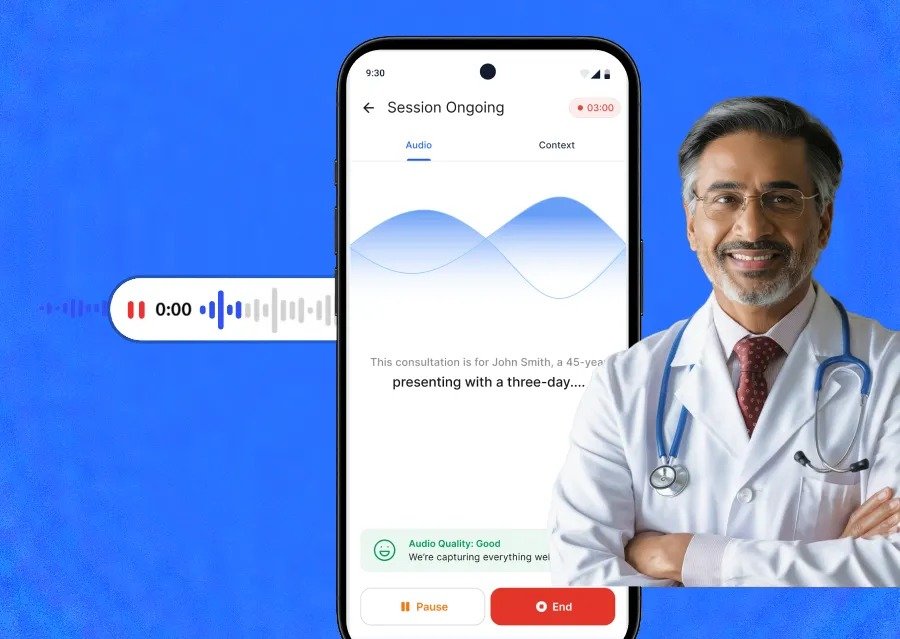
EkaScribe listens to a consultation and turns it into structured clinical notes. (Official visual: Eka Care)
The trick: an AI that speaks Indian medicine
The scribe’s job sounds simple — listen, understand, write it down — but Indian clinics are one of the hardest listening environments on earth. Consultations happen in fifteen-plus languages, often switching mid-sentence. Patients describe symptoms in everyday words, not textbook terms. Doctors abbreviate, interrupt themselves, and move fast.
More Read

Eka Care’s answer is built from two pieces of technology the company developed in-house. The first is Parrotlet-A 2.5 Pro, an open-weight speech model trained specifically for Indian healthcare conversations. The second is Lipi, an open-source agentic harness that turns what the model hears into structured records. The company says that in a benchmark covering 6,550 real Indian consultations, Parrotlet-A 2.5 Pro recorded the lowest error rate among the models tested, across all five languages in the benchmark.
What comes out the other end is a complete clinical note: the patient’s complaints, medical history, medications, vital signs, laboratory findings, diagnosis and treatment plan, laid out in speciality-specific templates and written in the FHIR format that lets health records move between systems. The notes are generated inside the National Health Authority’s own air-gapped, secure environment, running on NHA infrastructure — and the doctor stays in charge, approving every record before it is filed.
The system will run under the Ayushman Bharat Digital Mission, the national backbone for interoperable digital health. Eka Care was one of the first private platforms to register as both a Health Information Provider and a Health Information User on that backbone, and its ABDM Connect API already lets other developers plug into it.
From Goibibo to the clinic
Eka Care was founded in December 2020 by Vikalp Sahni and Deepak Tuli, the pair who had earlier co-founded travel giant Goibibo. They set out to give every Indian a health profile — a single, living record of their medical history that any doctor could read and build on.
The company, run as Orbi Health Private Limited, raised a $4.5 million seed round in July 2021 and a $15 million Series A in July 2022, led by Hummingbird Ventures with participation from 3one4 Capital, Mirae Assets, Verlinvest and Aditya Birla Ventures, alongside investors including Flipkart’s Binny Bansal.
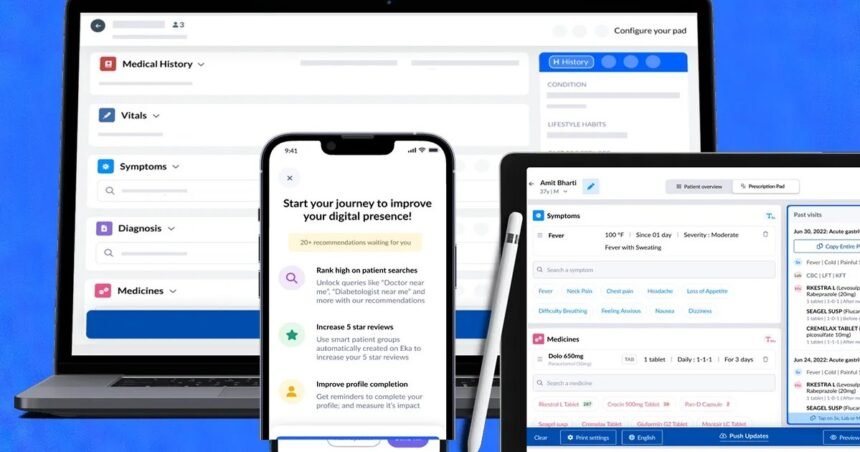
What they built since then is a full clinic operating system. Eka EMR digitises a doctor’s practice; EkaScribe, the voice scribe, does the documenting; a medical-records analyser turns old paper reports into structured data; and a patient-facing app, Eka PHR, lets people carry their entire health history in their pocket. A clinical decision-support layer adds real-time, evidence-based guidance during consultations.
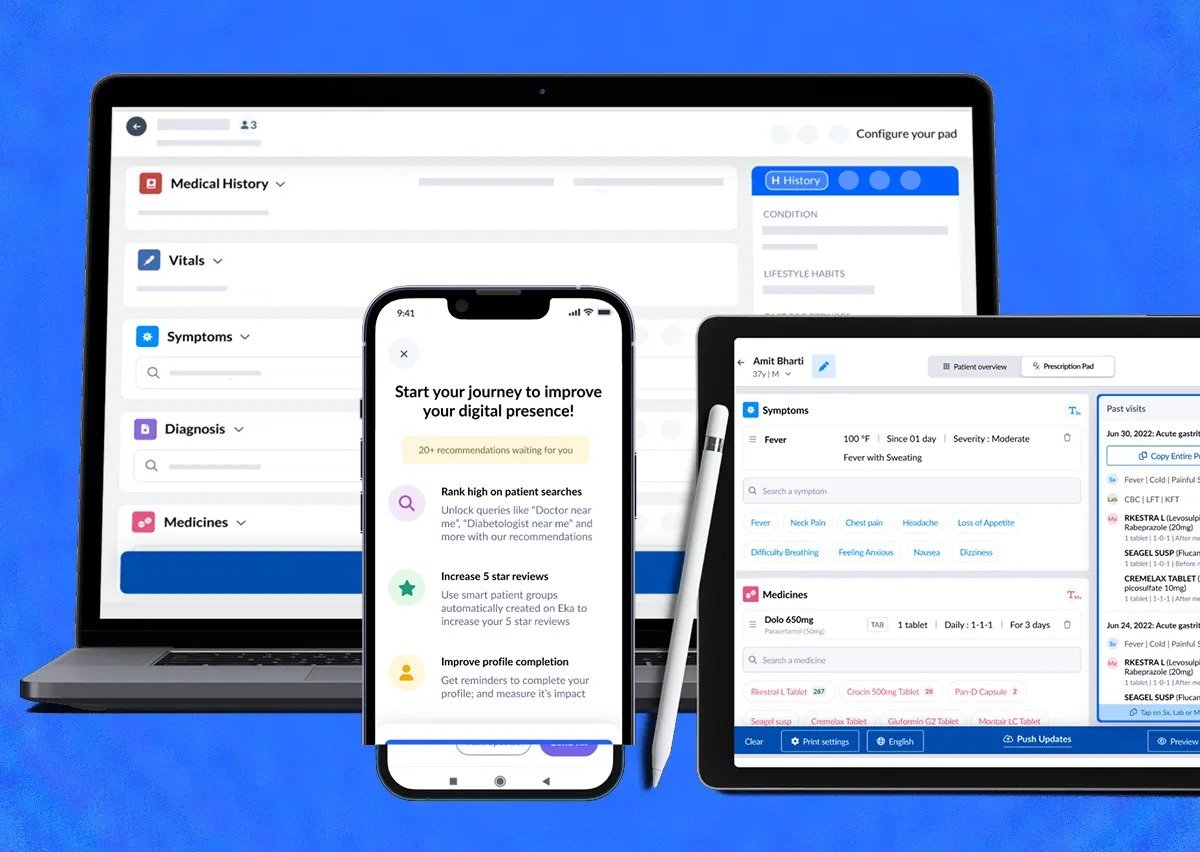
Eka EMR, the company’s clinic operating system, running across laptop, phone and tablet. (Official visual: Eka Care)
The numbers behind the pick
The scale Eka Care has already reached is what makes the NHA’s choice more than a pilot. The company says more than 33,000 clinics and hospitals and 90,000 doctors now use its platform, with over 20 million ABHA health IDs created and more than 140 million health records managed through it. EkaScribe alone has passed one million sessions.
NITI Aayog’s Frontier Tech platform, profiling the company in September 2026, put the physician count at around 55,000 and noted the company’s claim that a consultation can be transcribed in about 12 seconds, with 90% transcription accuracy on prescriptions. In February 2026, Eka Care showcased its “Voice AI for Bharat” work at the India AI Impact Summit.
That track record is why the NHA’s selection matters. The Authority chose Eka Care through a formal Expression of Interest process — a structured evaluation against competing proposals, not a handshake pilot. The voice scribe will now be built for the public facilities where India’s doctors carry the heaviest patient loads, and where every minute saved on documentation is a minute returned to care.
What comes next
The scribe is the kind of technology that disappears into the background when it works: the doctor talks, the patient talks, and the record writes itself. For India’s public health system, that means consultations that end when the patient leaves the room, records that are complete the same day, and a national health-data backbone that finally speaks the languages its doctors actually use.
Eka Care started with a simple idea — that every Indian should have a health profile. Six years later, the country’s own health authority has asked it to write the notes for the nation’s public hospitals. The paperwork, at last, is learning to keep up with the doctor.
Keep reading: Storing Data in DNA: Inside BioCompute, the Bengaluru Startup Turning Life’s Molecule Into a Hard Drive · No Power, No Chemicals, No Operator: Inside ECOSTP’s Sewage Plant Inspired by a Cow’s Stomach · More Chemicals, Materials & Life Sciences stories
Like stories like this? Add Exceptional Technology as a preferred source on Google to see more of our reporting in your search results and Discover feed.







