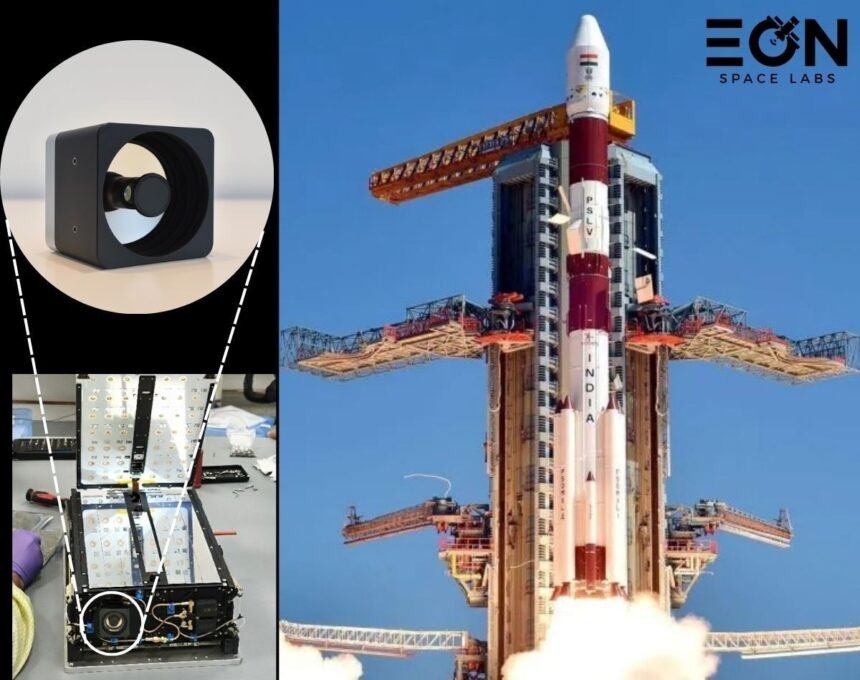
A space telescope the weight of a small bottle of water is now circling the Earth — and it was designed and built in Hyderabad. EON Space Labs’ MIRA earth-observation payload rode to orbit aboard SpaceX’s Transporter-18 rideshare mission on October 1–2, 2026, one of 130 payloads launched from Vandenberg Space Force Base in California, and the company expects to receive its first images within about ten days.
MIRA — the Miniaturized Telescope-Based Imaging System — weighs just 502 grams. The startup says it is 8 to 12 times lighter than comparable foreign space cameras, and it has now secured an Indian patent for the invention, titled “A Miniaturized Telescope-Based Imaging System.” For a country trying to build its own eyes in space, it is a genuine milestone.
Half a kilogram of telescope
MIRA captures multispectral imagery in nine or more spectral bands across visible and near-infrared light, according to the company’s own specifications. The optical system is machined from a single block of fused silica, which the company says improves stability and vibration tolerance, and EON says the payload meets space-grade requirements under NASA standards.
The indigenous content claim is one EON backs with a number: 85%, as stated on the company’s website. Co-founder and COO Punit Badeka has argued that this is what matters most. India, he told the press, imports around $11 billion worth of optical technology, and EON’s stated mission is to reduce that dependence by proving hardware that is designed and manufactured in India.
MIRA’s first flight, in January 2026, was aboard ISRO’s PSLV-C62 mission integrated with TakeMe2Space’s MOI-1 satellite — a flight the company itself described as its first orbital attempt. The second ride came on TakeMe2Space’s MOI-1A spacecraft aboard Transporter-18, where MIRA will demonstrate earth-observation imagery for agriculture, mining, marine monitoring, supply-chain management and insurance, according to reports on the mission.
One optical chain, three domains
EON does not just build space payloads. The startup works across three domains — space, aerial and ground — around a single indigenous optical stack: earth-observation payloads for satellites, electro-optical/infrared (EONIR) systems for drones, and surveillance systems for ground applications.
More Read
That breadth has already won defence attention. EON was selected as a winner of the iDEX Open Challenge 4.0 for MIRA, and through iDEX it is developing a handheld imaging system that combines short-wave infrared, long-wave infrared and a conventional day camera. Its LWIR optics use germanium-free lenses, replacing a material the company says has faced supply constraints. The lenses, it says, are made from synthetically grown material in India and cut lead times from six months to six weeks.
The system has been trialled aboard Indian Navy ships, where the company says it identified vessels at around 30 km, including in low-visibility conditions. In the aerial segment, EON says its EONIR payloads have drawn interest from around 120 Indian companies, and it has secured payload orders from Indian spacetech firms including Orbited Labs, which will fly an EON payload on an SSLV mission, and Kepler Aerospace, which placed an order worth around &rupee;6–7 crore for an iDEX programme.
Building the manufacturing itself
Founded in 2021 by Punit Badeka, Sanjay Kumar and Manoj Kumar Gaddam, EON raised $1.2 million in a pre-Series A round led by MountTech Growth Fund–Kavachh, with HHV Advanced Technologies as a strategic investor and long-term partner. Its optics are currently manufactured by HHV, and the startup plans to install its own ultra-precision machines in Hyderabad and transfer its designs to the facility, having applied for government support to build the capability. The company has also said it is preparing a &rupee;40 crore Series A1 round to fund international commercialisation of its Lumira aerial products, further payload launches, R&D and a cleanroom facility.
IN-SPACe chairman Pawan Goenka described the Transporter-18 flights carrying MIRA alongside TakeMe2Space’s and SatLeo Labs’ payloads as a “big day for India’s private space sector,” pointing to the range and ambition of the country’s private ecosystem.