


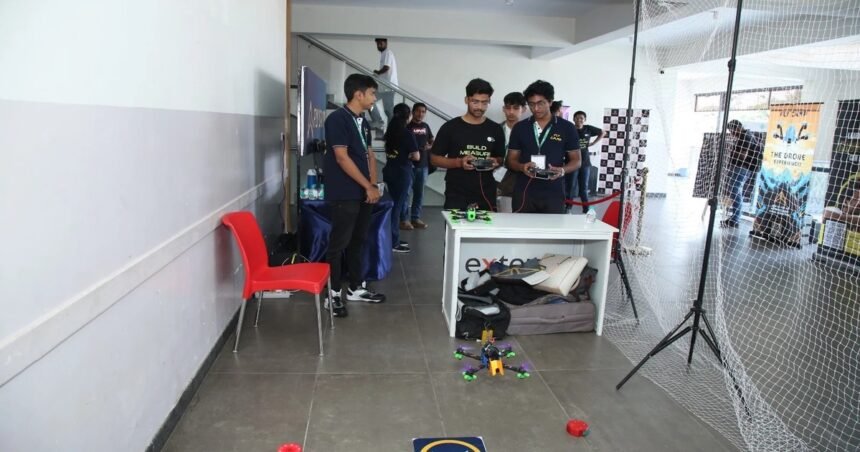
Most people have seen a drone. Very few have ever flown one — the controller, the sticks, the manual, the quiet fear of smashing it into a wall on the first try. At the Bengaluru Tech Summit, one stall swept all of that away: wave a hand over a mirror, and a drone flies to the matching spot on a mat. No remote, no manual, and no fear of losing control.
The stall belonged to Fly Camp, a Bengaluru startup founded by drone racer Devesh K Hegde, and the company says its gesture-controlled system can teach a complete beginner to fly a drone in five seconds. A camera tracks the visitor’s hand movements, sensors keep the drone inside a defined arena, and the whole experience is built around a single idea: flying should feel like play, not a pilot’s exam.

How the five-second flight works
The trick is in the sensors. A camera watches the visitor’s hand within its field of view, and when the hand is placed at a spot on the mirror, the drone moves to the corresponding location on the mat. Sensors hold the drone inside a fixed flying area, so it cannot wander off or get away from a first-time pilot. There is nothing to learn before the first flight — no stick layout, no throttle discipline, no manual to skim. One nervous visitor at the Tech Summit described the experience as being like a magician, and that is exactly the point: the technology disappears, and the flying is all that is left.
Eleven years of flying, distilled into five seconds
Devesh K Hegde, a 31-year-old drone racer from Udupi who lives in Bengaluru’s Mahalakshmi Layout, has been flying for eleven years. He grew up around electronics in his father’s business, fell in love with remote-control cars, and bought his first drone around 2014–15. A college professor introduced him to the institution’s chairman, who funded his participation in India’s first drone race at IIT Gandhinagar in 2016. In his final year he built a fire-surveillance drone swarm through a World Bank-funded project. He studied computer science, but the drones never let go.
More Read

From workshops to a drone experience centre
Fly Camp itself was born almost by accident. When his parents suggested he take up a job, Devesh chose to run drone workshops instead. A college principal in Yeshwanthpur agreed to host one but wanted certificates for the participants — and a certificate meant he needed a company. That company is now Fly Camp, which the company describes as India’s first drone experience centre. The team has since run workshops, events and corporate social responsibility programmes in Odisha and Andhra Pradesh and at orphanages, and its collection holds more than 50 types of drones, including a miniature model weighing just 25 grams. Between 20 and 40 engineering students are in regular training under his guidance.
The backing — and what comes next
The idea has already won institutional backing: the Karnataka government’s ITBT Elevate programme awarded Fly Camp Rs 35 lakh to develop the idea of making drone flying accessible through games, and the venture has incubation support from IIM Bangalore. Devesh plans to expand the drone-awareness programmes across Karnataka, reaching schoolchildren and corporate employees, and to organise drone competitions. The gesture-controlled stall at the Bengaluru Tech Summit was the first public taste of that plan — a room full of people who had never touched a controller, flying a drone with a wave of the hand.
That is the real promise of Fly Camp. Drones have spent a decade getting smarter, faster and more capable, but they have stayed in the hands of the people who already know how to fly them. A five-second first flight turns a spectator into a pilot, and a country full of first-time pilots is how a new generation of Indian drone builders begins.
Keep reading: No Towers, No Satellites, No Problem: Inside Krathveil’s Pocket Radio for India’s Soldiers · Eyes in the Water: Inside Hyper Horizon, the Bengaluru Startup Building Autonomous Submarines for the Indian Navy · More Aerospace & Defense stories
Like stories like this? Add Exceptional Technology as a preferred source on Google to see more of our reporting in your search results and Discover feed.









