


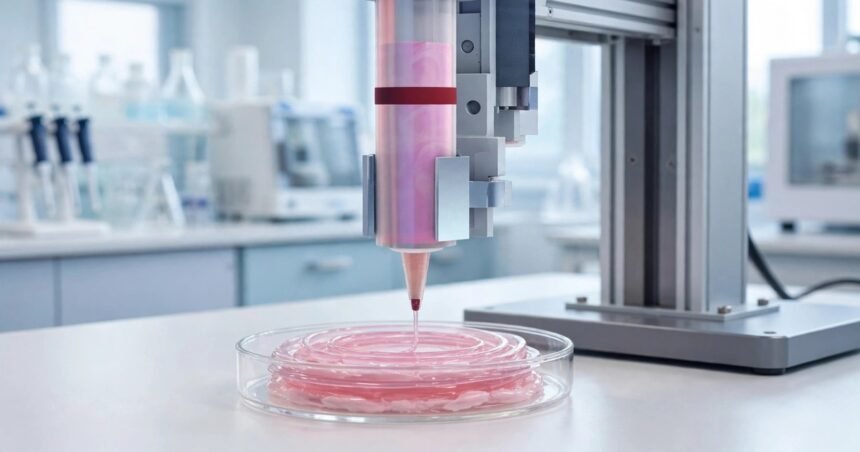
Picture a printer that does not print on paper. Its nozzle moves slowly over a petri dish, laying down a fine pink thread, layer upon layer, until a shape takes form — not plastic, not metal, but a living scaffold of cells. The thread it prints with is called a bioink, and until recently, every drop of it used in Indian laboratories had to be imported. In Kochi, a small Kerala company called Scire Science has changed that, with an ink born in one of India’s finest medical research institutes.
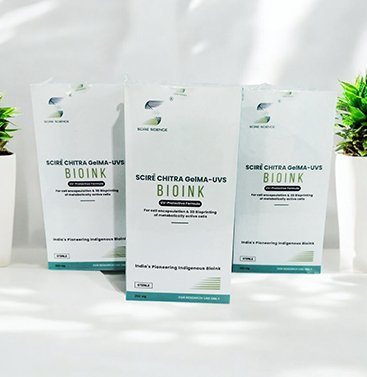
Scire Science was founded in 2016 by Dr Jikku Jose, and it has spent its life at the meeting point of medicine and engineering — 3D bioprinting, biomaterials, cell culture and the training of young researchers. Its flagship product, Scire Chitra GelMA-UVS Bioink, is the country’s first indigenous patented bioink for 3D bioprinting, the company says — a home-grown material that lets Indian researchers print living tissue models in their own labs, on their own terms.
An ink made of living-friendly jelly
At the heart of the bioink is GelMA — gelatin methacrylamide, a chemically modified gelatin that cells love. The clever part is what the scientists at SCTIMST, the Sree Chitra Tirunal Institute for Medical Sciences and Technology in Thiruvananthapuram, added to it: special ingredients that shield living cells from ultraviolet light while the printed structure is being crosslinked and set. UV light is essential to harden the print, but it is harsh on cells — this formulation keeps the cells safe while the structure holds its shape.
The result is an ink that is gentle to work with and generous in what it allows. It dissolves rapidly in water, arrives as dry flakes that are easy to store and ship, prints at room temperature, and can be tuned to different thicknesses for different tissues. It is biocompatible and biodegradable, and enzymes in the body can break it down — exactly the qualities a material needs when it is destined to become part of a living system.
From a national institute’s bench to a Kerala factory floor
The bioink began as research at SCTIMST, an institution of national importance under the Department of Science and Technology, where principal researchers Anil Kumar P. R. and Shiny Velayudhan led the work across the institute’s biomaterials and tissue culture divisions. Their formulation is protected by Indian patent 458341, granted in October 2021, and the technology was transferred to Scire Science in April 2024. The product was formally launched at SCTIMST in November 2024, under the brand name Scire Chitra GelMA-UVS Bioink.
By then, the ink had already proved itself where it matters most: in the petri dish. The SCTIMST team used it to bioprint liver tissue that expressed liver-specific functions — a complex, working piece of biology, printed layer by layer. The same ink can be used to biofabricate tissue models of the kidney, pancreas, skin, brain and heart, the institute says, opening a whole library of human biology to the printer.
More Read

What Indian labs can now print
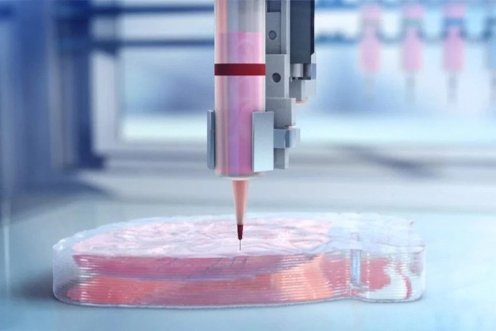
For researchers, a printed tissue model is a powerful tool. Drug candidates can be tested on a tiny piece of printed liver before they ever reach a patient; a disease can be studied in a model grown from a patient’s own cells; a new chemical can be checked for safety without an animal trial. The bioink makes all of this possible in Indian labs, with an Indian material, at a price and a supply chain that no longer depends on imports — and bioprinter manufacturers are already bundling it with their machines, the company says, after compatibility tests confirmed it prints beautifully.
The customers tell the story of where this goes next: biotech and hospital research labs across the country are now working with the ink, and every printed tissue brings personalised medicine a step closer — treatments tested on your cells, in a model of your tissue, before they are given to you.
More than a single product
Scire Science is building around the ink rather than stopping at it. The company runs its own 3D cell culture laboratory, offers research services to other teams, and trains students and young researchers in the life sciences — spreading the skills that bioprinting needs as fast as the material itself. Its catalogue is growing too, with laboratory devices such as the Scire ThermaBead bead bath system, and the ambition, as Jikku Jose puts it, is to make a whole range of biomaterials and inks readily available to Indian researchers.
It is a quiet kind of breakthrough — no roaring engine, no launch tower. Just a small Kochi company, a national institute, and a pink gel that lets India print pieces of living tissue. The future of medicine will be built layer by layer, and now, one of its most important layers is made in India.
Keep reading: The Sound of Clean Water: Inside Prasinos Tech Innovations, the Hyderabad Startup Healing India’s Lakes with Ultrasound and Nanobubbles · A Toaster-Sized Lifeline: Inside AgVa Healthcare, the Noida Startup Building India’s Own Ventilators · More Chemicals, Materials & Life Sciences stories
Like stories like this? Add Exceptional Technology as a preferred source on Google to see more of our reporting in your search results and Discover feed.







