In a hostage rescue, the most dangerous moment is the first step through the door. Nobody on the outside knows what is waiting on the inside — where the gunman stands, where the hostages are, whether the room is rigged. For decades, the only way to find out was to send a soldier in first. Gridbots Technologies, an Ahmedabad robotics company, has spent eighteen years building a different answer: throw a robot through the door instead, and let it look around while the soldier stays safely behind the wall.
The robot is called HUMMING-BIRD, and the company calls it India’s most advanced indigenous throwbot — a compact, tracked machine built to be hurled into rooms, stairwells and tunnels where drones cannot fly and people should not walk in blind. It is the sharpest edge of a company that has quietly spent nearly two decades building machines for the jobs India calls dirty, dull and dangerous: crawling inside live power-plant pipelines, climbing boiler walls, and now, scouting rooms for its soldiers.
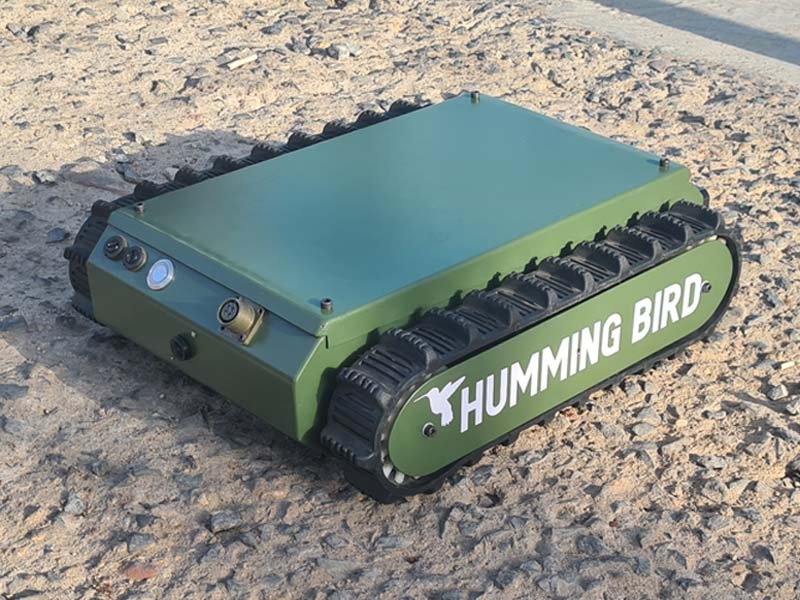
A robot built to be thrown
A throwbot is defined by one brutal requirement: it has to keep working after being thrown. The HUMMING-BIRD weighs under 4.5 kilograms and is built around an aircraft-grade aluminium chassis with shock-absorbing wheels, and the company says it survives repeated 9-metre drops onto concrete. Its symmetrical, dumbbell-shaped body means there is no wrong way up — however it lands, it auto-rights itself and starts streaming within milliseconds. A trained operator can deploy it in under three seconds: pull it from the chest rig, throw it through a window or over a wall — the company rates its throw range at 30 metres — and watch the feed.
Once inside, the robot goes quiet and gets to work. Its day/night camera and infrared illuminator stream encrypted video and two-way audio over an AES-256 encrypted link, and the company’s spec sheet lists a 20-kilometre mesh-radio range and a 20 km/h top speed. Reports on the system describe four cameras and four microphones giving soldiers multi-angle sight and sound before they commit to entry, a laser designator for precise targeting, and payload mounts for gun, grenade and disruptor fitments. It runs for more than 90 minutes on a charge and is sealed to IP67, so monsoon rain, desert dust and shallow standing water are all part of its working day. The whole system is engineered to the Ministry of Home Affairs’ qualitative requirements for throwable tactical robots, under the iDEX and Aatmanirbhar Bharat defence framework.
Eighteen years of dirty, dull and dangerous
More Read

Gridbots began in 2007, when founder Pulkit Gaur — a TED Fellow and MIT Young Innovator who has been building robots since childhood — set out to build machines for the work nobody wants to do by hand. The company bootstrapped its way up, with seed funding from the Government of India’s Department of Information Technology in 2009, and today employs more than 50 engineers in Ahmedabad. Its managing director, Dinesh Gaur, spent over forty years in counter-terrorism and insurgency operations, including as an Additional Director at the Intelligence Bureau — the kind of operational memory that shapes what the company builds and why.
The customer list reads like a map of India’s hardest engineering problems: the Ministry of Home Affairs, the Indian Navy, Bhabha Atomic Research Centre, ONGC, ISRO and IIT Gandhinagar on the government side, and Tata Power, the Adani Group, Borosil and Disney India among its corporate clients. It is a portfolio built one impossible job at a time.
The robots that go where people shouldn’t
Long before the throwbot, Gridbots earned its reputation inside India’s power plants. In 2014, a 30-inch wooden log jammed itself 33 feet inside a 12-inch high-pressure steam pipe at Tata Power’s Mundra plant, halting the unit. Gridbots’ Stinger robot went in and pulled the log out in five hours. The Stinger family has since grown into a full pipeline-operations line — inspection, grinding and hydroblasting robots that work inside pipes from 50 millimetres to 5,000 millimetres across — alongside the Spyder magnetic crawler, which climbs vertical steel surfaces carrying ultrasonic sensors to map pipe-wall thickness, and the TubeScan and Magneto waterwall robots that inspect boiler walls carrying payloads of up to 50 kilograms. An underwater service robot, SAUSR Alpha, extends the same idea below the waterline.

From power plants to the battlefield
The defence line grew out of the same stack — machine vision, autonomous navigation and rugged hardware. Alongside the HUMMING-BIRD, Gridbots builds the Zeus, Titan, Hawk and Brute unmanned ground vehicles, the Sentinel anti-drone system, the Katana autonomous weapon station, the BAT acoustic gun-shot locator and the Terawave drone-detection scanner. The company says its Titan once drew Prime Minister Narendra Modi to its booth at a defence exhibition — and a tweet of its picture.
What ties the power-plant crawlers and the throwbot together is a single idea, and it is the one Pulkit Gaur started with: there are jobs where sending a person first is the most expensive and most dangerous option, and a machine built for exactly that moment changes the arithmetic completely. The HUMMING-BIRD is that idea at its purest — a small green box that takes the first step through the door, so a soldier doesn’t have to.
Keep reading: The 13-Millisecond Fix: Inside Edgeble AI, the Hyderabad Startup Teaching Factory AI to Correct Itself · The AI That Learns How India’s Power Grid Thinks: Inside Arborum Labs’ World Models · More Industrial Automation & Technology stories
Like stories like this? Add Exceptional Technology as a preferred source on Google to see more of our reporting in your search results and Discover feed.