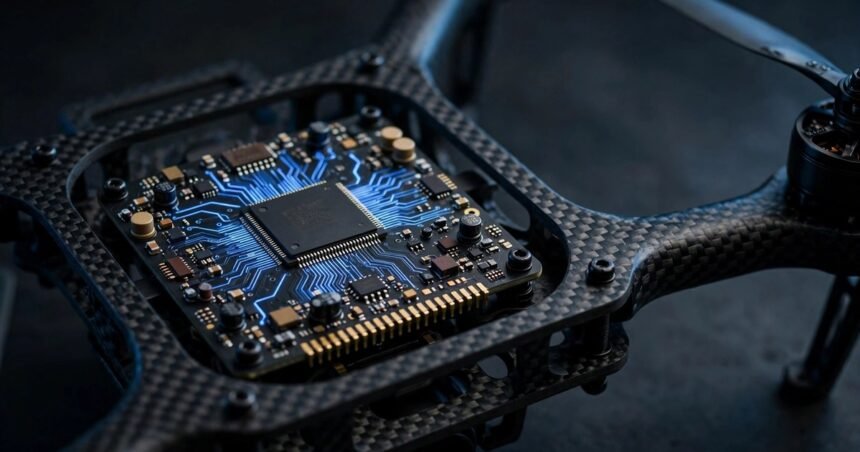
Every drone in the sky has a brain quietly keeping it there — the flight controller, the board that reads the sensors, steadies the frame and turns a command into motion. It decides how a drone navigates, how it holds its line in the wind, and how it talks to everything on board. In Mumbai, a young company called ChipUAV Systems is building that brain in India — and building it on an Indian chip.
ChipUAV Systems is a drone electronics and avionics startup, and in June 2026 it unveiled Vyom Chakra, its indigenous flight controller, built around SHAKTI, the open-source RISC-V processor family developed at IIT Madras. The team is led by chief executive Shardul Bhave, with Mrugendra Vasmatkar as mentor, and engineers Jaishree Epili, Pranay Wani, Gautam Singh, Rahul Desai and Hariom Dhage — a group of young engineers who set out to build a fully Indian technology stack for autonomous aerial platforms.

The drone’s brain, on an Indian chip
A flight controller is the most consequential board in any drone. It processes data from the gyroscopes, accelerometers and satellite receivers, executes navigation commands, stabilises flight and coordinates communication between every onboard system. Get it right and the aircraft flies true; get it wrong and nothing else about the drone matters. Vyom Chakra puts that job on SHAKTI, the processor family built by the Reconfigurable Intelligent Systems Engineering (RISE) group at IIT Madras and backed by the Ministry of Electronics and Information Technology under the Digital India RISC-V programme. RISC-V is an open instruction set anyone can build on without a licence, and SHAKTI is India’s homegrown expression of it.
The processor family behind Vyom Chakra has already proved itself in the hardest environments. IIT Madras and ISRO designed and booted IRIS, a 64-bit controller for space applications based on the SHAKTI baseline processor, in February 2025 — the third SHAKTI chip fabricated at the Semi-Conductor Laboratory in Chandigarh, after RIMO in 2018 and MOUSHIK in 2020, with the design, fabrication, packaging, motherboard and boot all completed inside India. A chip trusted to command spacecraft systems is now finding its way into the heart of a drone.
Why the chip inside matters
India builds drone airframes, cameras and payloads, but the brains of most drones — the flight controllers and the processors inside them — have largely been imported. For a technology that flies over borders, farms and disaster zones, that dependence carries real weight: whoever controls the controller controls the aircraft’s most trusted component. ChipUAV’s answer is a controller designed around an Indian processor, giving Indian drone makers a trusted and customisable alternative to imported boards. The company says its design philosophy is fully indigenous, from the processor architecture to the board around it, and the timing is right — India’s drone ecosystem has grown rapidly since the liberalisation of drone regulations and the production-linked incentive scheme, with demand rising from defence, agriculture, logistics, mapping and industrial inspection.
A stack, not just a board
ChipUAV calls its approach the Avionic Fabric, and Vyom Chakra is its first expression: reconfigurable hardware accelerators tightly integrated with memory-mapped peripherals, driving multi-channel motor control signals with nanosecond accuracy. The company’s long-term vision is to standardise customisable RISC-V system-on-chip fabrics across domestic industrial drone frameworks — scalable, high-integrity architectures built to survive rugged electronic-defence applications. “This is just the beginning,” the company says, inviting others to join it on the journey toward a stronger, self-reliant ecosystem for Indian UAV technology.
More Read

From a Mumbai workshop to the sky above it, a small board with an Indian processor at its heart is quietly changing who builds the brains of India’s drones — and proving that the most strategic component in the aircraft can be designed, built and trusted at home.
Keep reading: The Eyes of Pragyan: Inside Omnipresent Robot Technologies, the Noida Firm That Taught a Rover to See the Moon · Built in 60 Days: Inside HoverIt’s Indigenous RATO System and the Divyastra Loitering Munition · More Aerospace & Defense stories
Like stories like this? Add Exceptional Technology as a preferred source on Google to see more of our reporting in your search results and Discover feed.