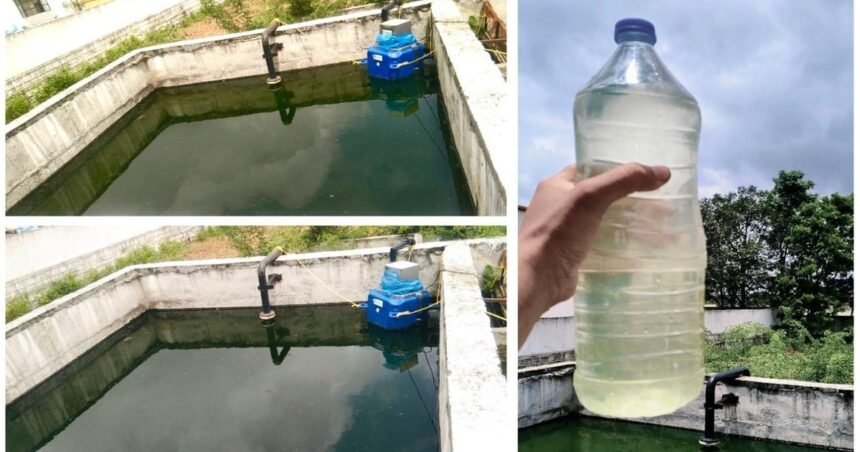
Stand on the bank of an Indian lake in summer and the problem is visible before you smell it: a thick green skin of algae spread across the water, sunlight blocked, oxygen falling, fish gasping below. Across the country, nutrient-rich sewage and fertiliser run-off feed these blooms, and the usual answers — chemical algaecides, dredging, aerators that churn power — treat the symptom for a season and leave the lake as sick as before. In Hyderabad, a young company called Prasinos Tech Innovations is cleaning these waters with two things you can barely perceive at all: a sound too high to hear, and bubbles too small to see.
Prasinos Tech Innovations was founded in 2022 by Dr Aditi Mullick and Dr Anupam Mukherjee, both chemical engineers — Mullick with a PhD from IIT Kharagpur, Mukherjee with a PhD from BITS Pilani. The idea began years earlier, during Mullick’s doctoral work, when she was asked to deal with algal growth in the water storage tanks of industrial plants at Haldia in West Bengal. Mild ultrasonic waves, she found, could disrupt the algae without harming anything else in the water. That laboratory insight became a company, and the company became a product now floating on lakes across India.
SwanCav: the sound that starves the bloom
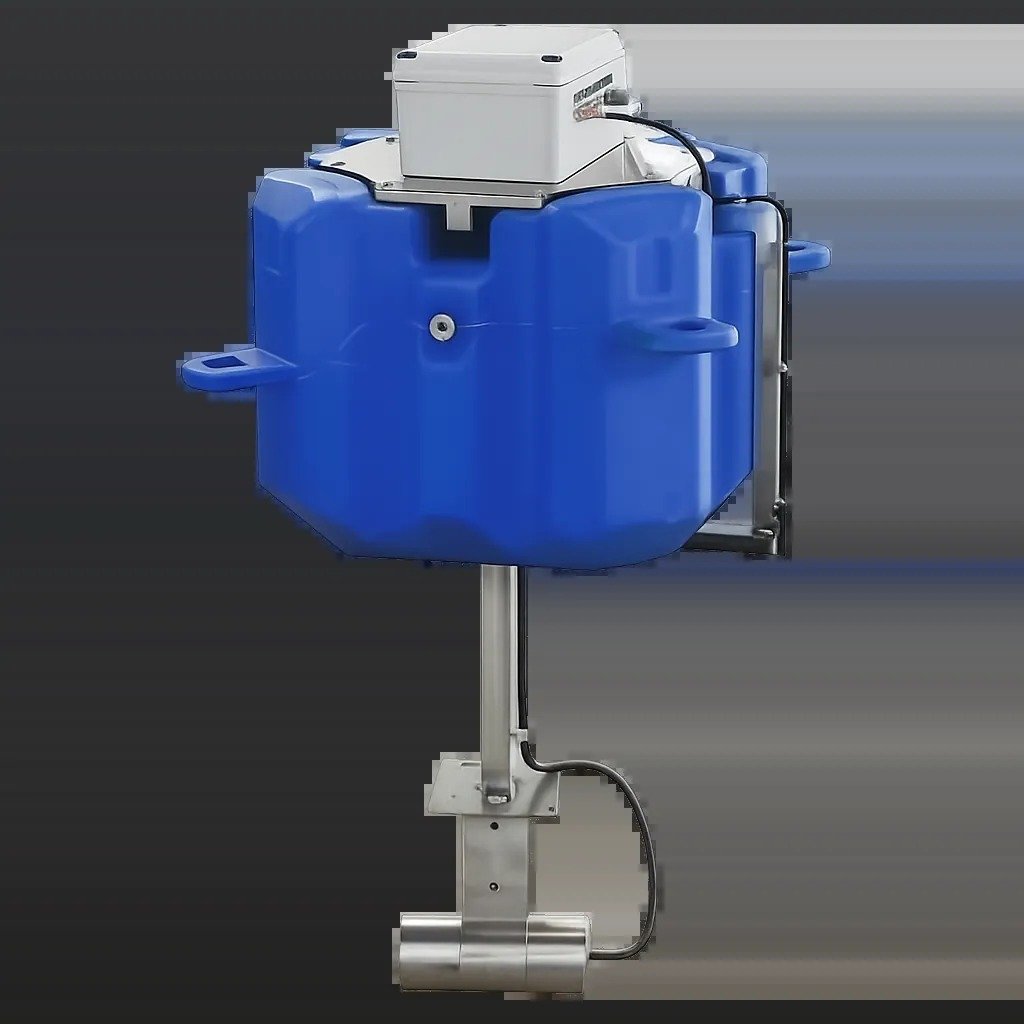
SwanCav is a solar-powered floating installation that works on a beautifully simple piece of physics. Algae survive by moving vertically through the water — rising to the surface by day to catch sunlight for photosynthesis, sinking at night to gather nutrients. SwanCav’s low-power ultrasonic emitters, operating at 20–60 kHz, send a pressure wave through the upper layer of the water that interferes with the algae’s buoyancy regulation. Unable to hold their position near the surface, the algae are starved of sunlight and nutrients, and the bloom collapses — while fish and other aquatic life, the company says, are unaffected.
The device comes in three sizes. The SwanCav Mini weighs just 5.5 kg and runs on 20 watts; the larger L and XL models are solar-powered, weighing 76 kg and 150 kg and drawing 50 and 90 watts. A single system can cover up to around 15 acres of water surface, the company says, and its comparison figures put algae reduction at 70–99% depending on species and exposure time, with operating costs 40–70% lower than chemical programmes — because there are no chemicals to buy, no dosing to repeat, and almost nothing to maintain. The whole approach uses no chemicals at all, which is the point: the water is cleaned, not re-poisoned.
From a Pune lake to a hundred deployments
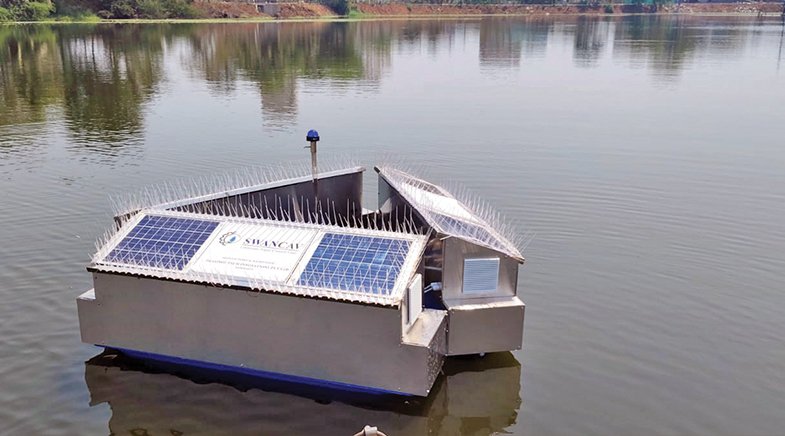
The technology earned its stripes in the open water. In 2023, Prasinos ran a pilot at Chikhali Lake near Pune, where conventional approaches such as algicides had provided only limited and temporary relief. “SwanCav brought about marked improvement in water quality in 40 days,” Mullick told Shaastra, the IIT Madras science magazine. The company has since deployed the installation to clean Kaza East Lake at Mangalagiri in Andhra Pradesh and the COWE Industrial Park reservoir in Hyderabad.
Those lake deployments are only one part of the story. The same engineering now serves industrial effluent and sewage treatment plants, aquaculture ponds, agriculture and precision irrigation, pharmaceutical and textile units, and municipal water systems. The company says it has crossed 100 deployments, built more than 50 industrial and OEM partnerships, and holds over 10 technology platforms and patents — all designed, manufactured and supported in India, with backing from central and state government incubators.
More Read

NanoCav: bubbles smaller than a red blood cell
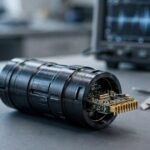
Prasinos’ second platform works at a scale the eye cannot follow. NanoCav generates nanobubbles — gas bubbles smaller than 200 nanometres across, finer than a red blood cell. Ordinary bubbles rise and pop within seconds; nanobubbles are neutrally buoyant, follow Brownian motion, and can stay suspended in a water column for weeks. Their huge surface area transfers oxygen into the water far more efficiently than conventional aeration, and their surface charge makes algae clump around them so they can be skimmed out — while the bubbles themselves break algae cell walls, the company says.
The numbers the company reports are striking: up to 90% oxygen transfer efficiency, 50–60% energy savings against conventional aeration, and up to 80% lower chemical dependency. The work won Prasinos the Bengaluru India Nano Innovation Award 2026, presented at INDIA NANO 2026, for applying indigenous nanobubble technology to water management, environmental sustainability, aquaculture and wastewater treatment.
Here’s the company’s own overview of NanoCav:
India’s lakes do not need another season of promises; they need engineering that works quietly, cheaply and without side effects. From a PhD bench at IIT Kharagpur to a solar-powered float on a lake in Andhra Pradesh, Prasinos Tech Innovations has built exactly that — a sound you cannot hear and bubbles you cannot see, bringing the blue back to India’s waters.
Keep reading: A Toaster-Sized Lifeline: Inside AgVa Healthcare, the Noida Startup Building India’s Own Ventilators · Written in Indian Genes: Inside 4baseCare, the Bengaluru Startup Making Cancer Treatment Personal · More Chemicals, Materials & Life Sciences stories
Like stories like this? Add Exceptional Technology as a preferred source on Google to see more of our reporting in your search results and Discover feed.