Look up at any Indian city’s new skyline and you will see the same sight: towers of glass rising twenty, thirty, forty storeys high. Somebody has to keep all that glass clean, and until now that somebody has usually been a worker hanging from a rope, tens of metres above the ground, with a squeegee in hand. A Chennai startup called Vividobots is changing that picture — with a robot that climbs the facade instead of a person.
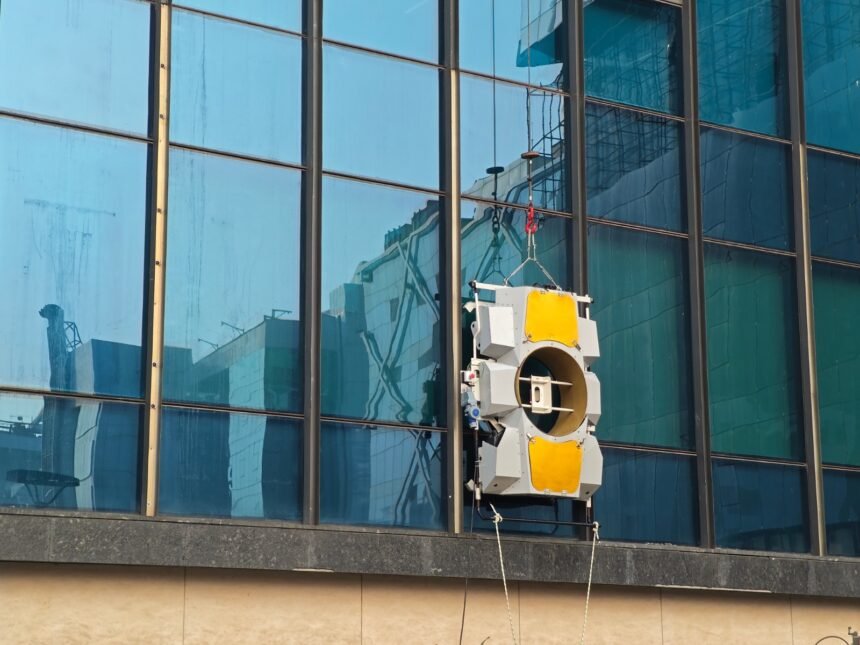
Vividobots’ first machine is called Wiperque, and it is already at work on real buildings. The rope-suspended robot washes glass and panel facades while its operator stays safely on the ground, watching every move through the company’s VIVID-GCS software, which streams live feedback from the robot through each run. Every run is logged too — coverage, duration and water used are recorded and handed to the facility team, so building managers get a clear record of exactly what was cleaned.
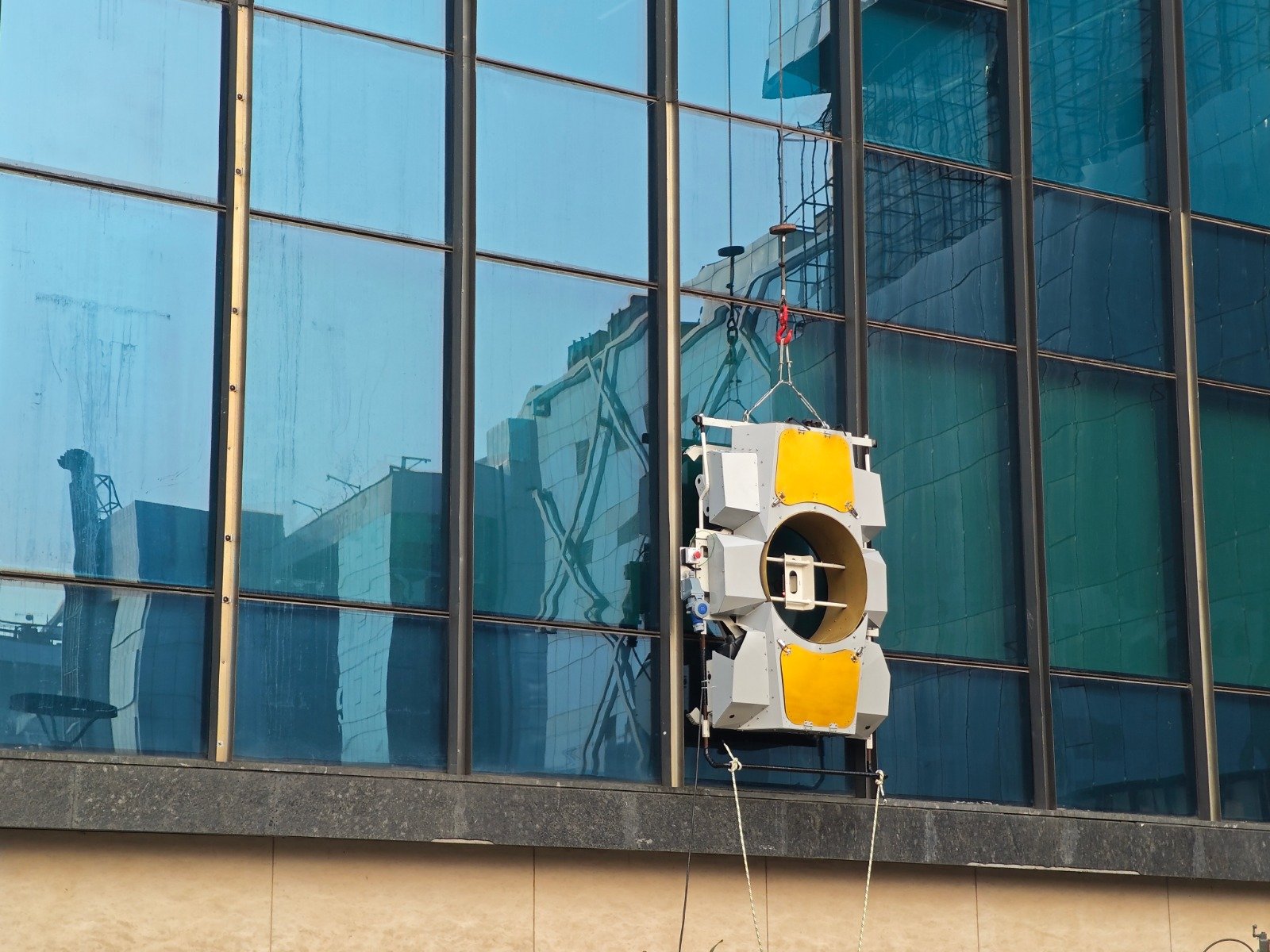
Vividobots’ Wiperque robot cleaning a high-rise glass facade, supervised from the ground.
Built for the work nobody should have to do on a rope
The idea behind Vividobots is simple: the most dangerous work on a building should move from people to machines. The company says Wiperque is semi-automated, supervised from the ground, with no one on the rope at all. Safety is built into every run — an emergency stop that halts the machine instantly from the operator’s controls, wind monitoring throughout the run, redundant suspension and mechanical braking that keep the machine secured, and fall protection as part of every deployment. The operator stays in command of every move, from the ground.
Getting a run going follows a simple rhythm the company describes as visit, rig, plug in, run. The team first visits the site to assess the facade, anchor points and access, then rigs and stabilises the rope-suspended platform from the roof, connects the machine at its hanging point, and operates it wirelessly from the ground in a seamless mode. The robot adapts to the building it is on: using machine vision, sensors and control algorithms, it navigates complex facade geometries rather than needing a perfectly flat wall.
More Read
Proven on site: from Noida to Chennai
Wiperque is not a lab demo — the company lists it as available now, with real runs on real buildings. At Ace Capitol in Noida, the robot cleaned a 17-floor, 55-metre-high, 19-metre-wide facade from the bottom to the top edge in a demonstration in December 2025. At L&T Mindtree in Chennai, it ran a site demo across a 12-floor, 54-metre-high facade. For facility managers, that kind of repeatable, logged cleaning run is a step change from rope crews, whose speed and finish vary with the worker and the weather.
The economics point the same way. Vividobots says its robotic systems deliver up to 70% time savings, 50% cost reduction and 15% lower material wastage compared with manual methods, with controlled, metered use of water and materials. And the timing is right: with construction labour in short supply, large real estate developers are ready to deploy facade robots, and demand is emerging fastest for exactly this kind of work.
Three engineers, one fall that started it all
Vividobots was founded in 2021 in Chennai by three postgraduate engineers — Dhinesh B, Velmurugan B and Kesavaraj S. The company traces its beginnings to a tragic incident in which a painter fell, an event that convinced the founders to find a safer way to do high-rise exterior work. The team has filed a patent for its product, was named among the Top 10 Tech Startups in Real Estate by Mahindra LEAP 2023, and is part of the Brigade REAP accelerator programme. In April 2025 the company raised ₹1.47 crore in a seed round led by Inflection Point Ventures to develop its robots further, and it works on a servicing model, renting its robots out to developers, contractors and facility managers.
Cleaning today, painting and plastering next
Wiperque is only the first step in a bigger plan. Vividobots describes one robotics platform for the whole construction cycle: facade cleaning is available now, a building-painting robot called Vibrantque is coming soon, and plastering, sanding and other repetitive construction operations are on the roadmap, along with robots that inspect and monitor buildings and sites. Its plastering robots are already in the pilot phase, and the company estimates they could cut labour requirements by 60–70% compared with traditional methods, at around 30–50% of the cost depending on the project.
From its Chennai base, Vividobots plans to scale into other metros where high-rise growth is surging. As India’s skylines keep climbing, the machines that look after them are climbing too — and they are being built in India, by a team that started with a simple conviction: no one should have to risk their life for routine work on a building.
Keep reading: Stronger Than Steel, Lighter Than Aluminium: Inside Fabheads, the Chennai Startup Teaching Robots to Print Carbon Fibre · From Prototype to Production: Inside Venttup, the Bengaluru Startup Turning India’s MSMEs Into Precision Factories · More Manufacturing & Engineering stories
Like stories like this? Add Exceptional Technology as a preferred source on Google to see more of our reporting in your search results and Discover feed.