


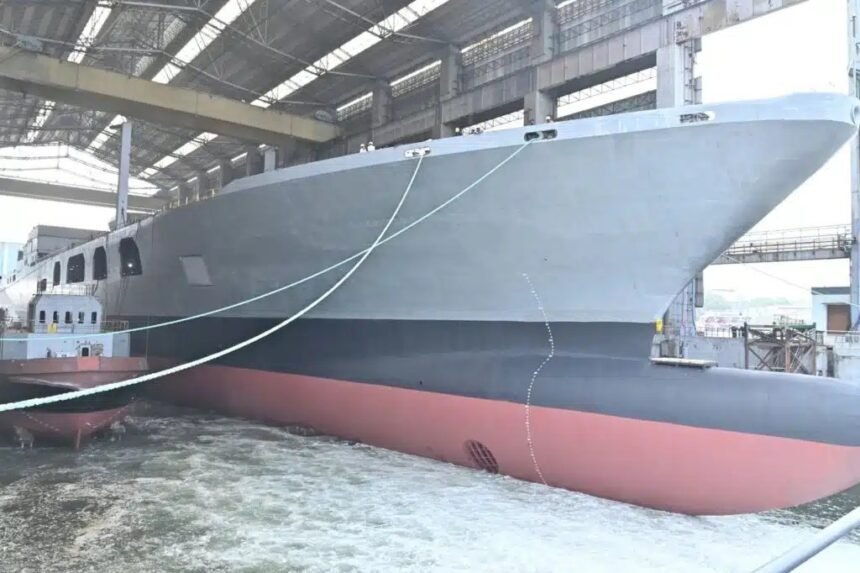
Every warship has a limit that has nothing to do with weapons or sensors: it runs out of fuel, food and stores. Out in the Indian Ocean, far from any harbour, that limit decides how long a fleet can stay on station. India now has a home-built answer to that problem, and it slid into the Bay of Bengal this October.
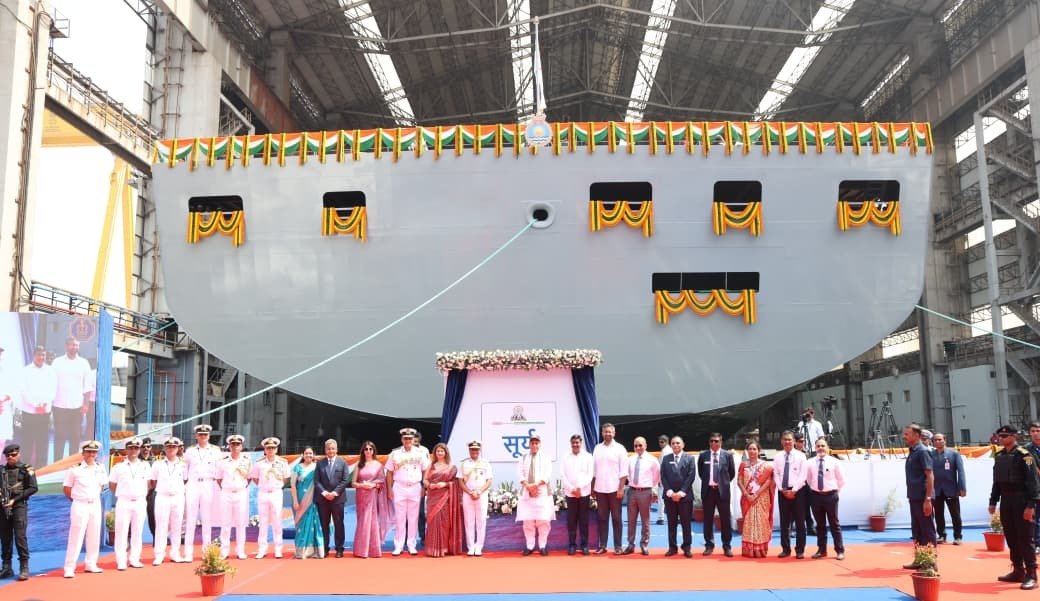
Surya is the Indian Navy’s first indigenously designed and built Fleet Support Ship, built by Hindustan Shipyard Limited (HSL) in Visakhapatnam. On 6 October 2026, Defence Minister Rajnath Singh launched the ship at the yard, with the traditional honours performed by Laila Swaminathan, President of the Navy Wives Wellness Association. It was a morning of three milestones at once: alongside Surya’s launch, the keel was laid for FSS-5, the fifth and final ship of the class, and HSL inaugurated its upgraded Slipway-4 and a new 300-tonne Goliath crane.
A Fleet Support Ship is a floating logistics hub. It sails with the fleet and refuels and resupplies warships, submarines and carrier battle groups at sea, so they can stay deployed without turning back to port. The company says Surya carries about 20,000 tonnes of diesel, 2,500 tonnes of aviation fuel and about 1,000 tonnes of fresh water for transfer at sea, plus solid stores of nearly 240 tonnes. With onboard first-line maintenance workshops, a helicopter deck for Multi-Role Helicopter operations and robust self-defence systems, she is built to keep a task force moving, and the shipyard says she can sustain 60-day missions.
The scale is striking. Surya is about 223 metres long with a 31.5-metre beam and displaces about 43,500 tonnes, making the class set to become the largest vessels in the Indian Navy by displacement. She runs at a top speed of 20 knots and can cover 12,000 nautical miles at 16 knots, extending the Navy’s reach and endurance across the Indian Ocean Region and beyond. The Navy’s Chief of the Naval Staff, Admiral Krishna Swaminathan, has said the ships will also support humanitarian assistance and disaster relief and personnel evacuation when needed.
Surya is the lead ship of a five-ship, ₹19,000-crore programme contracted in August 2023, built with about 82% indigenous content. HSL designed the ship itself, with SEDS as prime consultant, and Bharat Electronics Limited supplies the combat management, communications and electronic warfare systems. The shipyard says Surya entered the water just 18 months after steel cutting, and she is now being fitted out, with induction expected in mid-2027.
The launch also caps a remarkable turnaround for the yard itself. Founded in 1941 as Scindia Shipyard, HSL built Jala Usha, the first modern ocean-going steamship built in independent India, and has spent eight decades building and repairing ships for the nation. The yard became a Miniratna Category-I company in 2025, its turnover rising from ₹478 crore in FY21 to ₹1,400 crore in FY24, and its order book now stands past ₹20,000 crore, with INS Nipun, the second indigenous Nistar-class Diving Support Vessel, delivered in August 2026. The upgraded slipway, which lets HSL build and launch vessels up to 45,000 DWT, and the new crane, designed and manufactured by L&T Geostructure with Konecranes under Make in India, set the yard up for ships larger and more complex still.
More Read

At the launch, the Defence Minister summed up the morning in three lines: the launch of FSS-1 is a symbol of achievement, the keel laying of FSS-5 is a symbol of resolve, and the new slipway is a symbol of India’s growing capability. Surya is the ship that will keep the fleet at sea, and she is the proof that India can now build that capability itself.
Keep reading: Seeing Clearly in Murky Water: Inside Ci4, the Bengaluru Startup Giving the Navy Eyes Below the Surface · No Crew on Board: Inside Accurate Industrial Controls, the Pune Company Turning Indian Navy Patrol Boats Into Autonomous Vessels · More Shipbuilding & Maritime stories
Like stories like this? Add Exceptional Technology as a preferred source on Google to see more of our reporting in your search results and Discover feed.







