


India is building solar power at a pace the world watches with admiration — gigawatts of panels spread across deserts, dry plains and remote districts, soaking up some of the strongest sunshine on Earth. But sunshine brings dust, and dust quietly steals power. A dirty module can lose a meaningful share of its output, and in the arid places where India’s biggest solar plants stand, the water needed to wash millions of panels is itself scarce, expensive and trucked in from far away. The answer, built in Gujarat, is a robot that cleans without a single drop of water — and it has just got a powerful new upgrade.
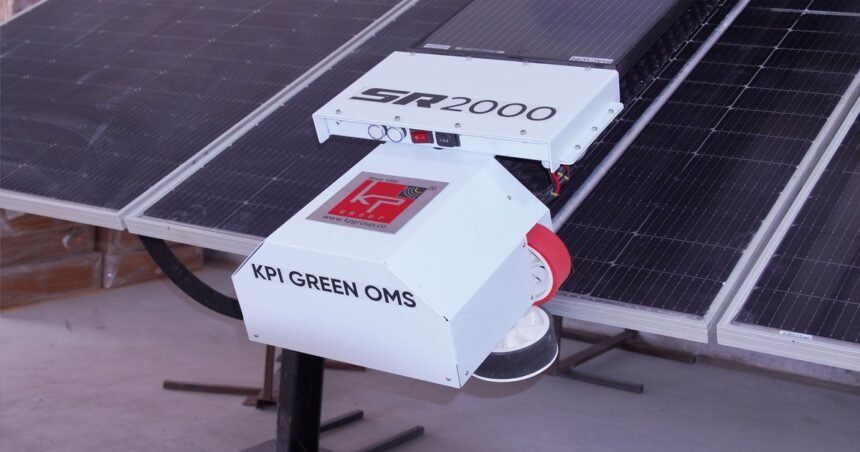
The company is KPI Green OMS, the operations-and-maintenance arm of Surat’s KP Group, and its newest machine is the SR 2000 V3.0, a waterless robotic solar-panel cleaning system launched at the Renewable Energy India (REI) Expo 2026 in Greater Noida. The robot is designed for single-axis tracker plants and fixed-tilt installations — the workhorse layouts of utility-scale solar — and it cleans entirely dry, using a UV-resistant polybutylene terephthalate (PBT) brush spinning at 130 rpm. The company says the system achieves a cleaning efficiency of 99.5 per cent while running quieter than 60 dB, so a plant can be cleaned without disturbing anything around it.
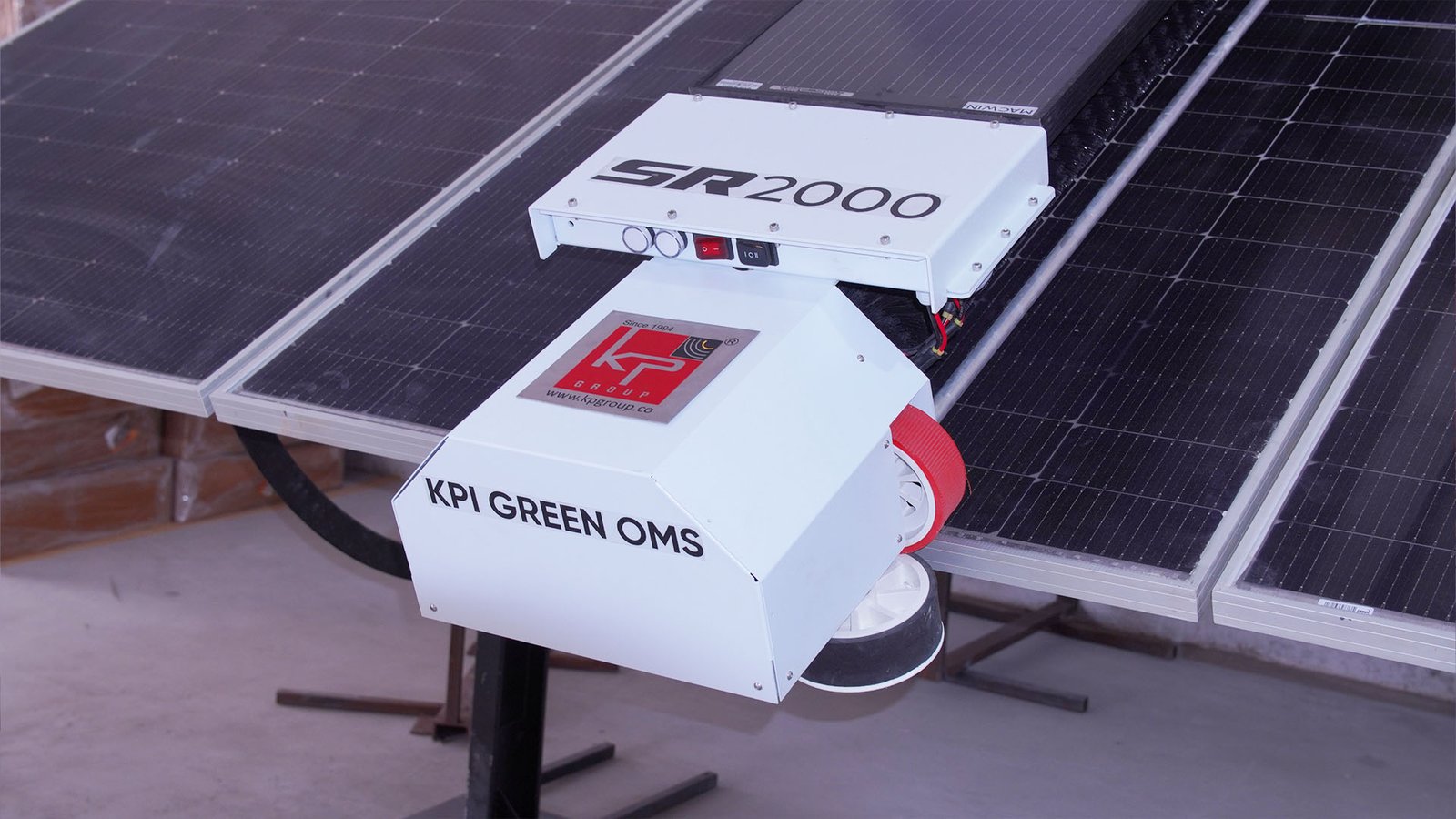
The engineering inside the SR 2000 V3.0 is built for the reality of a moving tracker table. The robot twists its body by up to ±25 degrees and tolerates 20 mm of module undulation, so it follows the table as it tilts through the day rather than fighting it. Four-wheel drive lets it climb slopes of 25 to 30 degrees and handle terrain slopes of up to 10 degrees, and the same machine suits fixed-tilt plants too. On a single charge, the company says, it cleans up to 3,600 modules — roughly 6,000 metres of panels — at 18 to 20 metres per minute, powered by a 24 V lithium iron phosphate battery that charges itself and recharges in about six hours. Operators monitor and control it remotely over LoRa, LoRaWAN or 4G using Modbus RTU/TCP, so a fleet can be run from a control room rather than from the field.
It is also built to survive the places it works in. The SR 2000 V3.0 is sealed to IP65 and rated C5 for corrosion resistance, operates from −20°C to 60°C, and keeps working in winds of up to 15 m/s; docked with its mechanical locking system engaged, it withstands winds of up to 55 m/s. Measuring 2,700 mm × 450 mm × 350 mm and weighing 45 kg, it carries ISO, BIS and UL certifications and is compatible with tracker systems from NEXTracker, GameChange Solar and Arctech, among others. The company gives it a design life of 20 years — built to keep pace with the panels themselves. Its cleaning system has also received a compatibility letter from Nextracker, the global tracker leader, confirming it meets the company’s testing criteria for its NX Horizon systems.
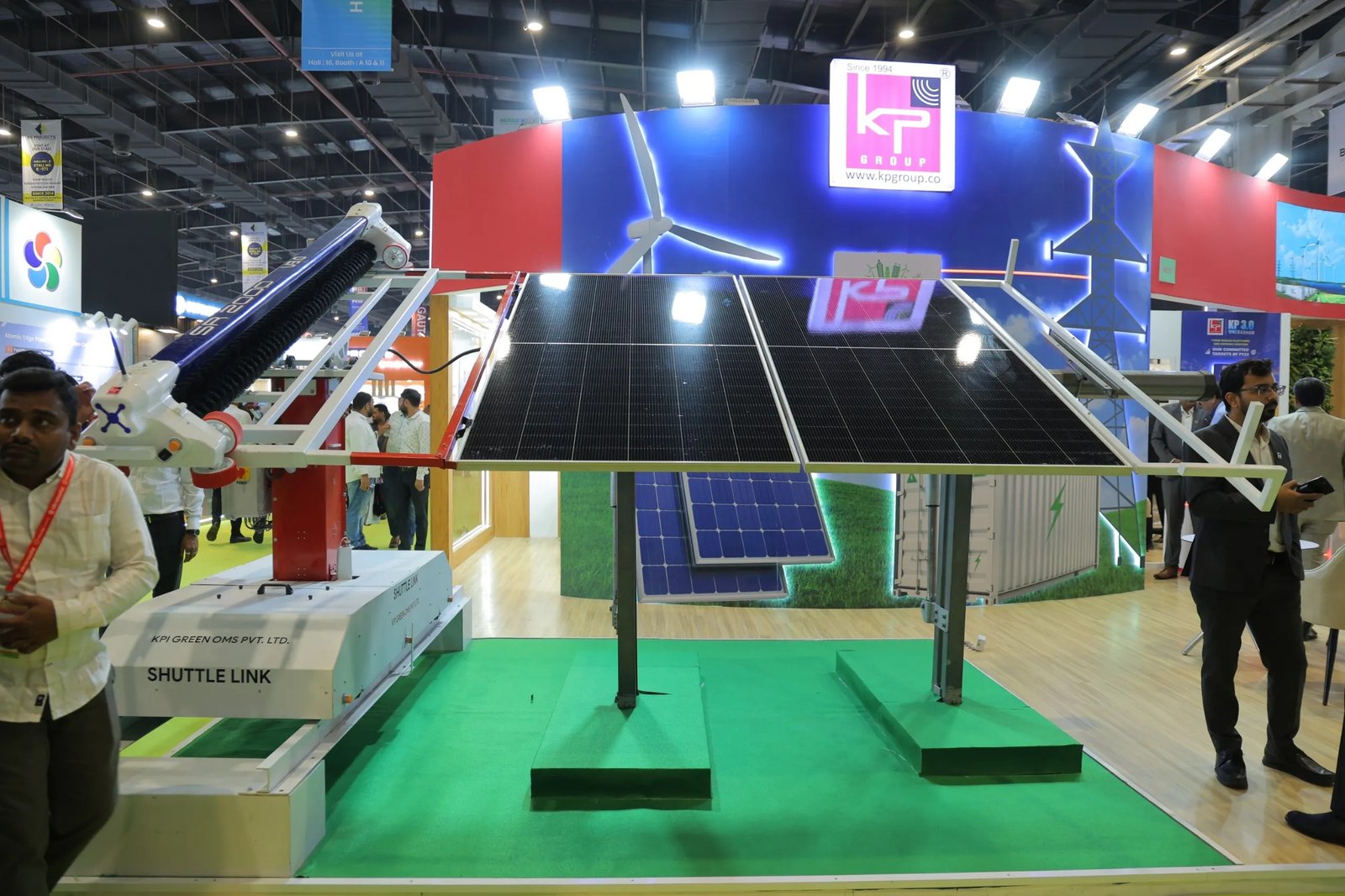
This is not a prototype shown for applause at an expo. KPI Green OMS, incorporated in 2022, designs, engineers and manufactures its robots in Gujarat, with more than 25 R&D engineers and a 2,010 sq. m facility at Kural, plus a further fabrication unit planned for 2027. The company says 880 of its robots are already deployed in the field, supporting 2.2 GW of assets under active operations and maintenance across 70 sites. Across its utility-scale plants, the company says robotic cleaning has already conserved more than 4.81 crore litres of water that manual washing would have used — and it has set a target of producing 5,000 robots this financial year. The SR 2000 sits in a family alongside the wide SR4000 platform for fixed-tilt arrays and the SR-Shuttle Link, a self-charging system that moves robots between rows without any manual handling.
“Solar capacity is growing rapidly across India, and keeping plants performing at their best over decades matters as much as building them,” said Dr. Faruk G. Patel, Chairman and Managing Director of KP Group. “Dust is a constant challenge, and water is not always available where plants are located. With the SR 2000 V3.0, we have built a waterless, intelligent robot designed specifically for trackers, helping plant owners keep modules clean, protect generation, and reduce the effort of routine upkeep.”
More Read

That is the quiet brilliance of this machine: it turns one of solar energy’s most stubborn chores — keeping millions of panels clean in the driest corners of the country — into something automatic, water-free and built to last. As India’s solar fleet keeps growing toward ever-larger ambitions, robots like the SR 2000 V3.0 make sure every panel keeps giving its best, year after year, without asking the land for a single drop of water in return.
Keep reading: From Thin Air to Drinking Water: Inside Akvo, the Kolkata Company Pulling Water Out of the Sky · From Sunlight to Storage: Inside VNT’s RAV5, the Indian Converter Built for the Battery Era · More Energy & Power stories
Like stories like this? Add Exceptional Technology as a preferred source on Google to see more of our reporting in your search results and Discover feed.







