


Every winter, the same grey blanket settles over Delhi. The air turns thick, the skyline fades, and the capital holds its breath against a haze that drifts in from the paddy fields of Punjab and Haryana, where farmers burn the stubble left after harvest because it is the fastest, cheapest way to clear a field for the next crop. Researchers estimate that farmers burn about 23 million tonnes of paddy stubble in India each year. In Delhi, a young entrepreneur who grew up breathing that smoke decided the answer was not to scold the farmers — it was to give them a reason to collect the stubble instead.
The company is Takachar, and what it builds is a machine that turns that waste into wealth. Its portable, tractor-mounted Takavator heats crop residue to between 400 and 700 degrees Celsius in a low-oxygen chamber — a process called oxygen-lean torrefaction — and out comes biochar, a carbon-rich material farmers can spread on their fields as a soil amendment or sell on as biofuel. The name says it all: taka, money, and char, carbon.
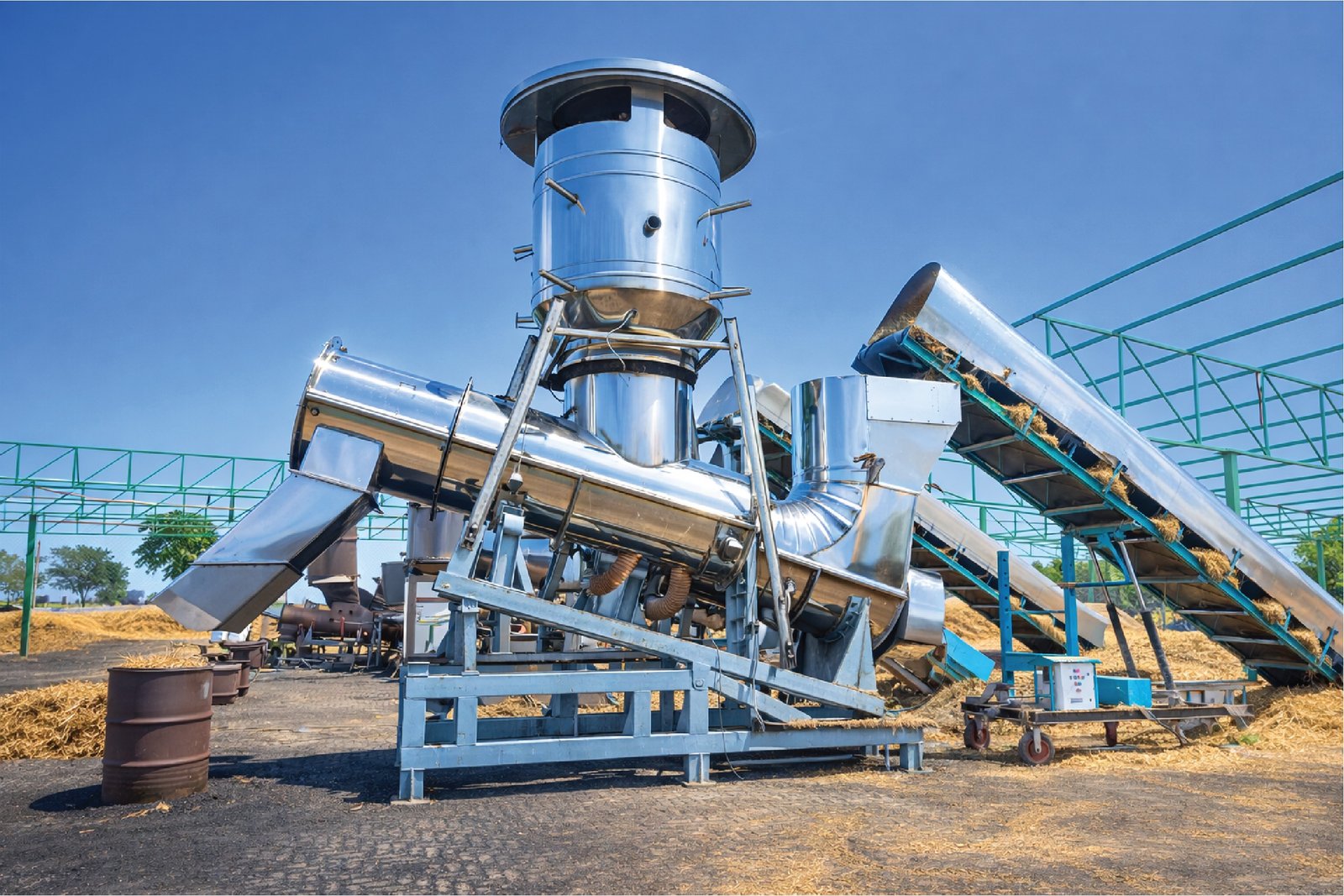
The machine that runs on its own heat
The clever part is what the machine does not need. It runs on the heat it produces, so it needs no external power source, and it can work off-grid, in the remotest fields. A full-size unit processes up to one tonne of stubble an hour, and the smaller Takavator Mini handles up to 100 kilograms an hour — village-scale equipment, sized for the fields where the residue actually is. Instead of hauling bulky, wet straw to a distant plant, the plant comes to the straw: the units latch onto the back of tractors and pick-up trucks and roll from farm to farm. The company says the same process works on a wide variety of crop and forest residues, turning them into biochar-based fertiliser blends, biofuels and chemicals, all without external energy input.
From an MIT lab to the Earthshot Prize
Takachar’s roots are in research conducted at MIT, where co-founder Vidyut Mohan studied the problem of loose, wet, bulky biomass that is too expensive to collect and transport — the reason rural communities are shut out of the bioeconomy and left with burning as their only option. He first proved the idea in 2016, running a pilot in Uttarakhand that turned pine-needle waste into charcoal and doubled the incomes of the locals involved. The company has since filed two patents on the core technology and published its findings in peer-reviewed journals. By 2020 it had already converted 3,000 tonnes of biomass that would otherwise have gone up in smoke.
More Read

Then came the recognition. Mohan was named to the Forbes 30 Under 30 list in 2019 and won the United Nations’ Young Champions of the Earth award in 2020. In 2021, Takachar won the Clean Our Air category at the Earthshot Prize — the “Eco Oscars” founded by Prince William — taking home £1 million to accelerate prototyping, hiring and research. The prize citation put the impact plainly: the technology reduces smoke emissions by up to 98 per cent.

What the fields are already showing
In Punjab, the change is already visible. Reporting in February 2026 found a nearly 90 per cent reduction in stubble burning over a single season where Takachar’s technology was at work. The company works with farmers in Rohtak, Haryana, alongside the CII Foundation, and says its technology has since been deployed in multiple locations around the world. For farmers, the maths is simple: the same stubble that once cost them a match now earns them a product — biochar for their own soil, or surplus material to sell — and the company is building the links to carbon markets so rural communities can verify and earn carbon credits for the first time.
What comes next
The timing feels fitting. As the 2026 Earthshot Prize winners were announced in Mumbai on 17 November, Takachar’s story was retold as the proof that decentralised technology can connect waste processing, farmer livelihoods and cleaner air in a single stroke. The company is building toward a closed-loop bioeconomy in the villages themselves: residues upgraded on-site into fertiliser blends, fuels and chemicals, communities less dependent on imported inputs, and a gigatonne-scale chance to pull carbon out of the atmosphere and lock it into the soil.
Takachar started with a simple question: can the residue left behind after a harvest become a resource that farmers have a reason to collect and use, rather than burn? In Punjab’s fields, the answer is already taking shape — one tonne at a time, one village at a time, and one clear winter sky at a time.
Keep reading: The Atta With Twice the Iron: Inside Better Nutrition, India’s First Biofortified Food Brand · The Fridge-Sized Farm That Needs No Sunlight or Soil: Inside X Boson AI’s CAAX · More Food Processing & Agri-Tech stories
Like stories like this? Add Exceptional Technology as a preferred source on Google to see more of our reporting in your search results and Discover feed.









