In 2019, three young engineers in Hyderabad looked at a problem that had nothing to do with farming. Dengue and malaria swept through Telangana’s towns every monsoon, and the old ways of fighting mosquitoes — workers with fogging machines walking street by street — were slow, patchy and risky. The three friends wondered whether a drone could do the job better. That question became Marut Drones, and the mosquito-fighting machine they built became the seed of something much bigger: a family of Indian drones that now sprays fields, sows seeds, plants forests and delivers medicine — all from the same sky.
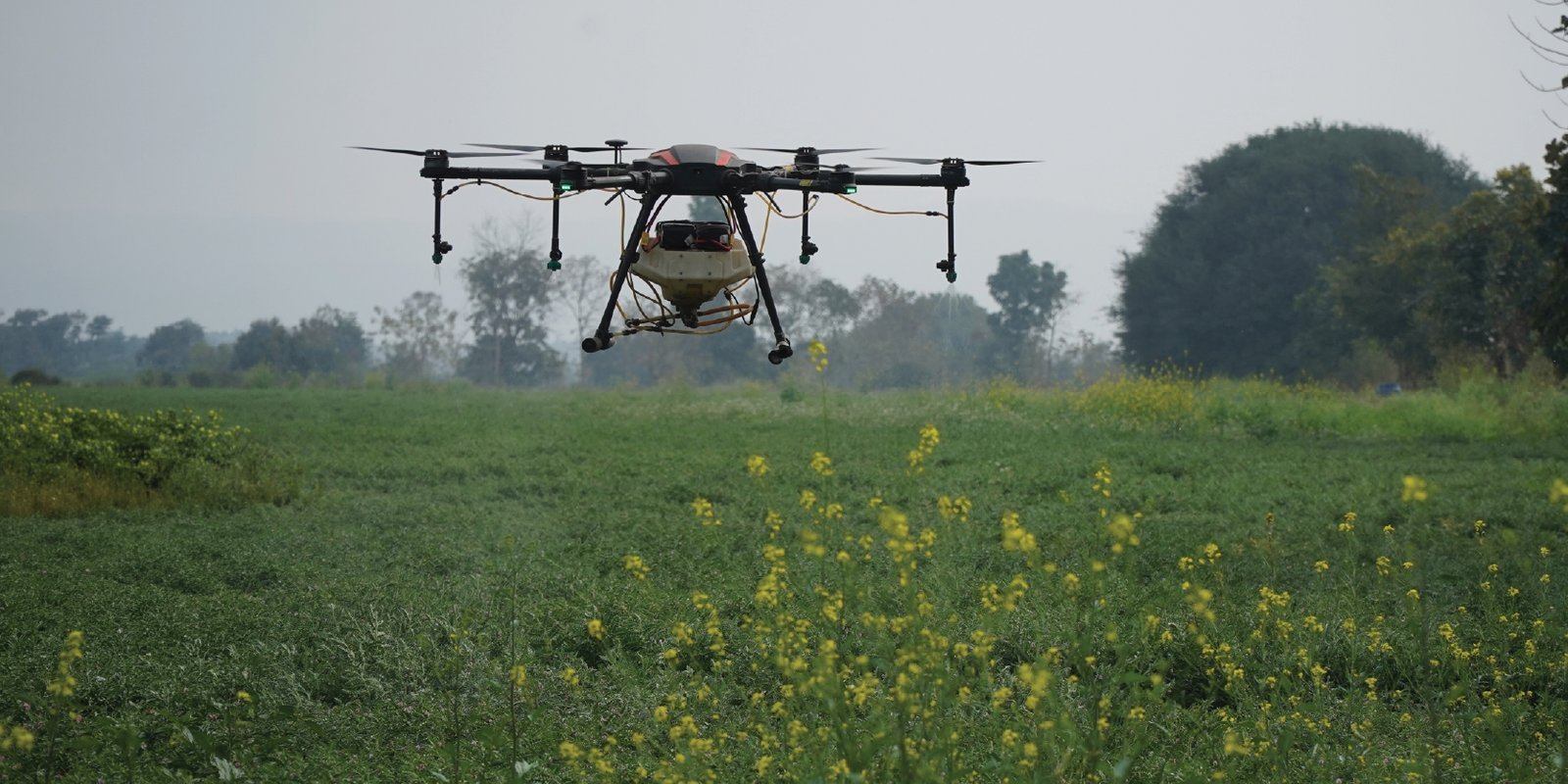
The company is Marut Drones, and its flagship is the AG365, a multi-utility agricultural drone the company calls an aerial tractor. Where most farm drones do one job for a few months a year, the AG365 was designed to work all 365 days, swapping plug-and-play payloads to spray pesticides, spread fertiliser granules, sow seeds directly into paddy fields, monitor crops and even help with pollination. The company says the same machine can cover six acres an hour, and that a drone entrepreneur can recover the cost of the machine in under six months — against nearly two years for a single-use spraying drone.
The drone that works 365 days a year
The AG365 is a DGCA type-certified agricultural drone, built for Indian conditions. The original AG365 carries an 11-litre tank and flies for about 22 minutes, while the newer AG365I and AG365XP carry 10 litres, stay up for more than 30 minutes and, the company says, can cover more than 30 acres in a working day. The AG365H, launched in October 2024, is India’s first portable agriculture drone, with foldable arms so it can be carried on a two-wheeler from farm to farm. Bigger versions are on the way — the company lists 30-litre and 50-litre models and a hybrid with a claimed 90-minute flight time — and the AG365i variant, the company says, is 80 percent Indian-made. Every model is eligible under central and state agriculture drone subsidy schemes, and Marut’s team helps buyers with the paperwork.
Planting a billion trees from the sky
Then there is the Seedcopter, Marut’s aerial seeding drone. With a take-off weight of up to 30 kg and a 10 kg payload, it flies for 25 minutes over a 10 km range, dropping 1,500 to 2,000 seed balls on every flight into places where no planter can reach — deforested hillsides, mined-out land, mangrove edges. The company’s ambition is to help plant one billion trees in India by 2030, and it says the work is designed to create local, women-led jobs in the villages around the planting sites. It is the same idea that started the company — a drone doing work that is slow, hard or dangerous for people — turned towards the forest.
More Read


From farms to fisheries — and beyond
Marut’s catalogue keeps growing past the farm gate. The Aquacopter is a heavy-lift drone built for fisheries, with a 70 kg payload delivery variant; in December 2025 the company says it demonstrated the Aquacopter with ICAR’s Central Inland Fisheries Research Institute at Kultali in the Sundarbans, at an event it says drew more than 4,000 women fishers. A logistics drone with a payload of up to 100 kg is built for medical deliveries — blood and vaccines — as well as cargo. And Marut ZAP, the company’s integrated drone and IoT vector-control platform, is the mosquito-fighting idea the company began with, grown into a full public-health tool. Surveillance drones for industry and police complete a range that now spans six different kinds of work from a single engineering core.

Training India’s drone pilots
A drone is only useful if someone nearby can fly it, and Marut has built the training to match the machines. Its academies in Punjab, Haryana, Andhra Pradesh and Telangana run DGCA-certified remote-pilot courses, and in September 2025 the company announced a training facility with Kaveri University in Siddipet, Telangana, which it says will train more than 1,000 people a year. More than 1,000 pilots have already been trained. At the PM Kisan Samman Sammelan, the Prime Minister appreciated the technology and its effect on rural incomes — the company presented women drone pilots who, it says, went from earning Rs 8,000–10,000 a month to Rs 25,000–30,000 by flying drones for their villages. The company’s stated aim is to create five lakh drone entrepreneurs by 2030.
A company built for scale
The numbers behind the story have kept climbing. Marut Drones says it has deployed more than 1,800 drones across India, holds five DGCA-certified drone platforms, has eight patents granted with more than 50 filed, and employs over 200 people. In November 2024 it raised $6.2 million in a Series A round from Lok Capital to deepen product development and expand manufacturing towards 3,000 drones a year. Its shelf already holds a FICCI Award for Sustainable Agriculture and a TiE Global Top 100 Emerging Startup honour, and the company says it is working with Japan’s SkyDrive on air-taxi technology. From a mosquito-fighting idea in 2019 to a full family of working drones in 2026, Marut has built its machines the same way it flies them: one job at a time, across the whole of India’s sky.
From mosquito control to medicine delivery, seed bombing to spraying, Marut Drones is showing what happens when a drone is designed as infrastructure rather than a gadget — built once, flown every day, and put to work for the people who need it most.
Keep reading: From Smoke to Soil: Inside Takachar, the Startup Turning India’s Stubble Into Biochar · The Atta With Twice the Iron: Inside Better Nutrition, India’s First Biofortified Food Brand · More Food Processing & Agri-Tech stories
Like stories like this? Add Exceptional Technology as a preferred source on Google to see more of our reporting in your search results and Discover feed.