Every battery, wind turbine and solar panel begins with a hole in the ground — and finding the minerals to fill them is still one of the slowest, most expensive gambles in industry. Conventional exploration burns about $12.5 billion a year, drills more than a hundred holes at a single site, and still succeeds less than one time in two hundred. The people doing the searching work in some of the most dangerous terrain on Earth.
A Bengaluru startup thinks the answer is to stop digging blind. Uncharted AI builds autonomous robots that walk the ground themselves, carrying a full survey laboratory on their backs — LiDAR, hyperspectral cameras, ground-penetrating radar and magnetometers — and turns what they sense into a three-dimensional map of what lies beneath, without a drill touching the soil.
The idea has already travelled far beyond Bengaluru. The company’s robots have run field trials in the Australian outback, validated their sensor fusion at ARTPARK at IISc, and tested closed-loop navigation with no GPS at the European Space Agency’s lunar-analogue site in Köln. In January 2026, the team took first place — and $150,000 — in the Smart Technologies track of Saudi Arabia’s Future Minerals Pioneers competition, chosen from 70 finalist teams from 57 countries.
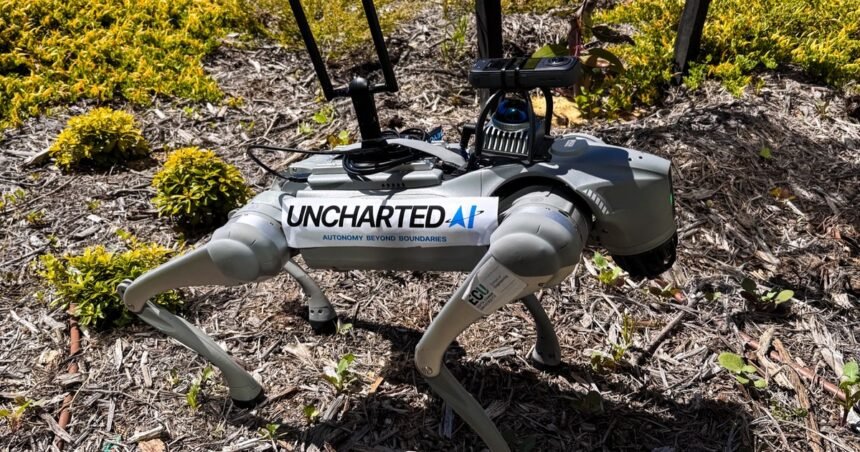
Uncharted AI’s legged survey robot on field trials in Western Australia. (Official visual: Uncharted AI)
The robot that sees underground
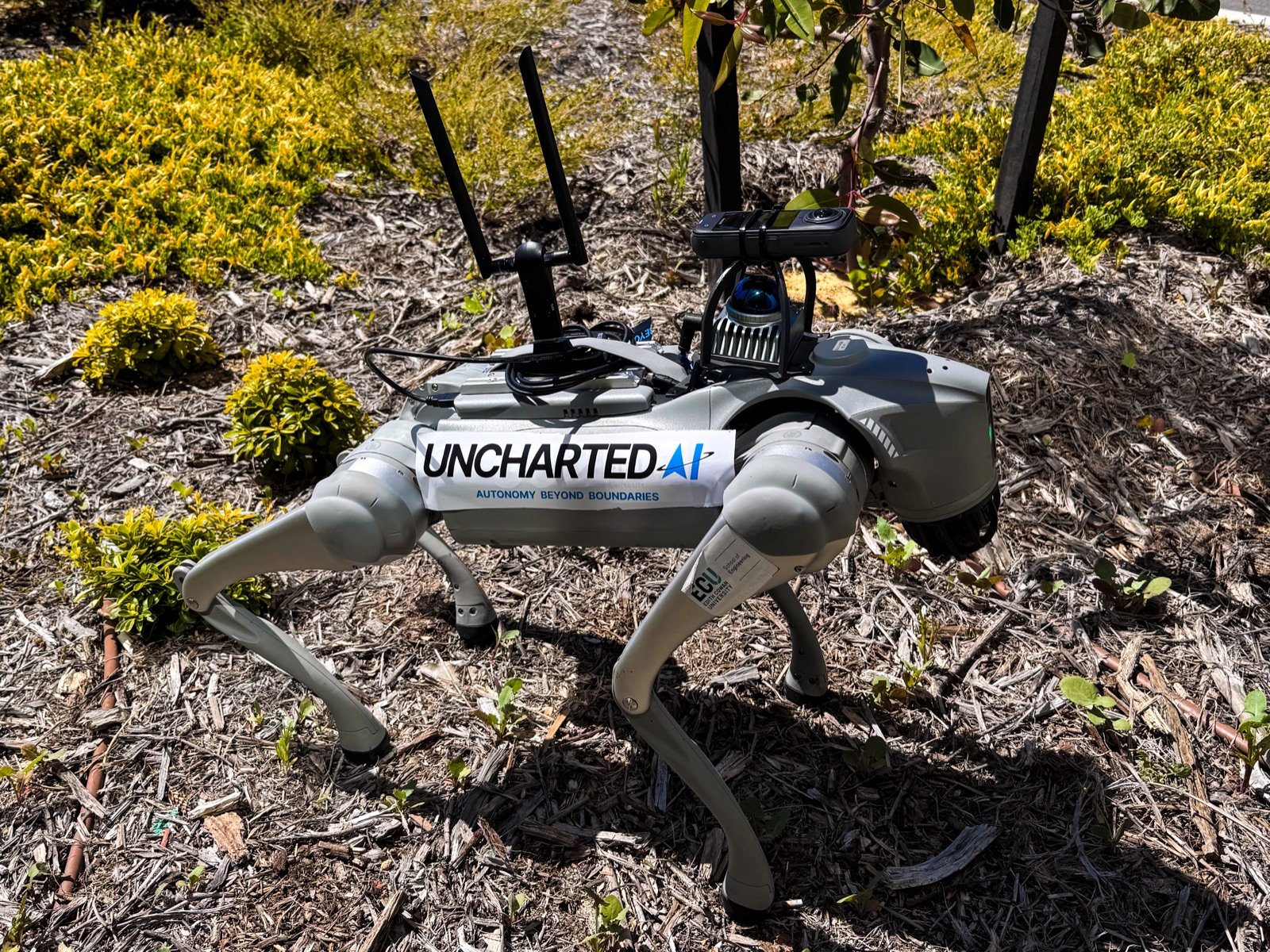
Uncharted AI’s platform works in three moves the company calls TRACE, SENSE and FiND. First, the robot goes where people and wheeled vehicles cannot: the company says its legged robots navigate steep, loose and subterranean terrain, guided by perception software built on a decade of NASA JPL mission work. Then the sensor payload does the seeing — LiDAR, hyperspectral and RGB-D cameras, magnetometry and custom geophysical sensors, including ground-penetrating radar, fused into a single spatial data product in one pass. Finally, the company’s AI turns that fused data into an interactive 3D model of the subsurface, which it describes as an always-on AI geologist that keeps learning as it surveys.
More Read
The pitch is speed and reach. The company says its surveys cover 95% of a site’s area, against about 12% for conventional drilling, and capture 150 times more data points — at less than a tenth of the cost. Its founders told EIT Manufacturing the system cuts exploration costs by up to 75% and timelines by half, replacing drill-heavy campaigns with AI-driven, minimally invasive surveys.
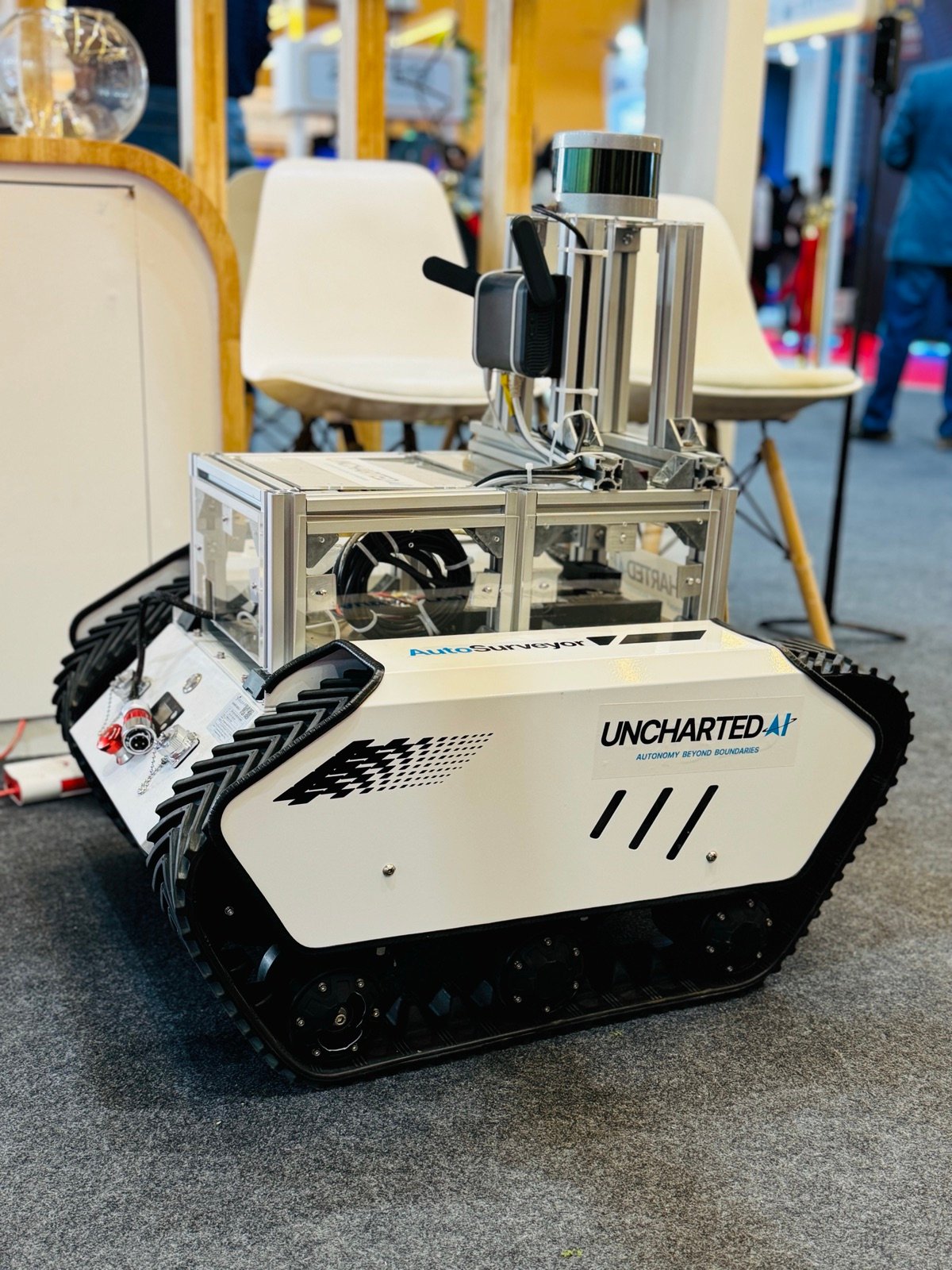
AutoSurveyor, Uncharted AI’s survey platform, carrying its LiDAR and sensor mast. (Official visual: Uncharted AI)
From the outback to the Moon
The robots have been proving themselves in some of the harshest places a survey team can go. In Perth, the company has run long-range autonomous trials across iron-ore and rare-earth terrain in the Australian outback. In Bengaluru, at ARTPARK at IISc, it validated the multi-modal sensor fusion — LiDAR, hyperspectral and ground-penetrating radar captured in a single autonomous pass. In Köln, Germany, its rover ran lunar-analogue terrain trials with the European Space Agency’s ESRIC programme, navigating with no GPS at sub-centimetre accuracy. A Nordic test range in Finland has put the system through Arctic conditions, and the founders’ earlier work ran multi-robot autonomy trials with the Canadian Space Agency in subterranean worlds with no GPS, no light and no map.
The space connection is more than a testing ground. In October 2025, Curtin University in Australia signed a memorandum of understanding with Uncharted AI to work together on coordinated multi-robot missions for Mars — the same TRACE platform, with its LiDAR, SLAM navigation and ground-penetrating radar, adapted for planetary exploration and for mineral prospecting back on Earth. And in November 2025, the company was one of two winners of the “Space meets manufacturing” competition at NL Space Campus in the Netherlands, pitching its robots as a way to prospect space resources reliably.
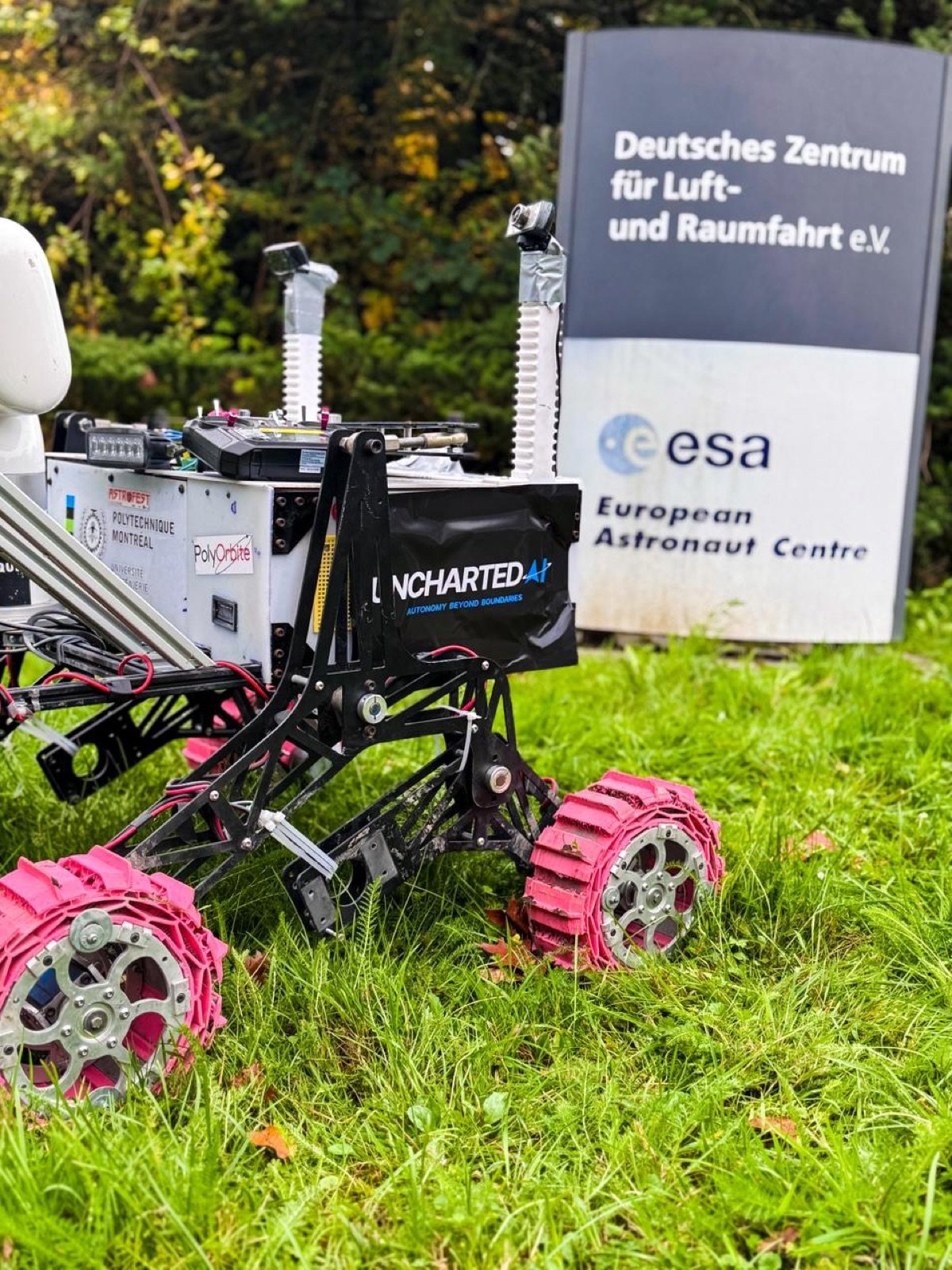
Uncharted AI’s rover at the European Astronaut Centre in Köln during lunar-analogue trials. (Official visual: Uncharted AI)
A $150,000 win in Riyadh
The clearest outside verdict so far came in Riyadh. The Future Minerals Pioneers competition, run by Saudi Arabia’s Ministry of Industry and Mineral Resources alongside the Future Minerals Forum, drew 1,812 applicants forming 371 teams from 57 countries. Seventy teams reached the in-person bootcamp in Riyadh from 8 to 10 January 2026, and Team UnchartedAI from India took first place in the Smart Technologies for Mining Operations and Services track — the only team in the track with embodied intelligence, as the organisers put it — winning $150,000.
For a young company, that kind of recognition matters: it is a judgement by mining’s own establishment that a robot-first way of finding minerals is ready to be taken seriously. Mining operators in Australia, the Middle East and India are now validating the full-stack system in field pilots, and the company is showing its robots at Bengaluru Tech Summit from 17 to 19 November 2026, from the ARTPARK pavilion.
Who’s behind it
Uncharted AI was founded by roboticists Pradyumna Vyshnav and Dr Vivek Varadharajan, who spent a decade sending machines into places humans cannot go — NASA JPL, the MIST Lab, and frontier subterranean autonomy research. Their starting point was the autonomy that Mars rovers carry on their missions, and their conviction that terrestrial exploration needs exactly the same kind of independence: machines that can explore, reason and decide on their own, far from any operator.
The company is based in Bengaluru, works from ARTPARK at IISc, and has set up a Perth Landing Pad for its Australian field work. Its ambition stretches in two directions at once: the trillion-dollar hunt for the critical minerals that power clean energy, and the adjacent frontiers of space and defence, where the same autonomy lets machines work where people cannot go at all.
What comes next
Mineral exploration has barely changed in a century: drill, sample, guess, repeat. Uncharted AI’s bet is that the next century starts with robots that map the ground before anyone drills it — faster, cheaper, and without putting people in harm’s way. If the pilots with mining operators turn into deployments, the quietest revolution in mining may be the one that never breaks the ground at all.
Keep reading: Teaching Robots to Use Their Hands: Inside Human Archive’s 500 Hours of India at Work · The Chip That Thinks at the Sensor: Inside Sensesemi, the Bengaluru Startup Building India’s Edge-AI Silicon · More Industrial Automation & Technology stories
Like stories like this? Add Exceptional Technology as a preferred source on Google to see more of our reporting in your search results and Discover feed.