


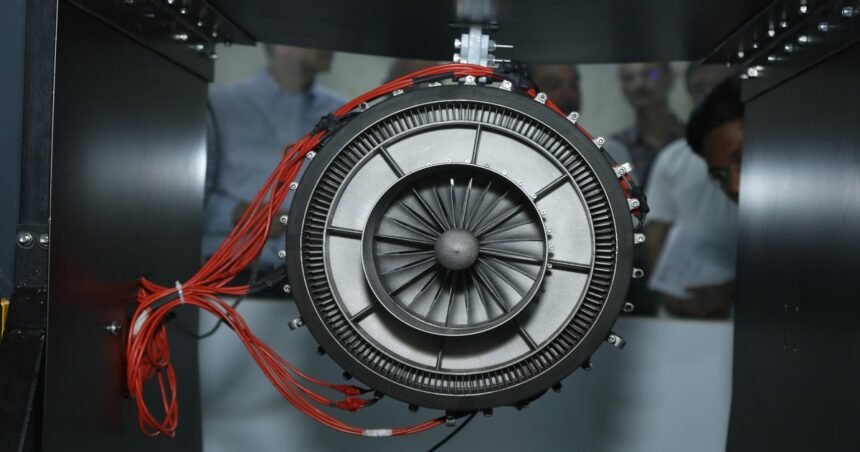
In a test facility in Pimpri, Pune, in April 2025, a jet engine spun past 40,000 revolutions a minute and pushed out 10 kilogrammes of thrust — with no flame, no fuel and no exhaust. There was no combustion chamber inside it, because there is nothing to burn. The engine runs entirely on electricity, and the company behind it, SiriNor, calls it the world’s first all-electric jet engine.
SiriNor is an Indo-Norwegian deeptech aerospace startup, launched in January 2022 by Abhijeet Inamdar, Pramod Vaditya and Norwegian entrepreneur Ivar Aune. The name carries a personal story: Inamdar named the company SiriNor in memory of his late wife, Sirihathai. What began as a tribute has become one of the most audacious engineering bets in Indian aviation — a jet engine that does away with burning fuel altogether.
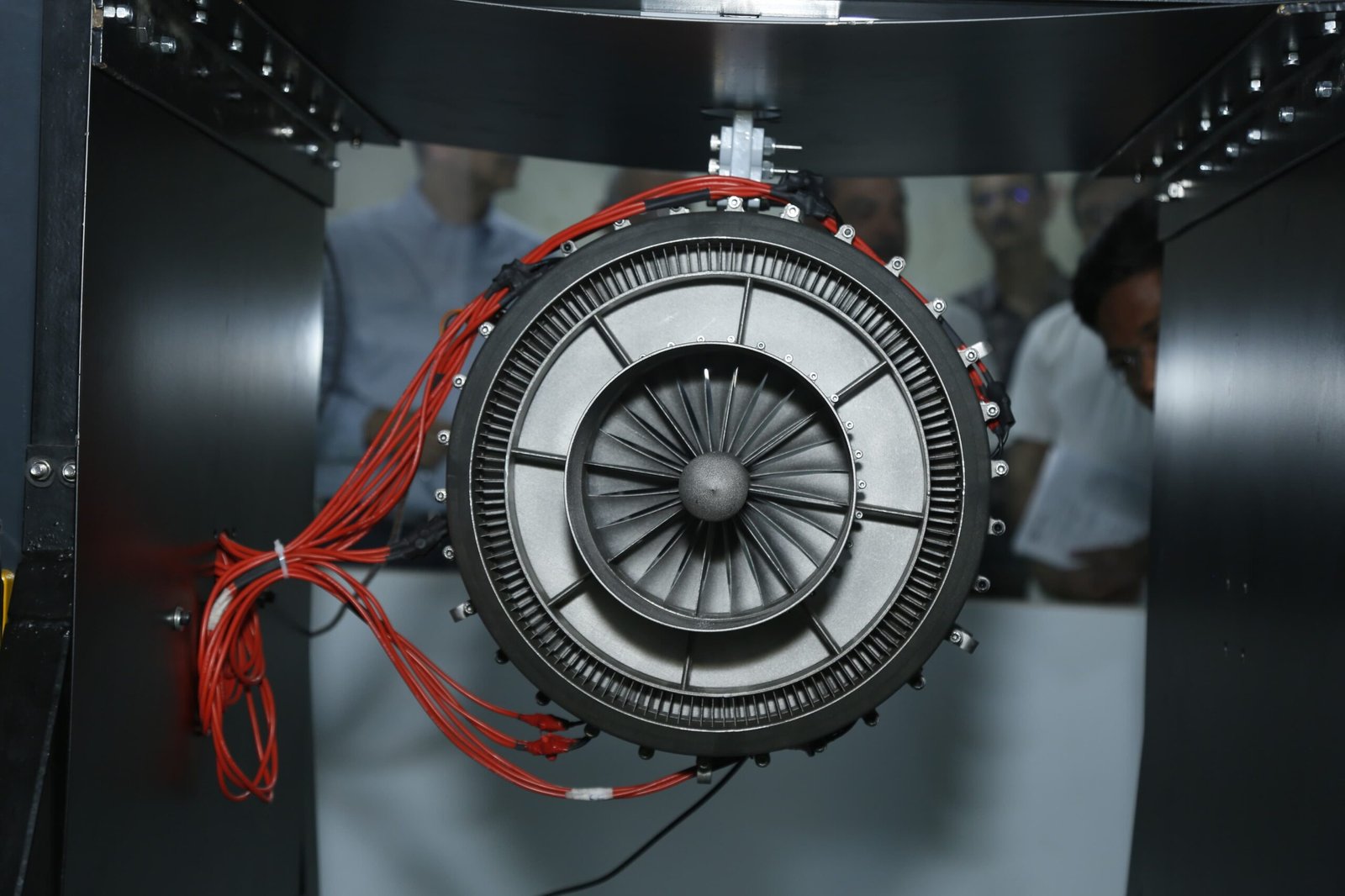
SiriNor’s all-electric jet engine prototype on the test rig in Pune. (Official visual: SiriNor)
A fan with no fire
A conventional jet engine burns fuel to spin its turbine. SiriNor’s design replaces the burn with electricity. Multiple electric motors sit around the edge of the engine, each connected to a small compressor designed in-house. The compressors push high-pressure air onto a central tip turbine — a fan that spins at extraordinary speed and pushes air out the back, just as a jet engine does. The difference is that nothing is ever set alight.
The design is power-source agnostic: it runs on batteries today, and the company says it is built to run on hydrogen fuel cells in the future. Because the engine operates below 400°C, it needs no super-alloys or exotic materials, which the company says keeps the entire supply chain buildable in India. The architecture is scalable, the company says, from small drone engines all the way to thrust beyond 90 kN and ranges of more than 4,000 km.
More Read

From a test rig to the runway
The April 2025 ground test in Pune was the moment the idea became hardware. The prototype ran successfully on the test rig, surpassing its design intent of 40,000 RPM and 10 kgf of thrust, measured by a load cell. The company says the milestone validated the engine at Technology Readiness Level 6, and the test was watched by industry leaders including Shell’s Subhrajit Dey, former Vistara CIO Ravinder Pal Singh and former Airbus executive Ravi Andrews.
The engineering behind it has been put through its paces: feasibility studies at IISc Bengaluru, validation by industry experts, and a global patent granted in the United States for the tip-driven architecture, with patent coverage being extended across major aviation manufacturing hubs. SiriNor is backed by Shell E4 and DCM Shriram, and it has signed a memorandum of understanding with Genser Aerospace to integrate its electric jet engine into Genser’s Light Business Programme, alongside letters of intent with global partners in unmanned aircraft, ground-effect vehicles and small aircraft.
Why it matters
Aviation accounts for around 3% of global CO2 emissions — nearly a billion tonnes a year — and the World Economic Forum has projected that share could climb sharply by 2050 without intervention. An engine that burns nothing at all changes that arithmetic completely. SiriNor’s own figures point to the commercial upside too: the company says its engines cut engine cost by 25–35%, maintenance by 15–25% and weight by 20–30%, bring noise down from 140 dB to below 80 dB, and lift cruising speeds by up to 20%.
The road ahead
SiriNor is working its way up the aviation ladder in stages. Smaller engines of 30 kgf and 100 kgf thrust are being built for unmanned aircraft, with a UAV retrofit test planned in India in mid-to-late 2026 and commercial revenue from unmanned platforms expected by the end of the year. The company is now preparing TRL 7 testing of its 40×50 cm prototype, with seaplane certification targeted for 2027 and regional aircraft by 2030 — and commercial aviation platforms by the mid-2030s. In January 2026, the startup presented its 2026 roadmap at the Global CleanTech Forum during the World Economic Forum’s annual meeting in Davos.
A jet engine with no fire sounds like a contradiction, until you watch one spin up on a test rig in Pune and realise the fire was never the point. The point was always the thrust. SiriNor has shown that thrust can come from electricity alone — and if the road ahead goes as the company plans, the skies over India’s regional routes could soon be a great deal quieter, cleaner and entirely homegrown.
Keep reading: The Four-Legged Soldier: Inside AeroArc’s MULE, the Robot Dog Marching With the Indian Army · The 6.5-kg Falcon: Inside Pixiu Systems’ SYENA ASTRA-1, the Backpack Loitering Munition for India’s Small Units · More Aerospace & Defense stories
Like stories like this? Add Exceptional Technology as a preferred source on Google to see more of our reporting in your search results and Discover feed.







